

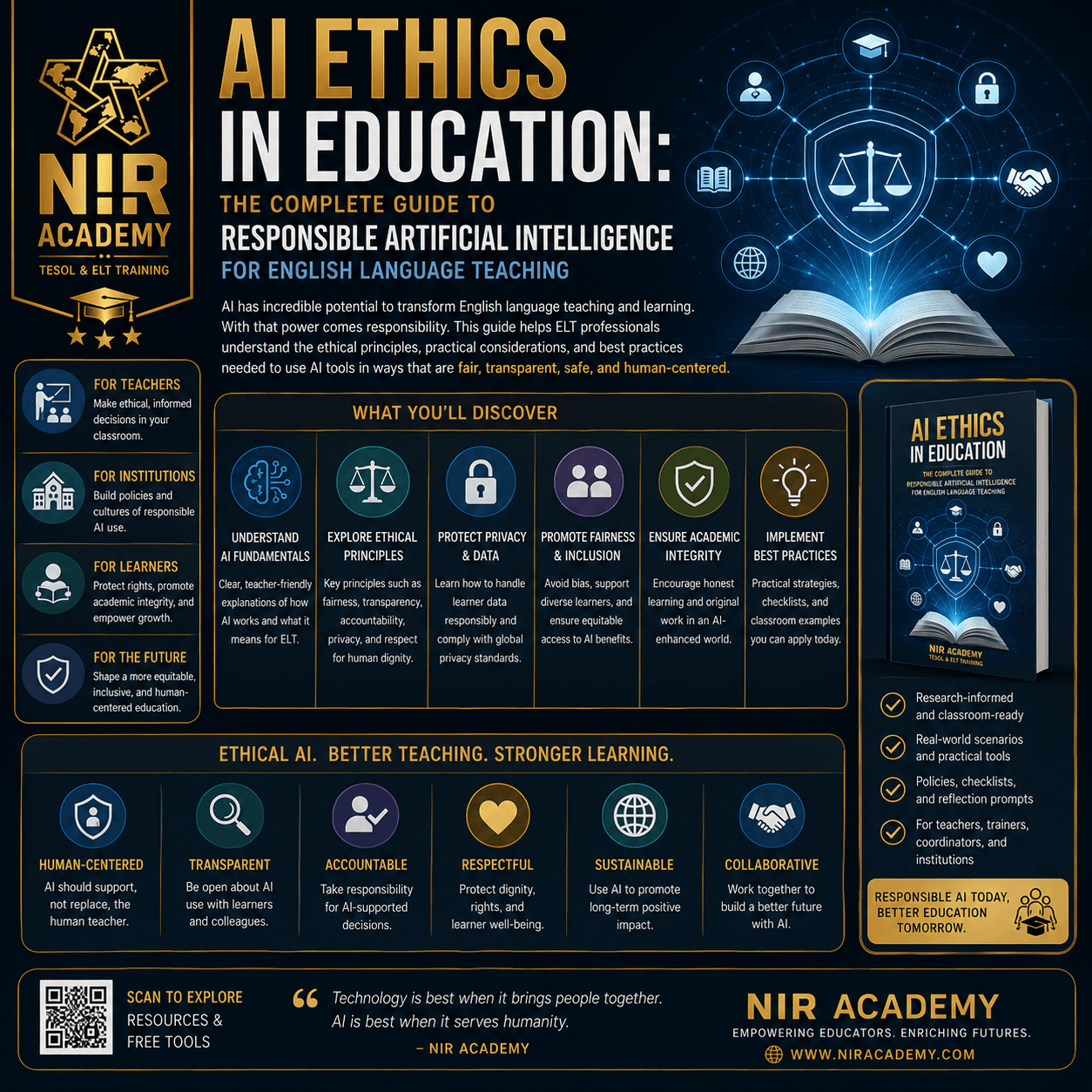
AI Ethics in Education: The Complete Guide to Responsible Artificial Intelligence for English Language Teaching
A practical, evidence-based reference for ELT and IELTS teachers, teacher trainers, school leaders, and researchers navigating AI ethics in education responsibly in the language classroom.
1. Introduction
Artificial intelligence has moved from the margins of education technology into the center of everyday teaching practice. Lesson planning assistants draft materials in seconds. Speaking practice tools give students instant pronunciation feedback. Writing assistants flag grammar errors before a teacher ever opens a document. For English Language Teaching (ELT) in particular — a field built on communication, culture, and human judgment — this shift raises a question that matters more than any single tool: how do we use AI responsibly?
This guide to AI ethics in education is written for the people who carry that responsibility every day: classroom teachers, IELTS instructors, teacher trainers, school leaders, university lecturers, researchers, and the policy makers who set the rules institutions live by. It does not assume you are an AI specialist. It assumes you are an education specialist who needs a clear, honest map of the ethical terrain — the benefits worth pursuing, the risks worth taking seriously, and the frameworks that can guide decisions when the answer isn’t obvious.
Throughout, the guiding principle is simple: AI should assist teachers, not replace them. Every section below returns to that idea in a different form — in assessment, in data handling, in classroom practice, and in institutional policy.
2. What Is AI Ethics in Education?
AI ethics in education is the set of principles, practices, and safeguards that govern how artificial intelligence tools are designed, deployed, and used in teaching and learning contexts. It sits at the intersection of three concerns that used to be handled separately: pedagogy (what helps students learn), technology (what the system can do), and human rights (what protects students and teachers from harm).
In practical terms, AI ethics in education asks questions like:
- Does this tool treat all students fairly, regardless of accent, dialect, or cultural background?
- Can a teacher understand and challenge a decision the AI made about a student’s work?
- Who is accountable when an AI-generated score or recommendation is wrong?
- What happens to a student’s data after they use the tool?
- Does the tool widen or narrow the gap between students with different levels of access and support?
None of these questions have purely technical answers. They require pedagogical judgment — which is exactly why English language teachers, not just engineers, need a working understanding of AI ethics.
3. Why AI Ethics Matters
Language classrooms are unusually sensitive environments for AI deployment. Assessment of speaking and writing is inherently subjective and culturally embedded; learner populations are often multilingual, multicultural, and unevenly resourced; and the stakes for learners can be high, from academic progression to IELTS scores that determine university admission or visa eligibility.
When AI ethics is treated as an afterthought, the consequences are concrete: a speech-recognition tool that consistently misreads a regional accent as an error, a writing checker trained mostly on American English that penalizes valid British or World Englishes usage, or a chatbot that quietly encourages students to submit AI-written work as their own. When AI ethics is built in from the start, the same technologies can expand access to feedback, free teachers from repetitive grading, and give students more practice opportunities than any classroom alone could provide.
The difference between these two outcomes is not the technology. It is the ethical framework wrapped around it.
4. The Role of AI in English Language Teaching
AI already touches most stages of the ELT workflow: lesson and materials planning, differentiated practice activities, automated (but teacher-reviewed) feedback on writing and speaking, exam preparation tools for IELTS and similar tests, and administrative tasks like report writing and progress tracking. Used well, these tools give teachers back time for the parts of teaching that AI cannot do — building relationships, reading a room, adapting on the fly, and modeling authentic communication.
Used poorly, the same tools can quietly narrow what “good English” is allowed to sound like, shift accountability away from qualified educators, or replace formative teacher feedback with an opaque score. The role of AI in ELT is therefore best understood not as a replacement for any part of teaching, but as an extension of teacher capacity — one that still requires a teacher’s professional judgment to be trustworthy.
5. Benefits of Ethical AI
| Benefit | What it looks like in an ELT classroom |
|---|---|
| Personalized practice | Adaptive exercises matched to a learner’s current level and error patterns |
| Faster, more frequent feedback | Instant draft feedback on writing tasks between teacher-graded submissions |
| Reduced teacher workload | First-pass grading and lesson material drafts that free time for planning and relationship-building |
| Expanded access | Speaking and listening practice available outside class hours, useful for under-resourced learners |
| Data-informed teaching | Pattern recognition across a class that helps teachers target recurring problem areas |
Each of these benefits is conditional. Personalization only helps if it doesn’t quietly track students into narrower learning paths. Faster feedback only helps if it’s accurate and explainable. None of these benefits are guaranteed by the technology itself — they depend on how ethically the tool is designed and used.
6. Potential Risks of AI
- Bias and unfairness — tools trained on limited accent or dialect data can systematically disadvantage certain learners.
- Opacity — “black box” scoring that neither teacher nor student can interrogate undermines trust and learning.
- Over-reliance — students (and teachers) leaning on AI output without critical engagement can erode independent skill development.
- Privacy exposure — student writing, voice recordings, and performance data collected without clear consent or minimization.
- Academic integrity erosion — AI-generated work submitted as original student work, and inconsistent, unreliable AI-detection tools used to police it.
- Deskilling — assessment and feedback tasks quietly shifting away from teachers toward systems no one fully understands.
None of these risks are arguments against using AI in ELT. They are arguments for using it with a framework — which is what the rest of this guide provides.
7. The Eight Principles of Responsible AI
Across the major international frameworks discussed later in this guide, eight principles recur consistently. Together they form a practical checklist for evaluating any AI tool before it enters a classroom.
- Fairness — the tool performs equitably across accents, dialects, cultural backgrounds, and proficiency levels.
- Transparency — teachers and students can understand, in plain language, how the tool reaches a decision or score.
- Accountability — a named human (teacher or institution) remains responsible for decisions the AI informs.
- Privacy — student data is collected, stored, and used with informed consent and clear limits.
- Security — student data and records are protected against breach or misuse.
- Inclusiveness — the tool is designed to serve learners with diverse needs, backgrounds, and access levels.
- Accessibility — the tool works for students with disabilities and varying levels of digital access.
- Human oversight — a qualified teacher can review, question, and override any AI-generated outcome.
8. Human-Centered AI: Why AI Assists Teachers, Not Replaces Them
The most persistent misconception about AI in education is that its purpose is automation for its own sake — replacing the teacher wherever possible. Human-centered AI inverts that assumption: technology exists to extend what a teacher can do, not to substitute for professional judgment, relationship, and cultural understanding.
Concretely, this means AI can draft a first-pass score on a practice essay, but a teacher decides what that score means for the student in front of them. AI can flag a recurring grammar pattern across a class, but a teacher decides how to teach it. AI can generate practice dialogues, but a teacher decides whether they’re culturally and pedagogically appropriate for their learners. The technology proposes; the qualified human disposes.
9. AI Assessment Ethics
Assessment is where AI ethics becomes most consequential for language learners, because scores and feedback directly shape academic and life outcomes.
Explainable feedback
Feedback that simply assigns a band score without explanation teaches a student nothing. Ethical AI assessment tools should indicate, in learner-appropriate language, why a piece of writing or speech received a particular evaluation — for example, identifying specific coherence, lexical range, or pronunciation issues rather than returning an unexplained number.
Fair scoring
Fair scoring means calibrating tools against diverse samples of learner English — not just “native speaker” norms — and testing regularly for systematic bias against particular accents, first languages, or writing conventions.
Human moderation
No AI-generated score for a high-stakes assessment (an IELTS mock test, a course-final essay) should reach a student without the option for a qualified teacher to review, moderate, or override it. This is standard practice in professional testing organizations like ETS and should be standard practice in classrooms using AI tools too.
Continuous validation
Assessment tools should be periodically re-checked against real teacher judgments to confirm they remain accurate as learner populations, curricula, and language use evolve.
10. AI Bias in Language Education
| Type of bias | Example in ELT | Practical mitigation |
|---|---|---|
| Dataset bias | Training data dominated by one variety of English | Choose tools tested on diverse learner corpora; ask vendors what data they trained on |
| Cultural bias | Writing prompts or examples that assume unfamiliar cultural context | Review and adapt AI-generated materials before use |
| Language bias | Penalizing valid non-American/British English usage | Cross-check flagged “errors” against recognized World Englishes standards |
| Accent bias | Speech recognition misreading regional or L1-influenced accents | Pilot speaking tools with your actual learner population before adopting |
| Algorithmic bias | Scoring models that systematically favor longer or more complex sentences regardless of quality | Combine AI scores with teacher judgment; audit for score/quality mismatches |
11. Student Data Privacy
AI tools used in language classrooms often collect sensitive data: written work, voice recordings, performance history, and sometimes biometric information from speaking assessments. Responsible use requires attention to several core practices:
- GDPR and equivalent regulations — understanding what applies where your students and institution are located, including rights to access, correct, and delete personal data.
- Informed consent — students (and parents, for minors) should know what data is collected and why, in plain language, before a tool is used.
- Data minimization — collecting only what is pedagogically necessary, not everything a tool is technically capable of gathering.
- Secure systems — verifying that vendors use encryption, limited data retention periods, and clear breach-notification policies.
12. Academic Integrity
Generative AI has made it trivially easy for a student to produce fluent English writing that isn’t their own. Responsible AI use in ELT addresses this directly rather than pretending it isn’t happening:
- Teach students when and how AI assistance is appropriate — brainstorming and grammar checking are different from having AI write the essay.
- Design assessment tasks (in-class writing, oral defense of written work, process portfolios) that are inherently harder to outsource to AI.
- Treat AI-detection tools as one imperfect signal among several, never as a sole basis for an academic integrity decision — these tools have well-documented false-positive rates, particularly for multilingual writers.
- Frame the goal as building genuine communicative competence and critical thinking, not simply catching violations.
13. AI Governance in Schools and Universities: Building AI Ethics in Education Policy
Institutions that deploy AI tools without a governance policy are, in effect, letting individual teachers and students set the rules ad hoc. A basic institutional AI policy should define approved tools and vetting criteria, clear teacher responsibilities (disclosure, moderation, data handling), clear student responsibilities (acceptable use, disclosure of AI assistance), and an escalation path when something goes wrong — a biased score, a data concern, or a suspected integrity violation.
14. International AI Ethics Frameworks
Institutional policy doesn’t need to be invented from scratch. Several international frameworks already provide well-tested foundations:
| Framework | Issuing body | Relevance to ELT |
|---|---|---|
| Recommendation on the Ethics of AI | UNESCO | Global baseline principles: human dignity, transparency, fairness, and human oversight in education systems |
| AI Principles | OECD | Inclusive growth, human-centered values, transparency, robustness, and accountability |
| AI Act | European Union | Risk-based regulation; education-related AI (e.g., exam scoring) is treated as higher-risk and subject to stricter requirements |
| Ethically Aligned Design | IEEE | Engineering-level guidance on embedding human well-being into AI system design |
| Guidance on AI and Children | UNICEF | Child-specific protections: safety, participation, and non-discrimination for learners under 18 |
These frameworks converge on the same core values covered in the eight principles above. Institutions don’t need to choose one — they need to translate the shared principles into practices that fit their own classroom reality.
15. The NIR Academy Responsible AI Framework
Drawing on these international frameworks and years of hands-on ELT practice, NIR Academy has developed its own applied framework for responsible AI use in language education:
- Human First — every AI-informed decision remains subject to qualified teacher judgment.
- Teacher Empowerment — AI tools should build teacher capacity and confidence, not diminish it.
- Explainable AI — no unexplained scores or opaque recommendations reach students or teachers.
- Responsible Assessment — human moderation and bias auditing are built into every assessment workflow.
- Privacy Protection — minimal data collection, clear consent, and secure handling by default.
- Inclusive Learning — tools are evaluated for fairness across accents, dialects, and access levels before adoption.
- Evidence-Based Development — pedagogical and research evidence, not novelty, drives tool selection.
- Continuous Improvement — tools and policies are revisited regularly as technology and learner needs evolve.
- Responsible Innovation — new AI capabilities are piloted cautiously before wide deployment.
This framework underpins NIR Academy’s own teacher training content, including the AI in ELT Pedagogy Course and the AITTC Teacher Training Course.
16. Best Practices for English Teachers
- Pilot any new AI tool with a small group before full-class rollout, watching specifically for accent, dialect, or cultural bias.
- Always review AI-generated feedback before it reaches a student, especially for high-stakes work.
- Be transparent with students about when and how AI is used in your classroom.
- Teach students explicitly how to use AI as a thinking partner, not a replacement for their own writing or speaking.
- Keep a simple record of which AI tools you use and why, in case a parent, student, or administrator asks.
- Revisit your AI practices each term — what worked, what didn’t, what needs adjusting.
For structured, practical guidance on prompt design and classroom integration, see NIR Academy’s Prompt Design for Teachers course and the broader ELT teaching resources library.
17. Case Studies
Case Study 1: Catching Accent Bias Before It Reached Students
A university language center piloted a new AI speaking-assessment tool with a small group of learners from diverse first-language backgrounds before adopting it program-wide. Teachers noticed the tool consistently under-scored students with certain L1-influenced pronunciation patterns compared to blind teacher scoring of the same recordings. The center paused full rollout, raised the discrepancy with the vendor, and used the tool only as a supplementary signal alongside teacher assessment until the issue was addressed.
Case Study 2: Making AI Feedback Explainable
An IELTS preparation program initially used an AI writing tool that returned a band score with no explanation, which left students confused and anxious. Teachers switched to a workflow where the AI’s suggested score was always accompanied by a teacher-reviewed explanation covering task response, coherence, lexical resource, and grammatical range — turning an opaque number into an actual feedback conversation.
Case Study 3: Addressing Academic Integrity Without a Zero-Tolerance Panic
A secondary school noticed a spike in AI-generated essay submissions. Rather than relying solely on an AI-detection tool with known false-positive issues, teachers redesigned major writing assessments to include an in-class drafting component and a short oral defense of the final piece, which restored confidence in what students actually knew and could do.
18. The Future of AI Ethics in Education
As AI systems become more capable — generating not just feedback but entire lesson sequences, adaptive curricula, and multimodal speaking partners — the ethical questions will only grow more complex. Emerging challenges include ensuring AI-generated curricula still reflect diverse cultural perspectives, maintaining teacher agency as systems become more autonomous, and keeping pace with regulation that is still catching up to the technology.
The opportunities are just as real: more equitable access to quality feedback for learners who currently have little, and more time for teachers to do the human work that no system can replicate. Which future arrives will depend less on the technology itself than on the ethical frameworks institutions and teachers choose to build around it.
19. Frequently Asked Questions
What is AI ethics in education?
It is the set of principles and practices that ensure artificial intelligence tools used in teaching and learning are fair, transparent, accountable, private, secure, inclusive, accessible, and subject to human oversight.
Is AI going to replace English teachers?
No. Responsible AI use is human-centered: AI can support tasks like drafting materials or giving first-pass feedback, but professional teacher judgment remains essential for meaningful instruction and assessment.
Can AI be biased against certain accents or dialects?
Yes. Speech-recognition and scoring tools trained on limited data can systematically misjudge learners with particular accents or non-standard dialects. Piloting tools with your actual learner population before adoption helps catch this.
Is it safe to use AI writing tools with student data?
It can be, if the tool follows data minimization, obtains informed consent, and complies with relevant regulations such as GDPR. Always review a vendor’s data policy before adopting a tool.
How do I know if an AI assessment score is fair?
Look for explainability (can you see why the score was given?), evidence of bias testing across diverse learner groups, and the ability for a teacher to moderate or override the score.
What is human-centered AI?
An approach where AI systems are designed to support and extend human decision-making rather than replace it — keeping a qualified teacher in control of decisions that affect students.
How should teachers handle AI-generated student writing?
Focus on redesigning assessment (in-class components, oral defense, process portfolios) rather than relying solely on AI-detection tools, which have known accuracy limitations, especially for multilingual writers.
What international frameworks guide AI ethics in education?
Key frameworks include UNESCO’s Recommendation on the Ethics of AI, the OECD AI Principles, the EU AI Act, IEEE’s Ethically Aligned Design, and UNICEF’s guidance on AI and children.
Does the EU AI Act apply to classroom AI tools?
Education-related AI, including exam scoring and assessment systems, is generally treated as higher-risk under the EU AI Act and subject to stricter transparency and oversight requirements. Institutions operating in or serving EU-based students should review current requirements.
What are the eight principles of responsible AI?
Fairness, transparency, accountability, privacy, security, inclusiveness, accessibility, and human oversight.
How can schools create an AI governance policy?
By defining approved tools and vetting criteria, clear teacher and student responsibilities, data handling rules, and an escalation process for bias, privacy, or integrity concerns.
What is algorithmic bias in language assessment?
A pattern where an AI scoring system systematically favors or penalizes certain writing or speaking styles regardless of actual language quality — for example, rewarding sentence length over clarity.
Should students be told when AI is used to grade their work?
Yes. Transparency with students about when and how AI is involved in their assessment is a core part of responsible, ethical practice.
What is the NIR Academy Responsible AI Framework?
An applied framework built on Human First, Teacher Empowerment, Explainable AI, Responsible Assessment, Privacy Protection, Inclusive Learning, Evidence-Based Development, Continuous Improvement, and Responsible Innovation.
Where can teachers learn more about applying AI ethically in ELT?
NIR Academy’s AI in ELT Pedagogy Course and AITTC Teacher Training Course both cover responsible AI practice in depth.
20. Conclusion
AI is not inherently good or harmful for English language education — it is a set of tools whose impact depends entirely on the ethical framework guiding its use. AI ethics in education is not an abstract academic exercise; fairness, transparency, accountability, privacy, security, inclusiveness, accessibility, and human oversight are practical checkpoints that any teacher or institution can apply before adopting a new tool.
The international frameworks from UNESCO, the OECD, the EU, IEEE, and UNICEF converge on the same message NIR Academy’s own framework reflects: AI should strengthen the teacher’s role, not diminish it. Approached this way, artificial intelligence can genuinely expand what is possible in the language classroom — without compromising the trust, fairness, and human judgment that good teaching has always depended on.
