

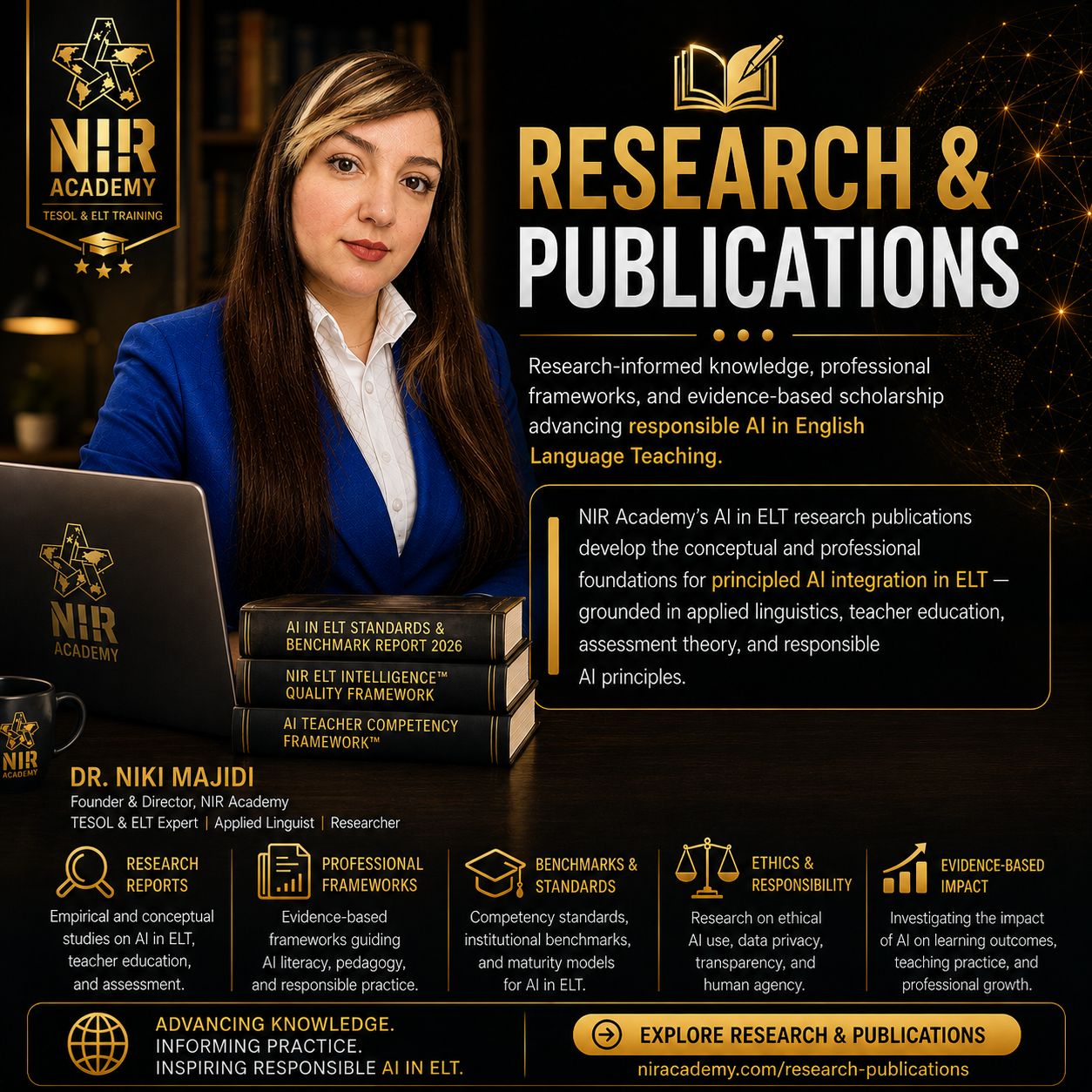
NIR Academy Research and Publications — AI in ELT research, AI in English language teaching, Applied Linguistics research, AI teacher education, responsible AI in ELT, AI literacy for English teachers, and ELT pedagogy research. Research-informed frameworks and scholarly resources led by Dr. Niki Majidi, PhD in Teaching English as a Foreign Language (TEFL).
Research & Publications
Research-informed knowledge, professional frameworks, and scholarly resources advancing responsible AI in English Language Teaching (AI in ELT).
NIR Academy’s research and publications develop the conceptual and professional foundations for principled AI integration in English Language Teaching — grounded in Applied Linguistics, AI teacher education, assessment theory, language pedagogy, and responsible AI principles.
Areas of AI in ELT Research & Scholarship
NIR Academy’s AI in ELT research publications address the practical and theoretical dimensions of AI integration across the English Language Teaching profession.
AI in ELT
The nature, scope, and implications of AI integration in English Language Teaching — including tools, methodologies, and professional standards.
Teacher Competency
The professional knowledge, skills, judgment, and responsible practice required for AI-supported ELT — across six defined competency standards.
Pedagogy & Learning
How AI tools interact with established ELT methodologies — communicative language teaching, task-based learning, and CEFR-informed pedagogy.
Assessment & Evaluation
The validity, reliability, and pedagogical implications of AI-supported assessment in ELT — and the professional competencies required to use it responsibly.
Institutional Readiness
Organisational conditions — infrastructure, policy, staff development, and governance — required for sustainable, responsible AI integration in ELT institutions.
Responsible AI
Ethics, transparency, privacy, bias, academic integrity, and equitable access in AI-supported English language education.
NIR Academy’s research hub connects established scholarship in Applied Linguistics, ELT pedagogy, assessment, educational technology, AI literacy, and responsible AI with emerging questions in AI-supported English Language Teaching. The frameworks underpinning NIR Academy’s tools and professional resources are research-informed — developed through structured synthesis of peer-reviewed scholarship and authoritative institutional guidance.
Selected Scholarly & Institutional Sources
Selected scholarly publications and authoritative research sources informing NIR Academy’s work in AI in ELT, English Language Teaching, and Applied Linguistics. External citations do not imply endorsement of NIR Academy’s frameworks by their authors, publishers, or institutions.
External Scholarly & Institutional Sources
Artificial intelligence in higher education: the state of the field
NIR Academy is not the author or publisher of this work. This record provides research commentary and professional context for ELT practitioners.
Provides a systematic evidence base for understanding how AI is being integrated across educational contexts — directly relevant to ELT practitioners evaluating AI tools for teaching, assessment, and professional development.
Informs the conceptual foundation of NIR Academy’s AI in ELT Standards & Benchmark Report 2026, particularly the institutional readiness and AI integration dimensions.
International Journal of Educational Technology in Higher Education, 20(1), Article 22
A systematic review of AI in higher education research — identifying key themes including AI-supported learning, assessment, and institutional readiness.
AI writing assistance and transformative AI as a literacy issue
NIR Academy is not the author or publisher of this work. This record provides research commentary and professional context for ELT practitioners.
Examines AI writing tools specifically in language learning — raising critical questions about learner agency, assessment integrity, and the teacher’s role when AI mediates writing practice.
Directly informs the Learner Agency and Assessment Validity dimensions of NIR ELT Intelligence™.
Language Learning & Technology, 26(2), 1–26
Examines AI writing assistance tools in language learning contexts — exploring implications for learner agency, teacher judgment, and assessment validity.
Should Robots Replace Teachers? AI and the Future of Education
NIR Academy is not the author or publisher of this work. This record provides research commentary and professional context for ELT practitioners.
Provides a critical, evidence-grounded examination of AI’s role in education — challenging assumptions about teacher replacement and foregrounding the irreplaceable role of professional judgment.
Foundational for NIR Academy’s Teacher Agency dimension and the principle that AI should support rather than replace professional teacher decision-making.
Polity Press, Cambridge
A critical examination of AI’s role in education — questioning the assumption that AI can or should substitute for human teacher judgment.
Recommendation on the Ethics of Artificial Intelligence
NIR Academy is not the author or publisher of this work. This record provides research commentary and professional context for ELT practitioners.
The first global standard-setting instrument on AI ethics — establishing internationally recognised principles for human oversight, transparency, fairness, and responsible AI.
Directly informs the five Responsible AI principles in NIR Academy’s AI in ELT Standards & Benchmark Report 2026.
UNESCO, Paris
The first global standard-setting instrument on the ethics of AI — establishing principles for human oversight, transparency, fairness, and responsible AI practice.
NIR Academy Research & Frameworks
AI in ELT Standards & Benchmark Report 2026
NIR Academy · Version 1.0
A professional competency framework and institutional readiness benchmark for the integration of AI in English Language Teaching — defining six competency standards, four teacher readiness levels, and five responsible AI principles.
Explore the ReportAI Teacher Competency Framework™
NIR Academy · Version 1.0
A research-informed professional framework defining the knowledge, skills, judgment, and responsible practice required for effective AI integration in English Language Teaching — organised around six AI-in-ELT competency standards.
Explore the FrameworkNIR ELT Intelligence™
NIR Academy · Version 1.0
A pedagogical evaluation framework for assessing the quality of AI-supported English Language Teaching — examining eight professional dimensions including CEFR alignment, learner agency, assessment validity, and responsible AI practice.
Explore the FrameworkAI Teacher Readiness Assessment™
NIR Academy · Version 1.0
A research-informed professional self-assessment for English language teachers — measuring current AI readiness across six competency standards and four developmental readiness levels.
Explore the AssessmentResearch Articles
AI Teacher Competency in ELT: A Framework for Professional Practice
NIR Academy original research article. Proposes a six-domain AI teacher competency framework situated within ELT professional practice.
NIR Academy Research & Publications · Version 1.0
Proposes a research-informed framework for AI teacher competency in ELT comprising six interconnected domains — AI Literacy, Pedagogical AI Integration, Prompt & Interaction Skills, AI Output Evaluation, AI Assessment Literacy, and Responsible AI Practice — converging in an integrated model of AI-supported professional judgment.
Read the ArticleTheoretical bases of communicative approaches to second language teaching and testing
NIR Academy is not the author or publisher of this work. This record provides research commentary and professional context for ELT practitioners.
Established the communicative competence model that remains the professional foundation of English Language Teaching — essential for evaluating whether AI-generated ELT content genuinely supports communicative language development.
Underpins the Pedagogical Fit and Communicative Interaction dimensions of NIR ELT Intelligence™.
Applied Linguistics, I(1), 1–47
Foundational paper establishing the communicative competence framework — defining linguistic, sociolinguistic, and strategic competence dimensions.
Common European Framework of Reference for Languages — Companion Volume
NIR Academy is not the author or publisher of this work. This record provides research commentary and professional context for ELT practitioners.
The primary international reference for language proficiency levels — essential for evaluating whether AI-generated ELT content is calibrated to appropriate CEFR levels.
The definitive reference for the CEFR Alignment dimension of NIR ELT Intelligence™.
Council of Europe Publishing, Strasbourg
The definitive CEFR Companion Volume — providing updated proficiency descriptors for language teaching and assessment.
Validity
NIR Academy is not the author or publisher of this work. This record provides research commentary and professional context for ELT practitioners.
Established validity as the central concept in educational measurement — essential for evaluating whether AI-generated assessment items genuinely measure the intended language constructs.
Informs the Assessment Validity dimension of NIR ELT Intelligence™ and NIR Academy’s AI Quality Assurance in ELT.
In R. L. Linn (Ed.), Educational Measurement (3rd ed., pp. 13–103). ACE/Macmillan
The foundational treatment of validity in educational measurement — establishing construct validity as the central concept for all assessment evaluation.
Analyzing language and education in the 21st century
NIR Academy is not the author or publisher of this work. This record provides research commentary and professional context for ELT practitioners.
Provides methodological grounding for evaluating digital and technology-mediated language learning — directly applicable to the professional evaluation of AI-supported ELT environments.
Informs NIR Academy’s approach to pedagogical evaluation of AI-supported language teaching environments and the evidence base for the NIR ELT Intelligence™ framework.
Annual Review of Applied Linguistics, 27, 133–149
Examines the intersection of language education and technology — providing a methodological foundation for evaluating digital and AI-supported language learning environments.
AI in ELT Standards & Benchmark Report 2026
AI in ELT Standards & Benchmark Report 2026
A professional competency framework and institutional readiness benchmark for the integration of Artificial Intelligence in English Language Teaching.
This report provides a structured, research-informed framework for AI competency in ELT — grounded in established pedagogical principles, aligned with international teacher education standards, and designed to support human-centered, responsible AI integration.
Explore the Report →- Six AI-in-ELT Competency Standards
- Four AI Teacher Readiness Levels
- Institutional AI Readiness Benchmark™
- Seven AI Application Domains in ELT
- Five Responsible AI Principles
- Research foundation & methodology
- Versioning & limitations
NIR Academy Frameworks & Assessment Tools
NIR Academy’s professional frameworks operationalise the research foundations into practical tools for teachers, teacher educators, and institutions. All frameworks are described as developing — methodology and evidence bases will be refined over time.
A professional framework defining the knowledge, skills, judgment, and responsible practice required for AI-supported English Language Teaching — organised around six AI-in-ELT Competency Standards.
A research-informed professional self-assessment for English language teachers — measuring current AI readiness across six competency standards and four developmental levels.
An evaluation framework for assessing the pedagogical quality of AI-supported ELT — examining teaching materials, activities, and assessments across eight pedagogical dimensions.
NIR AI-in-ELT Quality Framework™
The pedagogical quality architecture underpinning NIR ELT Intelligence™ — a four-stage model (Understand → Evaluate → Integrate → Reflect) guiding responsible AI integration in English Language Teaching.
Evidence & Methodology
NIR Academy’s research and framework development follow principles of transparency, academic responsibility, and honest representation of the evidence base.
Research Synthesis
Frameworks are developed through a structured synthesis of peer-reviewed scholarship, international institutional guidance, and established professional principles — not original empirical research at this stage.
Evidence Selection
Sources are selected for direct relevance to AI in ELT contexts. Priority is given to peer-reviewed publications, international standards bodies, and authoritative professional frameworks.
Transparent Versioning
All frameworks carry version numbers and publication years. Limitations, developing status, and absence of external validation are stated explicitly in each publication.
Citation Accuracy
All cited sources are real, verifiable, and bibliographically accurate. No invented citations, DOI numbers, or fabricated institutional endorsements appear in any NIR Academy publication.
Research Domains
NIR Academy frameworks draw on scholarship across Applied Linguistics, ELT pedagogy, SLA, educational technology, assessment literacy, AI literacy, teacher professional development, and responsible AI ethics.
Developing Frameworks
NIR Academy frameworks are research-informed professional resources — not externally validated psychometric instruments. Future validation studies and expert review are identified priorities.
Research Director
Dr. Niki Majidi
PhD in Teaching English as a Foreign Language (TEFL) · Founder & Research Director, NIR Academy
Dr. Majidi leads NIR Academy’s research and framework development, combining academic grounding in English Language Teaching with practical expertise in AI integration and professional development for ELT educators.
NIR Academy’s research and publications are led by an academic with direct experience in ELT practice, teacher education, and AI tool development — ensuring that frameworks remain grounded in classroom realities as well as research evidence.
All publications carry clear authorship, version information, and honest statements of limitations — in alignment with principles of academic integrity and professional transparency.
Principles of Academic Integrity
NIR Academy is committed to honest, transparent, and responsible research practice — particularly important in a field where AI claims are frequently overstated.
Transparent Methodology
All framework development processes, evidence sources, and methodological limitations are documented and disclosed in each publication.
Accurate Citations
No invented references, DOI numbers, institutional affiliations, or fabricated peer-review claims appear in any NIR Academy publication.
Honest Claims
NIR Academy clearly distinguishes between research evidence, professional synthesis, developing frameworks, and recommendations for practice.
Versioning
All frameworks carry version numbers and dates. Changes, refinements, and updates are documented as the evidence base develops.
Developing Status
Current frameworks are explicitly research-informed rather than externally validated. No psychometric validation claims are made without independent supporting evidence.
Professional Purpose
Research and frameworks serve the professional development of English language teaching practitioners — not commercial claims or promotional exaggeration.
Advancing AI in ELT Research
Access NIR Academy’s professional frameworks, evidence reviews, and research-informed resources for responsible AI integration in English Language Teaching.
