

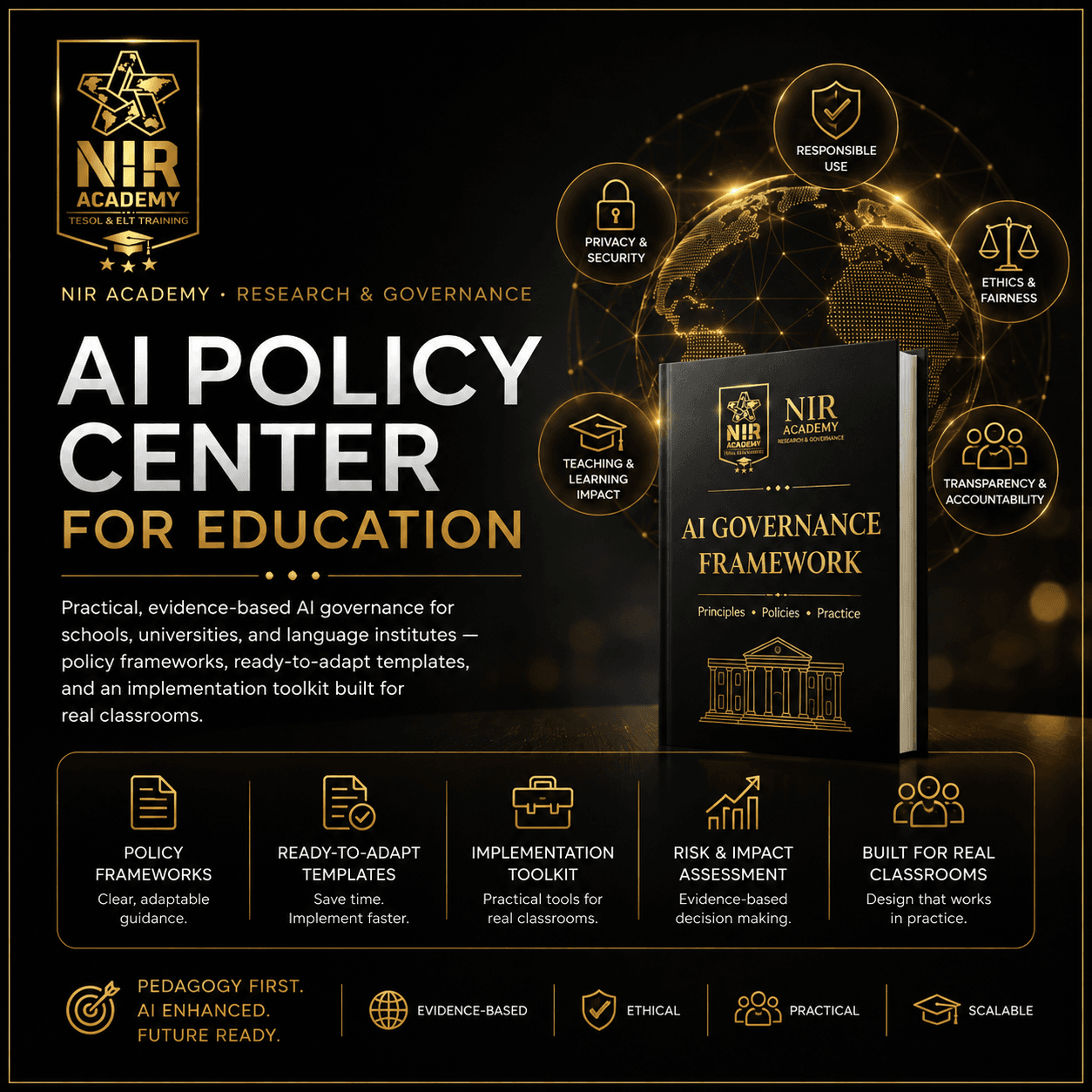
AI Policy Center for Education
Practical, evidence-based AI governance for schools, universities, and language institutes — policy frameworks, ready-to-adapt templates, and an implementation toolkit built for real classrooms.
On this page
Institutions can’t afford to improvise on AI
AI tools have entered classrooms faster than most institutions have written rules for them. Without a clear policy, decisions get made ad hoc — by individual teachers, by students testing the boundaries, or by silence. This AI Policy Center exists to close that gap: a written AI policy protects academic integrity, clarifies expectations, and gives staff and students a shared, defensible standard to work from. For a global perspective on the issue, see UNESCO’s guidance on AI in education.
Consistency
One standard across departments and campuses, instead of every teacher setting their own rules.
Accountability
Clear lines of responsibility for how AI-generated work is reviewed, disclosed, and assessed.
Trust
Students, parents, and accreditors can see how the institution is managing risk — not just adopting tools.
Core Principles
Every template and guideline on this page is built on the same five principles. They form the baseline any institutional AI policy should cover.
Responsible AI
AI supports learning and instruction — it doesn’t replace human judgment or educator authority.
Academic Integrity
Clear rules on disclosure, permitted use, and what counts as a student’s own work.
Privacy & Data Protection
Student and staff data handled in line with applicable data protection requirements.
Transparency
Staff and students know when and how AI tools are used, and by whom.
Human Oversight
A qualified person reviews AI-assisted decisions before they affect a student’s outcome.
Who Is This AI Policy Center For?
The frameworks and templates on this page are built for four types of education providers, each with different regulatory and classroom realities.
Schools
K-12 leadership teams setting classroom rules, parent communication, and age-appropriate tool vetting.
Universities
Higher-ed departments balancing academic freedom with consistent, defensible integrity standards.
Language Institutes
ELT schools and centers managing AI-assisted writing, speaking practice, and CEFR-aligned assessment.
Teacher Training Organizations
Programs preparing educators to teach AI-aware classrooms and model responsible use themselves.
AI Policy Center Templates for Every Institution
Each template applies the five core principles to a specific setting. Use them as a starting draft — every institution should adapt the details to its own context.
School AI Policy K-12
Covers classroom AI use, homework and assessment boundaries, age-appropriate tool vetting, and parent communication.
- Permitted vs. restricted AI use by grade band
- Teacher approval process for classroom tools
- Parental notification and consent guidelines
University AI Policy Higher Ed
Addresses academic freedom, coursework disclosure standards, research use of AI, and consistency across faculties.
- Faculty-level discretion within an institution-wide baseline
- AI disclosure statements for coursework and research
- Guidance for academic integrity committees
Language Institute AI Policy ELT
Written for language schools: AI-assisted writing in a second language, speaking practice tools, and placement/assessment integrity.
- Distinguishing AI language support from AI-generated submissions
- Guidance for CEFR-aligned assessment integrity
- Multilingual staff and student communication templates
Teacher AI Guidelines Staff
Practical guardrails for lesson planning, grading assistance, and communication tools — what to disclose, and what needs human review.
- Acceptable use for lesson prep and materials creation
- Rules for AI-assisted grading and feedback
- Data handling when using AI with student work
Student AI Guidelines Learners
Plain-language rules students can actually follow: what’s allowed, what must be disclosed, and what counts as a violation.
- Simple disclosure format for AI-assisted work
- Examples of acceptable vs. unacceptable use
- Consequences aligned with existing academic integrity policy
Assessment & Academic Integrity
AI changes what academic dishonesty looks like — and what fair assessment design looks like too. This section covers both sides of that shift.
Detecting AI-assisted work
Why AI-detection tools are unreliable on their own, and how to build a review process that combines evidence, context, and a conversation with the student.
Designing AI-resistant assessment
Shifting weight toward in-class writing, oral defense, and process evidence (drafts, edit history) rather than relying only on final submissions.
Privacy, Copyright & Data Protection
Institutions are responsible for how student data enters third-party AI tools, and for the copyright status of AI-generated materials used in class.
Student data & GDPR
What counts as personal data in an AI context, vendor due diligence questions, and consent requirements for tools that log student input — see the official GDPR text for the underlying legal requirements this part of the AI Policy Center is based on.
Copyright of AI content
Ownership and usage rights for AI-generated materials, and how to credit AI assistance in published or shared institutional content.
AI Governance Checklist
Where most institutions should start before writing a full policy.
Implementation Roadmap
A realistic sequence for rolling out the policies from this AI Policy Center at your institution.
Assess
Run the AI Readiness Checklist and identify current, uncontrolled AI use.
Draft
Adapt the relevant policy template with your leadership and academic teams.
Train
Brief staff and students before enforcement begins, not alongside it.
Review
Revisit the policy each term — AI tools change faster than most policy cycles.
Downloadable Resources
PDF policies, editable Word templates, and printable checklists.
AI Policy Maturity Model
Most institutions fall somewhere on this five-level scale. Knowing your current level is the fastest way to identify the next realistic step — not level 5 overnight.
No AI Policy
AI use happens informally, with no institutional guidance or oversight.
Basic Classroom Rules
Individual teachers set their own informal AI rules, with no shared standard.
Department Policy
A department or program writes a formal policy, but it isn’t consistent institution-wide.
Institution-wide Governance
A single AI policy applies across departments, with defined roles and approval processes.
Continuous Review & AI Governance
The policy is reviewed on a regular cycle, with a named owner and a process for evaluating new tools.
Frequently Asked Questions
Are these policy templates legally binding?
No. They’re starting drafts based on established AI governance principles in education. Institutions should review any policy with their own legal or compliance team before adoption, especially regarding local data protection law.
What should an AI policy include?
At minimum: acceptable and prohibited uses, disclosure requirements for AI-assisted work, data privacy safeguards, how violations are handled, and a review cycle. The Core Principles section above outlines the five areas every policy should cover.
Can teachers use ChatGPT in class?
Generally yes, for lesson planning, materials creation, and differentiation — but institutions should set clear boundaries around grading, feedback on student work, and handling of student data. See the Teacher AI Guidelines template above.
Should students disclose AI use?
Yes. Most institutional policies require students to disclose when and how AI tools were used in a submission, similar to citing a source. The Student AI Guidelines template includes a simple disclosure format institutions can adopt.
Can we use these templates for free?
Yes — the templates are free to adapt for your institution. We only ask that you don’t redistribute them commercially as your own product.
Do you offer a custom policy for our institution?
Yes. NIR Academy works directly with schools, universities, and language institutes to develop a tailored AI policy based on your size, region, and existing academic integrity framework. See the Collaboration section below.
Who should approve an institutional AI policy?
Typically academic leadership (principal, dean, or academic director) together with a representative from IT/data protection and at least one teaching staff member — so the policy reflects both compliance requirements and classroom reality.
How often should an AI policy be updated?
At minimum once per academic year. Institutions with fast-changing AI tool adoption should review every term.
Need a Custom AI Policy for Your Institution?
NIR Academy works with school leaders, university departments, and language institute directors to build AI policies suited to their real classrooms — not generic boilerplate.
