

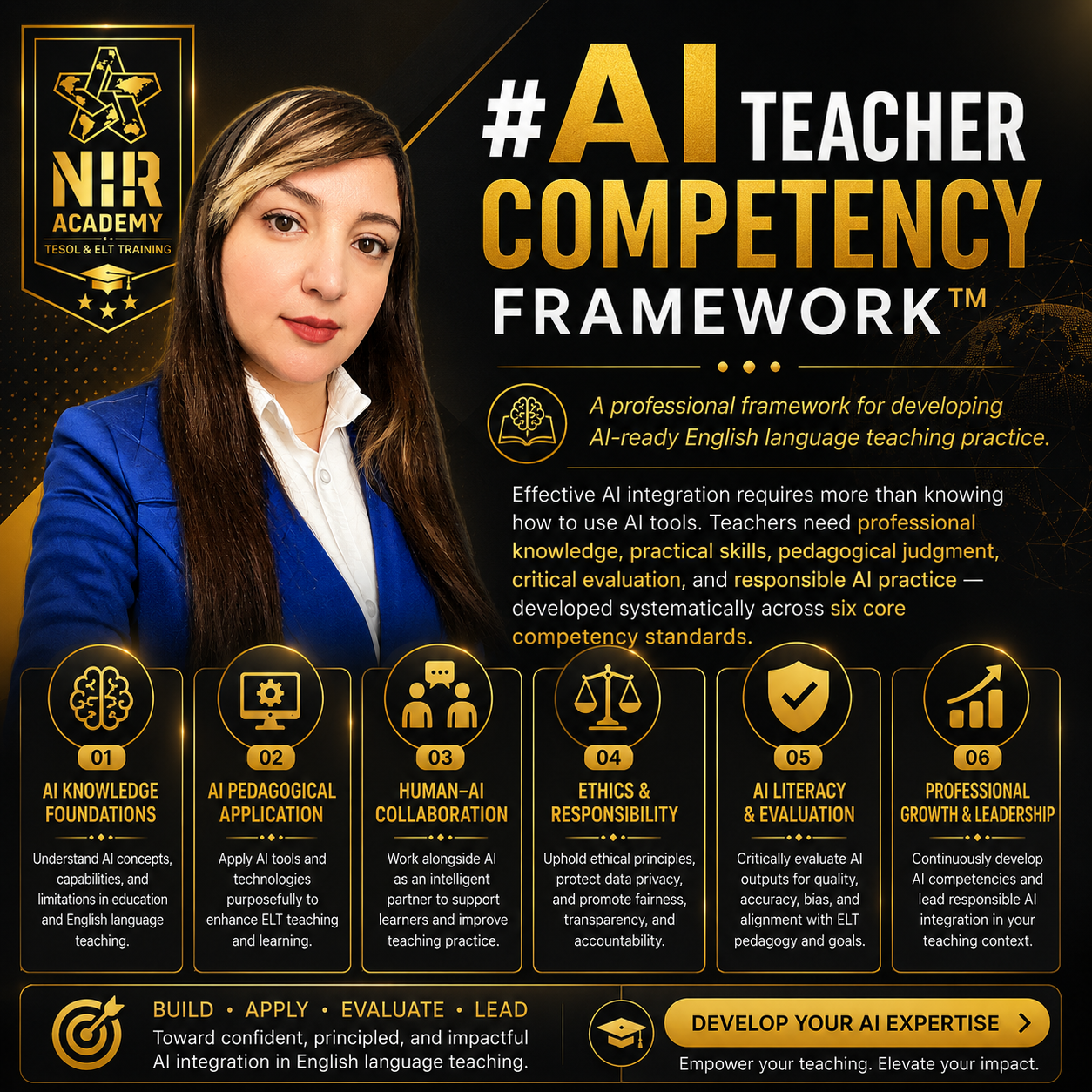
AI teacher competency Framework™ by NIR Academy — a research-informed professional framework defining the six AI-in-ELT competency standards, knowledge, skills, judgment, and responsible practice required for AI-supported English Language Teaching. Grounded in UNESCO AI ethics principles and Council of Europe CEFR guidance.
AI Teacher Competency Framework™
A professional framework for developing AI-ready English language teaching practice.
Effective AI integration requires more than knowing how to use AI tools. Teachers need professional knowledge, practical skills, pedagogical judgment, critical evaluation, and responsible AI practice — developed systematically across six core competency standards.
Why AI Teacher Competency Matters
AI tools are becoming increasingly accessible in English language teaching. But access to AI does not automatically produce effective, principled, or responsible teaching.
A professionally AI-ready teacher must be able to:
AI changes fast — judgment persists
Specific AI tools will continue to evolve. Professional judgment about when and how to use them remains the durable competency.
Learners are also using AI
Teachers who understand AI competency can better support learners in developing their own critical and responsible AI practices.
Responsibility cannot be delegated to AI
Professional responsibility for teaching quality, learner welfare, and ethical practice cannot be transferred to an AI system.
Six AI-in-ELT Competency Standards
The following six competency standards define the professional capabilities required for responsible and effective AI-supported English language teaching. They are reproduced from the AI in ELT Standards & Benchmark Report 2026 — the terminology is exact and should be used consistently across all NIR Academy resources.
AI Literacy
Understanding how AI systems function, what they are designed to do, and where their limitations and potential biases lie. AI literate teachers distinguish appropriate from inappropriate use cases and communicate that understanding to their learners.
Pedagogical AI Integration
Connecting AI tools to established ELT methodologies — CLT, TBLT, PPP — rather than using AI as an independent content source. The teacher maintains agency over learning objectives, materials selection, and assessment design.
Prompt & Interaction Skills
The ability to frame AI requests that generate pedagogically appropriate, CEFR-calibrated outputs. Includes understanding how context, role specification, and iterative refinement shape AI responses.
AI Output Evaluation
No AI output should be used in educational contexts without professional evaluation. Covers assessment of AI-generated content for factual accuracy, linguistic appropriateness, cultural sensitivity, level suitability, and hallucination detection.
AI Assessment Literacy
Using AI in assessment contexts — item generation, automated feedback, progress tracking — without compromising validity, reliability, or positive washback. Includes designing tasks that remain meaningful when AI assistance is available to learners.
Responsible AI Practice
The capstone competency. Encompasses data privacy, transparency of AI involvement, academic integrity, equitable access, and professional decision-making when AI recommendations conflict with ethical or pedagogical principles.
From AI Tool Use to Professional Competency
Familiarity with AI tools is a starting point — not a destination. Tool knowledge tells you what an AI system can do. It does not tell you whether, when, or how to use it professionally.
Professional competency integrates knowledge, judgment, and responsibility into principled teaching decisions.
A Professional Model of AI Teacher Competency
AI teacher competency involves several interconnected dimensions. These are not additional standards — they describe the nature of professional competency within the broader framework.
Knowledge
Understanding AI concepts, capabilities, terminology, and limitations — specifically in ELT contexts.
Practical Skills
Using AI tools effectively for relevant professional tasks — lesson planning, materials development, feedback design.
Pedagogical Application
Connecting AI use to learning objectives, learner needs, teaching methodology, and ELT contexts.
Critical Evaluation
Questioning AI output, identifying limitations, detecting inaccuracies, and evaluating pedagogical quality.
Professional Judgment
Deciding when AI adds genuine value, when teacher expertise must intervene, and when AI should not be used.
Responsible Practice
Considering privacy, bias, transparency, academic integrity, learner agency, and ethical use in every AI decision.
Four Levels of AI Teacher Readiness
Competency development can be reflected through four professional readiness levels. These describe where a teacher currently is in their AI development — not how effective they are as a teacher overall.
AI-Aware
Understands basic AI concepts and opportunities but has limited systematic application in ELT practice. Development focus: foundational AI literacy.
AI-Developing
Can use AI tools for selected teaching tasks but requires stronger evaluation skills and pedagogical judgment. Development focus: critical evaluation and pedagogical integration.
AI-Competent
Uses AI strategically, evaluates outputs critically, and integrates AI with clear pedagogical purpose and professional judgment. Development focus: assessment literacy and leadership.
AI-Innovative
Demonstrates advanced, reflective, responsible AI integration and contributes to professional practice — at the classroom, institutional, or field level.
How AI Teacher Competency Develops
Understand
Build foundational AI literacy. Understand AI capabilities, limitations, and what they mean for English language teaching specifically.
Apply
Use AI for appropriate ELT tasks with clear professional and pedagogical purposes — with consistent teacher review of all outputs.
Evaluate
Critically examine AI outputs, identify risks and limitations, and develop structured evaluation practices for all AI-generated content.
Integrate
Develop reflective, responsible, evidence-informed AI-supported teaching practice — and contribute that knowledge to others.
Professional development is iterative rather than linear. Teachers may progress at different rates across different competency standards.
What Does AI-Competent Teaching Look Like?
Competent AI use in ELT looks different from simple AI adoption. The distinction is professional judgment — applied at every stage of the teaching process.
Lesson Planning
“Ask AI to create my lesson.”
Define the learning objective, learner level, context, and pedagogical requirements first — then use AI selectively and evaluate the resulting lesson against those criteria.
Materials
“Use whatever AI generates.”
Review accuracy, level appropriateness, cultural suitability, interactional value, and alignment with learning objectives before any AI-generated material reaches learners.
Assessment
“Let AI grade everything.”
Use AI as an assistive tool for specific assessment tasks while maintaining professional responsibility for all significant assessment decisions and interpretations.
Learner AI Use
“Encourage students to use AI for every task.”
Determine when AI supports meaningful learning and when independent learner production — speaking, writing, reasoning — is more pedagogically valuable for the learning objective.
Teacher Agency Remains Central
“AI can assist professional practice.
It cannot assume professional responsibility.”
AI teacher competency includes the specific professional ability to exercise independent judgment — even when AI makes a confident-sounding recommendation.
Competent teachers actively exercise agency by:
Responsible AI Competency in ELT
Responsible AI competency is not a separate checklist — it is integrated into every professional decision. The following are key professional considerations for AI-supported ELT practice.
Accuracy & Verification
Review all AI-generated content for factual correctness, linguistic accuracy, and hallucinations before professional use.
Privacy & Data
Understand what learner data AI tools collect, store, and process — and comply with applicable data protection obligations.
Bias & Representation
Recognise that AI outputs may reflect cultural, linguistic, or demographic biases present in training data.
Transparency
Disclose AI involvement in instruction and assessment to learners in ways appropriate to the professional context.
Academic Integrity
Establish clear professional positions on AI use in learning and assessment contexts — and communicate them to learners.
Learner Agency
Design AI use that supports learner development — not dependency. Protect the productive struggle that drives language acquisition.
Equitable Access
Consider whether AI tools and AI-supported tasks are accessible to all learners in the specific teaching context.
Human Oversight
Maintain meaningful professional oversight of all AI-supported processes — particularly in assessment and learner feedback contexts.
These are professional considerations rather than legal advice. Applicable obligations will vary by jurisdiction and institutional context.
From Assessment to Professional Development
The AI Teacher Competency Framework™ sits at the centre of a professional development pathway — connecting self-assessment, conceptual grounding, structured development, and applied practice.
Identifies where the individual teacher currently stands across the six competency standards and four readiness levels.
Defines the professional competencies required — clarifying what teachers need to develop and why each competency matters.
Structured development aligned to the competency standards — through the AITTC and NIR Academy’s professional resources.
Applies competency in real teaching contexts — with evaluation, reflection, and continuous professional development.
Teacher Competency vs. Pedagogical AI Quality
The AI Teacher Competency Framework™ and NIR ELT Intelligence™ address different dimensions of AI-supported ELT. They are complementary — not interchangeable.
| AI Teacher Competency Framework™ | NIR ELT Intelligence™ | |
|---|---|---|
| Primary focus | Teacher professional competency | Pedagogical quality of AI-supported teaching materials |
| Evaluates | Teacher knowledge, skills, judgment, and responsible practice | AI-supported lessons, materials, activities, and assessments |
| Framework | 6 AI-in-ELT Competency Standards | 8 Pedagogical Dimensions |
| Core question | Is the teacher professionally ready to use AI? | Is this AI-supported teaching pedagogically sound? |
| Primary user | Teachers and teacher educators | Teachers, teacher educators, and institutions |
The Framework Behind the 2026 Standards
The AI in ELT Standards & Benchmark Report 2026 provides the broader professional framework from which teacher-facing assessment and development pathways are derived.
The Report includes the full six competency standards, a four-level teacher readiness model, a four-dimension institutional readiness benchmark, and five responsible AI principles — grounded in established research and international guidance.
The AI Teacher Competency Framework™ makes those standards accessible for individual teacher development and professional reflection.
Research-Informed Professional Framework
Peer-Reviewed Evidence
The framework draws on established research in SLA, communicative language teaching, CEFR pedagogy, AI ethics, and teacher education — including UNESCO AI ethics guidance and Council of Europe CEFR frameworks.
Translating Standards into Practice
The competency framework translates the professional standards of the 2026 Report into teacher-facing concepts, observable professional behaviours, and practical development guidance.
AI Teacher Competency Framework™ · 2026
This is Version 1.0, published in 2026. The framework will be reviewed as evidence, professional feedback, and research in AI in ELT continue to develop.
Research-Informed, Not Externally Validated
This framework is research-informed and professionally grounded. It should not be presented as externally validated unless independent validation is explicitly documented. Future development may include expert review and empirical validation studies.
Who Is This Framework For?
Questions About the AI Teacher Competency Framework™
Build Your AI Teaching Competency
AI readiness is not about using more AI. It is about developing the professional knowledge, skills, judgment, and responsibility to use AI well — and to know when not to use it.
Research-informed · ELT-specific · Not a certification · 2026 Edition
