

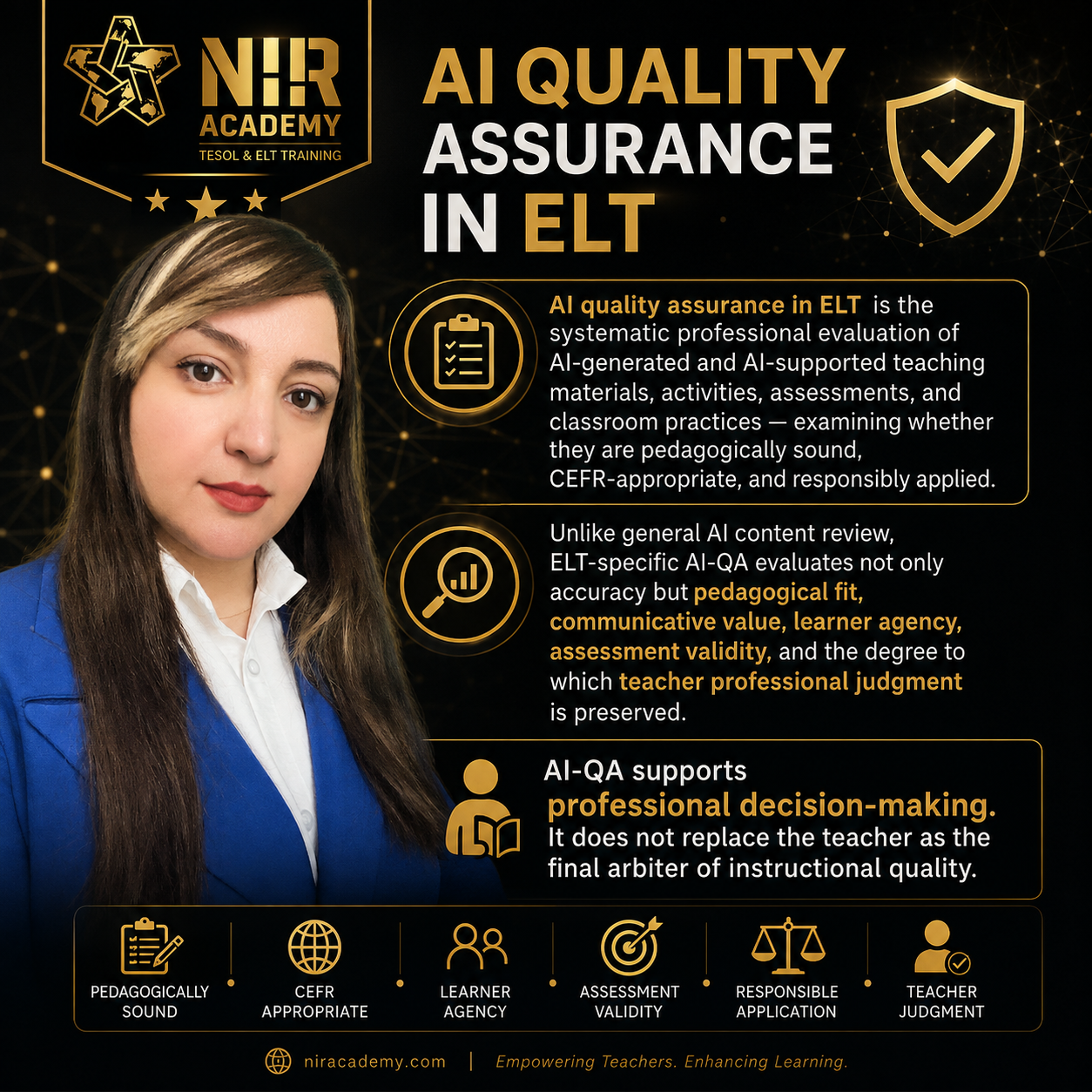
AI quality assurance in ELT — NIR Academy’s professional framework for evaluating AI-supported English Language Teaching across eight pedagogical dimensions: Pedagogical Fit, CEFR Alignment, Learner Agency, Interaction, Teacher Agency, AI Dependency, Assessment Validity, and Responsible AI.
AI Quality Assurance
in English Language Teaching
Evaluating AI-supported ELT for pedagogical quality, CEFR alignment, and responsible use.
AI can produce a lesson in seconds. What it cannot do is guarantee that lesson is pedagogically sound, level-appropriate, or suitable for your learners. AI quality assurance in ELT is the professional practice that bridges that gap.
AI quality assurance in ELT is the systematic professional evaluation of AI-generated and AI-supported teaching materials, activities, assessments, and classroom practices — examining whether they are pedagogically sound, CEFR-appropriate, and responsibly applied.
Unlike general AI content review, ELT-specific AI-QA evaluates not only accuracy but pedagogical fit, communicative value, learner agency, assessment validity, and the degree to which teacher professional judgment is preserved.
The Risks of Unevaluated AI in ELT
Fluent AI output is not the same as pedagogically effective teaching. Without professional evaluation, AI-generated content introduces specific risks in English language teaching contexts.
Pedagogical Misalignment
AI-generated tasks may be grammatically correct but fail to meet learning objectives, develop communicative competence, or align with the teaching methodology in use.
CEFR Inaccuracy
AI systems can misjudge CEFR levels — particularly when task difficulty involves interacting linguistic, cognitive, and contextual demands — producing content inconsistent with the specified learner proficiency.
Reduced Learner Agency
Poorly designed AI activities replace active learner production with passive consumption — undermining the communicative and interactive foundations of effective language learning.
Assessment Invalidity
AI-generated assessment items may not measure the intended construct. AI feedback may reward surface accuracy while missing the communicative or grammatical target entirely.
Ethical & Privacy Risks
Unreviewed AI use may introduce cultural bias, inaccurate representations, privacy violations, or academic integrity concerns that require professional oversight to identify and address.
AI Dependency
Systematic over-reliance on AI-generated content can erode teacher professional judgment and reduce the deliberate instructional decision-making that characterises expert teaching.
NIR AI Quality Assurance Framework™
The NIR AI Quality Assurance Framework™ — the professional evaluation framework that underpins NIR ELT Intelligence™ — examines AI-supported ELT across eight professional dimensions. It is a developing, research-informed framework grounded in applied linguistics, CEFR-informed pedagogy, assessment theory, and responsible AI principles.
| # | Dimension | Core Question | What Weak QA Looks Like |
|---|---|---|---|
| 1Pedagogical Fit | Does this activity achieve its stated learning objective? | Engaging tasks that produce no measurable language learning | |
| 2CEFR Alignment | Is the language demand appropriate for this proficiency level? | B1 label on a task requiring C1 reasoning and vocabulary | |
| 3Learner Agency | Does the learner actively produce, decide, and communicate? | Comprehension-only tasks replacing productive language use | |
| 4Interaction | Does the task create meaningful communicative exchange? | Monologic AI-narrated input with no learner interaction | |
| 5Teacher Agency | Does AI support rather than substitute professional judgment? | AI-automated feedback replacing teacher assessment decisions | |
| 6AI Dependency | Is AI used where it adds genuine pedagogical value? | AI generating content that learners should produce themselves | |
| 7Assessment Validity | Does this assessment measure the intended construct? | Fluency-focused AI scoring missing the grammatical target | |
| 8Responsible AI | Are privacy, bias, transparency, and integrity addressed? | Undisclosed AI use in learner assessment contexts |
What the Framework Evaluates
The NIR AI QA Framework™ applies across the full range of AI-supported ELT practice — from lesson planning to classroom assessment.
AI-Generated Lessons
Evaluate pedagogical coherence, objective alignment, CEFR accuracy, and whether the lesson design supports — rather than replaces — teacher-led instruction.
Teaching Materials
Review reading texts, grammar explanations, vocabulary activities, and task sequences for linguistic accuracy, cultural sensitivity, and level suitability.
Communicative Activities
Assess whether AI-designed activities produce genuine interaction, learner output, and communicative purpose — or merely simulate engagement.
AI-Generated Feedback
Evaluate whether automated feedback targets the intended linguistic construct, supports learner development, and is transparent about its AI origin.
Assessment Items
Examine AI-authored test items and rubrics for construct validity, appropriate difficulty, and alignment with stated learning outcomes and proficiency descriptors.
How the Framework Was Developed
The NIR AI QA Framework™ is a research-informed professional synthesis — not an independently validated psychometric instrument. Its development follows a transparent, staged process.
Conceptual Foundations
The eight dimensions were developed through structured synthesis of applied linguistics, CEFR pedagogy, assessment theory, AI literacy research, and responsible AI frameworks — identifying the professional dimensions most relevant to AI-supported ELT.
Dimension Development
Each dimension was defined to be conceptually distinct, professionally observable, and relevant across diverse ELT contexts — from lesson planning and materials development to assessment and AI-supported classroom practice.
Scoring Approach
The NIR Pedagogical AI Score™ represents a developing composite indicator across the eight dimensions. The current interpretation bands are provisional professional guidance — not empirically validated cut scores. Independent validation is a stated future priority.
Versioning & Refinement
Version 1.0 (2026) reflects the current state of the framework. Dimensions, scoring, and guidance will be reviewed as professional feedback, applied use, and research in AI in ELT continue to develop.
The AI-QA Process in ELT
Professional AI quality assurance is not a single checklist. It is a reflective cycle that integrates evaluation into ongoing teaching practice.
Understand
Identify the learning objective, learner level, and pedagogical context before selecting or generating AI content.
Evaluate
Apply the eight NIR AI-QA dimensions to the AI-generated output. Identify strengths, risks, and pedagogical gaps.
Improve
Revise, adapt, or reject AI-generated content based on professional evaluation. Treat all AI output as a draft.
Integrate
Use evaluated content where it adds genuine pedagogical value — maintaining teacher agency throughout delivery.
Reflect
Review outcomes. Did AI-supported content achieve its learning objective? Refine criteria and practices accordingly.
NIR Pedagogical AI Score™
The NIR Pedagogical AI Score™ is a developing composite indicator derived from the eight QA dimensions. It identifies areas of pedagogical strength and dimensions requiring professional intervention. A high score indicates strong alignment with the framework criteria — it does not guarantee learning effectiveness or serve as a substitute for teacher judgment.
| Pedagogical Fit | 91 | |
| CEFR Alignment | 86 | |
| Learner Agency | 70 | |
| Interaction | 78 | |
| Teacher Agency | 88 | |
| AI Dependency | 68 | |
| Assessment Validity | 79 | |
| Responsible AI | 92 |
| Score | Band | Implication |
|---|---|---|
| 85–100 | Strong | Ready for use with minor review |
| 70–84 | Adequate | Address flagged dimensions before use |
| 55–69 | Developing | Significant revision recommended |
| <55 | Insufficient | Reject or fundamentally redesign |
Framework version 1.0 — 2026. Developing. These bands are provisional professional guidance, not empirically validated cut scores.
Teacher & Institutional AI Quality Assurance
For Individual Teachers
- Apply the eight dimensions before using any AI-generated content in class
- Use the NIR Pedagogical AI Score™ to identify which dimensions need attention
- Build structured evaluation habits into daily lesson preparation
- Use AI Teacher Readiness Assessment™ to identify personal QA development priorities
- Treat AI output as a professional draft — never as a finished resource
For ELT Institutions
- Establish shared AI-QA standards aligned to the eight NIR dimensions
- Integrate QA evaluation into materials approval and lesson planning processes
- Use NIR OBSERVE™ to monitor AI integration quality in classroom practice
- Build staff AI-QA competency through the AITTC
- Review institutional AI readiness through the 2026 Standards Report
AI-QA Checklist for ELT Teachers
Use this checklist before adopting any AI-generated content in your teaching. Each item corresponds to one of the eight NIR AI-QA dimensions.
This checklist is a practical reflection tool — not a validated assessment instrument. Adapt it to your specific teaching context.
Selected Research Foundations
The NIR AI QA Framework™ is grounded in peer-reviewed scholarship and international institutional guidance. The research foundations inform the framework’s conceptual basis — they do not constitute empirical validation of the specific eight dimensions or scoring model. The intellectual provenance follows the path: Research foundations → NIR synthesis → Professional framework → Developing operationalisation.
References are provided for academic transparency. NIR Academy draws on the research traditions represented by these works; it does not claim endorsement by their authors. All citations are real and verifiable.
Questions About AI Quality Assurance in ELT
Evaluate AI Quality in Your ELT Practice
The NIR AI Quality Assurance Framework™ is operationalised through NIR ELT Intelligence™ — NIR Academy’s pedagogical evaluation framework for AI-supported English Language Teaching.
