

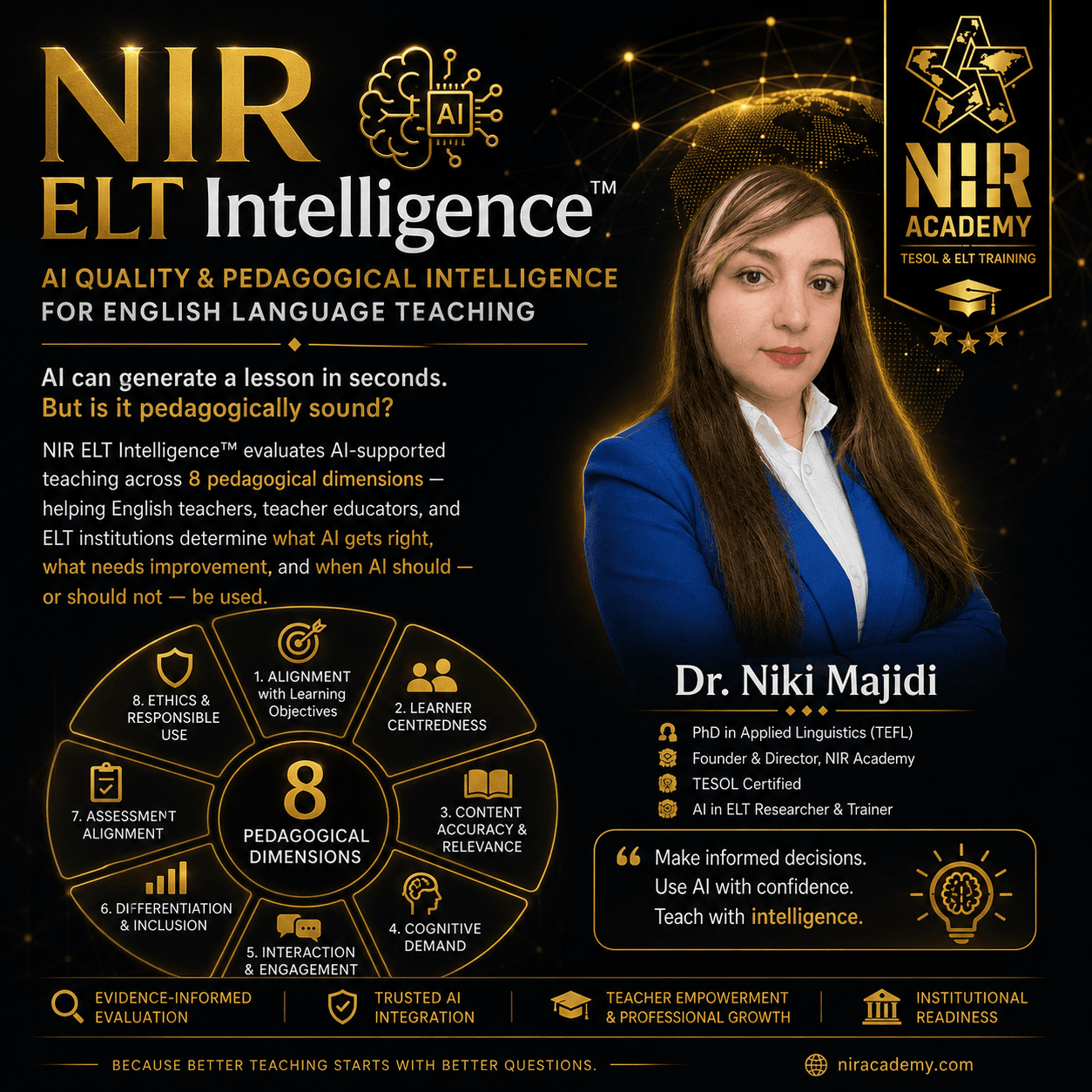
What is NIR ELT Intelligence™?
NIR ELT Intelligence™ is a framework for evaluating the quality and pedagogical value of AI use in English language teaching. It examines factors such as pedagogical fit, CEFR alignment, learner agency, teacher agency, assessment validity, AI dependency, interaction, and responsible AI to help teachers make informed decisions about AI.
NIR ELT Intelligence™ is NIR Academy’s proprietary framework for evaluating the pedagogical quality of AI in English Language Teaching across eight research-informed dimensions for teachers, institutions, and teacher educators.
NIR ELT Intelligence™
AI Quality & Pedagogical Intelligence for English Language Teaching.
AI can generate a lesson in seconds. But is it pedagogically sound?
NIR ELT Intelligence™ evaluates AI-supported teaching across 8 pedagogical dimensions — helping English teachers, teacher educators, and ELT institutions determine what AI gets right, what needs improvement, and when AI should — or should not — be used.
NIR Academy proprietary framework · In development · 2026
Designed to support — not replace — judgment
Beyond AI Generation.
Toward Pedagogical Intelligence.
Generative AI can produce lesson plans, activities, assessments, and materials in seconds. But generation is not the same as pedagogical quality.
NIR ELT Intelligence™ is designed to evaluate whether AI-supported English Language Teaching is pedagogically sound — examining not only whether AI can produce useful content, but whether that content supports meaningful learning, appropriate interaction, learner agency, teacher judgment, valid assessment, and responsible AI use.
“AI can generate. Educators must evaluate.”
— NIR Academy framework principleNot a grading tool
NIR ELT Intelligence™ provides a structured pedagogical lens — it highlights strengths, identifies risks, and supports teacher decision-making.
Research-informed design
The eight dimensions are grounded in Applied Linguistics, CEFR pedagogy, SLA research, and responsible AI principles.
Teacher agency first
No score replaces professional judgment. The framework positions teachers as the final decision-makers in AI-supported ELT.
AI Can Generate. Teachers Must Evaluate.
AI can produce.
Lesson plans, activities, worksheets, and assessments — fast.
AI can sound convincing.
Fluent output does not guarantee pedagogical validity.
AI can accelerate teaching.
But speed does not necessarily mean better learning.
AI needs professional judgment.
Teachers must decide what to use, how to use it, and when not to.
Can AI create this?
- Is the grammar correct?
- Is the content fluent?
- Is the information accurate?
- Is the content well-structured?
Should this be used for learning?
- Does this achieve its learning objective?
- Is the task appropriate for this CEFR level?
- Does it promote meaningful interaction?
- Does it preserve learner agency?
- Is AI replacing productive learning?
- Is the assessment pedagogically valid?
- Is the teacher still making the decisions?
Eight Pedagogical Dimensions of AI Quality in ELT
Each dimension addresses a distinct aspect of pedagogical quality in AI-supported ELT — grounded in applied linguistics, CEFR descriptors, and research-informed teaching practice.
Pedagogical Fit
Does the AI-supported activity align with the intended learning objective?
CEFR Alignment
Is the language, cognitive demand, and task appropriate for the learner’s proficiency level?
Learner Agency
Does the learner actively think, produce, communicate, decide, and create?
Interaction
Does the activity create meaningful learner interaction rather than passive consumption?
Teacher Agency
Does AI support professional judgment rather than replace the teacher?
AI Dependency
Is AI being used where it adds genuine pedagogical value, or simply because it is available?
Assessment Validity
Does the AI-supported assessment actually measure the intended construct?
Responsible AI
Are accuracy, transparency, privacy, bias, and responsible use appropriately considered?
NIR AI-in-ELT Quality Framework™
A Pedagogical Framework for Evaluating AI-Supported English Language Teaching
NIR ELT Intelligence™ evaluates AI-supported teaching through a research-informed framework designed to help educators determine whether, where, and how AI adds genuine pedagogical value.
The framework moves beyond AI generation and focuses on professional pedagogical judgment.
“Responsible AI integration begins with pedagogical judgment.”
The framework is designed to support — not replace — teacher and institutional professional judgment.Understand
Identify what AI can and cannot contribute to a specific teaching and learning context.
Evaluate
Examine AI-supported activities, materials, and assessments across eight pedagogical dimensions.
Integrate
Use AI where it meaningfully supports learning, teaching, and professional practice.
Reflect
Review outcomes, identify limitations, and refine future AI-supported decisions.
From AI Output to Pedagogical Intelligence
Input
Upload or paste any AI-supported teaching material for analysis.
Analyze
NIR ELT Intelligence™ examines the material across all eight pedagogical dimensions.
Score
Receive a NIR Pedagogical AI Score™ with a full dimensional breakdown.
Improve
Receive targeted recommendations and a pedagogically improved version of the material.
A New Way to Evaluate AI in ELT
The NIR Pedagogical AI Score™ provides a structured, developing framework for assessing the pedagogical quality of AI-supported teaching — designed to support professional judgment, not substitute for it.
“The score is designed to support professional judgment — not replace it. A high score indicates pedagogical alignment; a lower score signals where teacher expertise must intervene.”
How the NIR Pedagogical AI Score™ Is Interpreted
The NIR Pedagogical AI Score™ is a structured composite indicator derived from the eight dimensions of the NIR AI-in-ELT Quality Framework™. It is designed to identify areas of pedagogical strength, potential risk, and required teacher intervention rather than provide an absolute measure of teaching quality.
The score should be interpreted in context. A higher score indicates stronger alignment with the framework criteria; it does not guarantee learning effectiveness or replace professional teacher judgment.
See NIR ELT Intelligence™ in Action
NIR ELT Intelligence™ does not simply grade AI output. It identifies what needs improvement and provides pedagogically grounded recommendations.
AI Output
Generic AIDiscuss the advantages and disadvantages of social media. Use the vocabulary list provided. Speak for 2–3 minutes. AI will give you feedback on fluency and grammar.
- Appropriate B1 vocabulary range
- Clear instructions
- Relevant contemporary topic
- Monologic format — limits genuine interaction
- Minimal learner production
- No communicative purpose or real audience
- AI feedback substitutes for teacher judgment
NIR Recommendation
NIR ELT Intelligence™Task: You and your partner must advise a 16-year-old on whether to join a new social media platform. Discuss, agree on three key points, and present your recommendation to the class.
- Pair interaction creates real communicative exchange
- Decision-making activates learner agency
- Shared outcome gives the task authentic purpose
- Teacher evaluates communication — not AI
Built for the ELT Ecosystem
English Teachers
Evaluate and improve AI-supported teaching decisions before they reach your learners.
Teacher Educators
Develop teachers’ ability to evaluate AI critically and with pedagogical grounding.
ELT Institutions
Benchmark AI integration and ensure pedagogical quality across all programmes.
Researchers
Explore AI quality, pedagogy, teacher agency, and responsible AI in language education.
Research-Informed. Evidence-Based.
NIR ELT Intelligence™ draws on peer-reviewed scholarship across eight foundational domains of language education and AI ethics research.
Peer-Reviewed Evidence
The eight evaluation dimensions derive from established SLA research, CEFR descriptors, communicative language teaching theory, and AI ethics literature.
Analytical Framework
Each dimension is operationalised through observable and professionally interpretable indicators grounded in ELT practice, teacher education research, and established principles of language education.
International Standards
NIR Academy’s framework draws on UNESCO AI ethics recommendations and Council of Europe CEFR guidance.
Framework Version 1.0
Initial release: 2026. NIR ELT Intelligence™ will be updated as the evidence base for AI in ELT continues to develop and as research in the field matures.
Selected Research Foundations
The following sources represent key works in the research domains that inform the NIR AI-in-ELT Quality Framework™. This is a selective, not exhaustive, reference list.
- 1 Council of Europe. (2020). Common European Framework of Reference for Languages: Learning, Teaching, Assessment — Companion Volume. Council of Europe Publishing. coe.int
- 2 UNESCO. (2022). Recommendation on the Ethics of Artificial Intelligence. United Nations Educational, Scientific and Cultural Organization. unesco.org
- 3 Canale, M., & Swain, M. (1980). Theoretical bases of communicative approaches to second language teaching and testing. Applied Linguistics, I(1), 1–47. doi.org/10.1093/applin/I.1.1 — Foundational framework for communicative competence underlying the Interaction and Learner Agency dimensions.
- 4 Messick, S. (1989). Validity. In R. L. Linn (Ed.), Educational Measurement (3rd ed., pp. 13–103). American Council on Education/Macmillan. — Core validity framework informing the Assessment Validity dimension.
- 5 Godwin-Jones, R. (2022). Partnering with AI: Intelligent writing assistance and instructed language learning. Language Learning & Technology, 26(2), 5–24. doi.org/10.64152/10125/73474 — Examines AI writing tools in relation to SLA principles and learner autonomy.
- 6 Crompton, H., & Burke, D. (2023). Artificial intelligence in higher education: the state of the field. International Journal of Educational Technology in Higher Education, 20(1), Article 22. doi.org/10.1186/s41239-023-00392-8 — Systematic review mapping AI applications across educational levels.
- 7 Long, M. H. (2015). Second Language Acquisition and Task-Based Language Teaching. Malden, MA: Wiley-Blackwell. — Foundational text for task-based methodology informing the Pedagogical Fit and Learner Agency dimensions.
- 8 Selwyn, N. (2019). Should Robots Replace Teachers? AI and the Future of Education. Cambridge: Polity Press. — A critical examination of AI claims in education, essential for the Teacher Agency and AI Dependency dimensions.
References are provided for academic transparency. NIR ELT Intelligence™ draws on the research traditions represented by these works; it does not claim endorsement by their authors.
The Intellectual Architecture
NIR ELT Intelligence™ sits within a broader intellectual ecosystem that connects framework, standards, and application into a unified approach to AI quality in ELT.
Pedagogical evaluation framework
Understand · Evaluate · Integrate · Reflect
6 competency standards · 4 readiness levels
Professional development · Institutional benchmarking
AI in ELT Standards & Benchmark Report 2026
A professional competency framework and institutional readiness benchmark for the integration of Artificial Intelligence in English Language Teaching — published by NIR Academy as a companion to this framework.
The Report introduces six AI in ELT competency standards, a four-level teacher readiness model, and an institutional benchmark that directly extends the pedagogical principles underlying NIR ELT Intelligence™.
Explore the 2026 Standards Report →The Pedagogical Intelligence Layer Across NIR Academy
NIR ELT Intelligence™ does not sit beside the NIR ecosystem — it runs through it, providing pedagogical quality evaluation at every stage of AI-supported ELT practice.
Together, these tools form an AI ecosystem where NIR ELT Intelligence™ provides the shared pedagogical standard for evaluating AI quality across all applications.
Three Applications of Pedagogical Intelligence
Evaluate
Evaluate the pedagogical quality of AI-generated ELT materials, lesson plans, prompts, and assessments using the eight-dimension framework.
Benchmark
Benchmark individual teachers and institutions against structured AI readiness levels — from AI-aware to AI-innovative practice.
Certify
Develop structured certification pathways for AI-ready ELT practice — for individual educators and institutions seeking formal recognition.
Questions About NIR ELT Intelligence™
Don’t Just Use AI in ELT.
Learn to Evaluate It.
The future of AI in English Language Teaching depends not only on what AI can generate, but on what educators know is worth using.
