


Intelligence Built for the Future of ELT.
The NIR AI Intelligence Hub is an integrated intelligence ecosystem connecting artificial intelligence, pedagogical expertise, teacher competency, assessment, research, and responsible implementation.
More Than Tools. An Integrated Intelligence Ecosystem.
NIR Academy brings together specialized AI applications, educational intelligence, teacher development, assessment, research, and institutional expertise within a focused English language teaching context.
The NIR AI Intelligence Hub reflects a simple idea: the value of the ecosystem lies in the relationships between its components, not merely in the existence of individual tools.
This page describes NIR’s conceptual architecture. It does not imply that every application shares one technical backend or operates as a single real-time platform.
NIR AI Intelligence Hub: AI in ELT Ecosystem
Select a component to reveal what it covers and where to learn more.
- The conceptual intelligence layer connecting pedagogical quality, AI evaluation, and educational decision-making in ELT.
Explore NIR ELT Intelligence → - Specialized AI applications serving different English language teaching needs, from teacher assistance to speaking, writing, assessment, and simulation.
Explore NIR Technology → - Frameworks for AI teacher competency and readiness, centered on professional judgment and responsible classroom implementation.
Explore the frameworks → - Research, evaluation criteria, and publications on AI in ELT, each labeled by its evidence status.
Explore Research & Publications → - Structured criteria and standards for examining the quality and responsible use of AI in English language teaching.
Explore AI Quality Assurance → - Support for institutions on AI readiness, teacher development, and responsible implementation.
Explore institutional consultation →
The Intelligence Behind Better Language Education.
NIR ELT Intelligence™ is the conceptual layer connecting pedagogical quality, AI evaluation, and educational decision-making. Its eight dimensions offer a structured way to examine AI applications in ELT.
- Whether an AI application’s design and outputs serve a clear, sound teaching purpose.
- Whether language, tasks, and feedback are appropriate to the intended CEFR level. Reference: Council of Europe CEFR.
- Whether learners keep meaningful control over their own learning decisions and effort.
- Whether the tool supports genuine communication rather than one-way output.
- Whether teachers can inspect, adapt, and override what the AI produces.
- Whether use of the tool builds capability or encourages over-reliance.
- Whether assessment-related outputs measure what they claim to measure.
- Whether transparency, fairness, privacy, and appropriate oversight are considered.
A conceptual framework for examination. It is not presented as independently validated, empirically proven, or universally adopted.
Specialized AI Technology for English Language Teaching.
Specialized tools serving different ELT needs. Each application is described on its own page.
NIRA
An AI assistant for English teachers.
Explore NIRA →NIRON
Grammar and vocabulary support.
Explore NIRON →NIRVO
Speaking support for English language teaching.
Explore NIRVO →NIRVE
Writing support for English language teaching.
Explore NIRVE →NIREV
AI-supported assessment for ELT.
Explore NIREV →NIRAS
Exam authoring for educators.
Explore NIRAS →NIR SIM™
AI teaching simulation.
Explore NIR SIM™ →NIR OBSERVE™
Observation-related functionality for teaching.
Explore NIR OBSERVE™ →NIR CEFR Checker
CEFR-related analysis of language.
Explore NIR CEFR Checker →Human Competency at the Center of AI Adoption.
Teacher competency, AI readiness, professional development, pedagogical judgment, and responsible classroom implementation determine whether AI improves teaching.
AI Teacher Competency Framework™
A framework for the professional competencies teachers need to use AI responsibly.
Learn more →AI Teacher Readiness Assessment™
An assessment of teacher readiness for AI in ELT.
Learn more →AI in ELT Standards & Benchmarks
Reference points for examining AI use in English language teaching.
Learn more →Existing frameworks are distinguished from proposed concepts on their own pages. No external accreditation or endorsement is implied.
Research-Informed. Quality-Focused. Transparent.
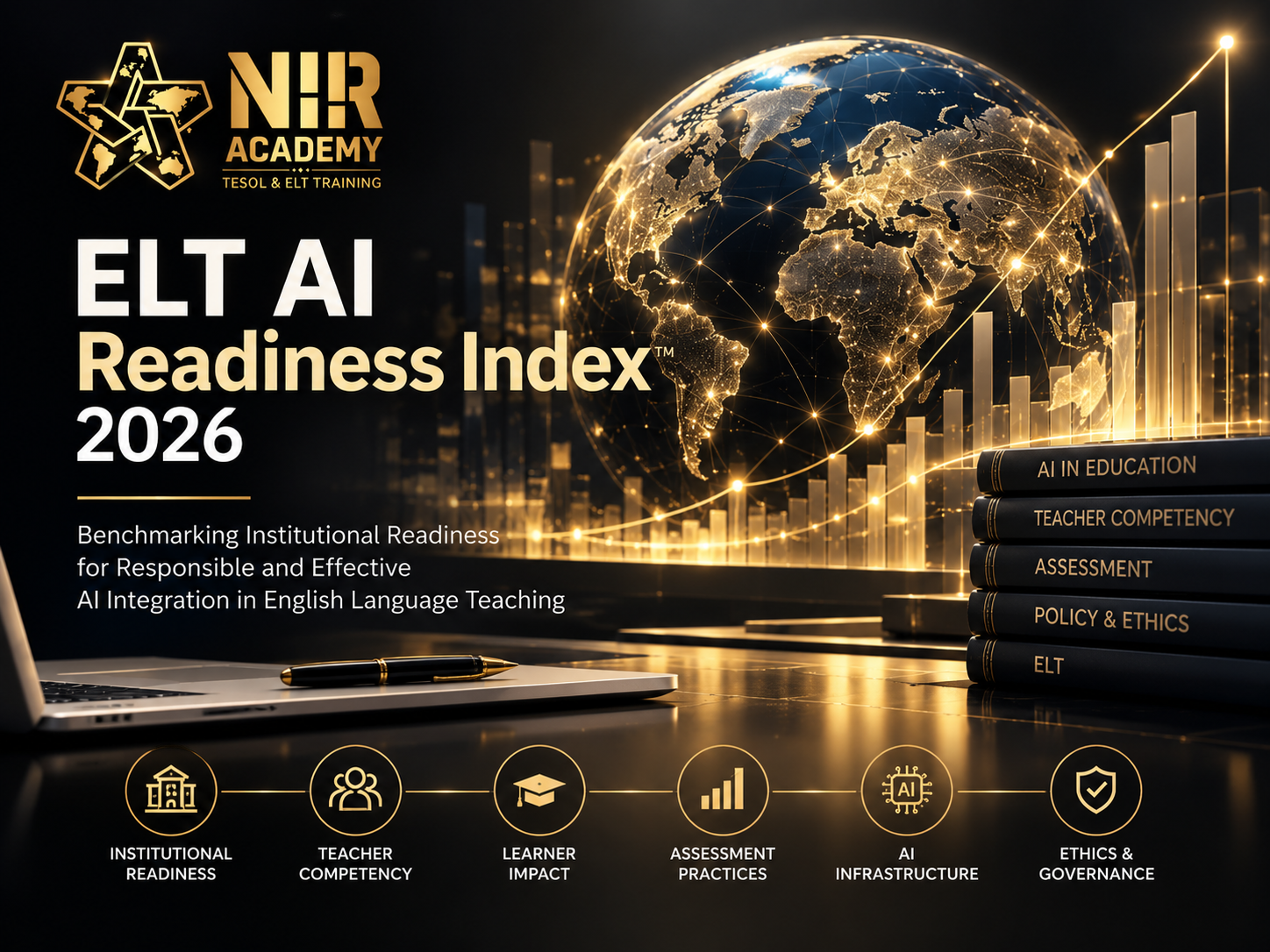
Research, evaluation criteria, standards, and responsible AI practices improve the quality of AI use in ELT. Areas of work include AI Quality Assurance for ELT, AI in ELT standards and benchmarks, the ELT AI Readiness Index™ 2026, research and publications, and AI policy and responsible implementation resources.
- Published research
- Working papers
- Conceptual frameworks
- Proposed standards
- Empirically validated findings
Each item should be read according to its own status. A conceptual framework or proposed standard is not a validated finding.
AI Should Strengthen Teaching, Not Replace Teacher Judgment.
NIR places pedagogical purpose before technological novelty. AI can assist with teaching, feedback, assessment, and professional development, while educators remain responsible for interpreting evidence and making instructional decisions.
- 01Pedagogical purpose comes before technological novelty.
- 02AI competency involves professional judgment, not prompting alone.
- 03AI quality must be evaluated rather than simply assumed.
From Individual Tools to Institutional Capability.
NIR’s relevance to educational institutions centers on AI readiness and strategy, teacher professional development, educational quality assurance, AI evaluation and ELT expertise, and responsible implementation and oversight.
Currently available services are described on their own pages. Future strategic possibilities are not presented as current features, and no automated institution-wide monitoring, live analytics, or enterprise integration is implied.
Four Pathways Into the Ecosystem.
Explore AI-assisted teaching, classroom simulation, assessment, and professional development.
Explore courses →Explore AI readiness, teacher development, quality assurance, and responsible implementation.
Explore for institutions →Explore frameworks, research, evaluation criteria, and AI in ELT standards.
Explore research →Explore institutional strategy, teacher competency, oversight, and evidence-informed decisions.
Explore consultation →Built Around ELT, Pedagogy, and Evidence.
- INTEGRATED
Connects specialized tools, educational frameworks, research, and professional development.
- ELT-SPECIFIC
Focuses on English language teaching rather than generic AI use alone.
- PEDAGOGY-CENTERED
Places educational purpose and teacher judgment at the center of AI adoption.
- RESEARCH-INFORMED
Emphasizes transparent criteria and clear communication of supporting evidence.
- RESPONSIBLE
Recognizes learner agency, assessment quality, appropriate oversight, and responsible AI use.
Discover the NIR Ecosystem.
Explore the technology, intelligence, frameworks, and research shaping a more thoughtful approach to AI in English language education.
Pedagogy First. AI Enhanced. Future Ready.
