

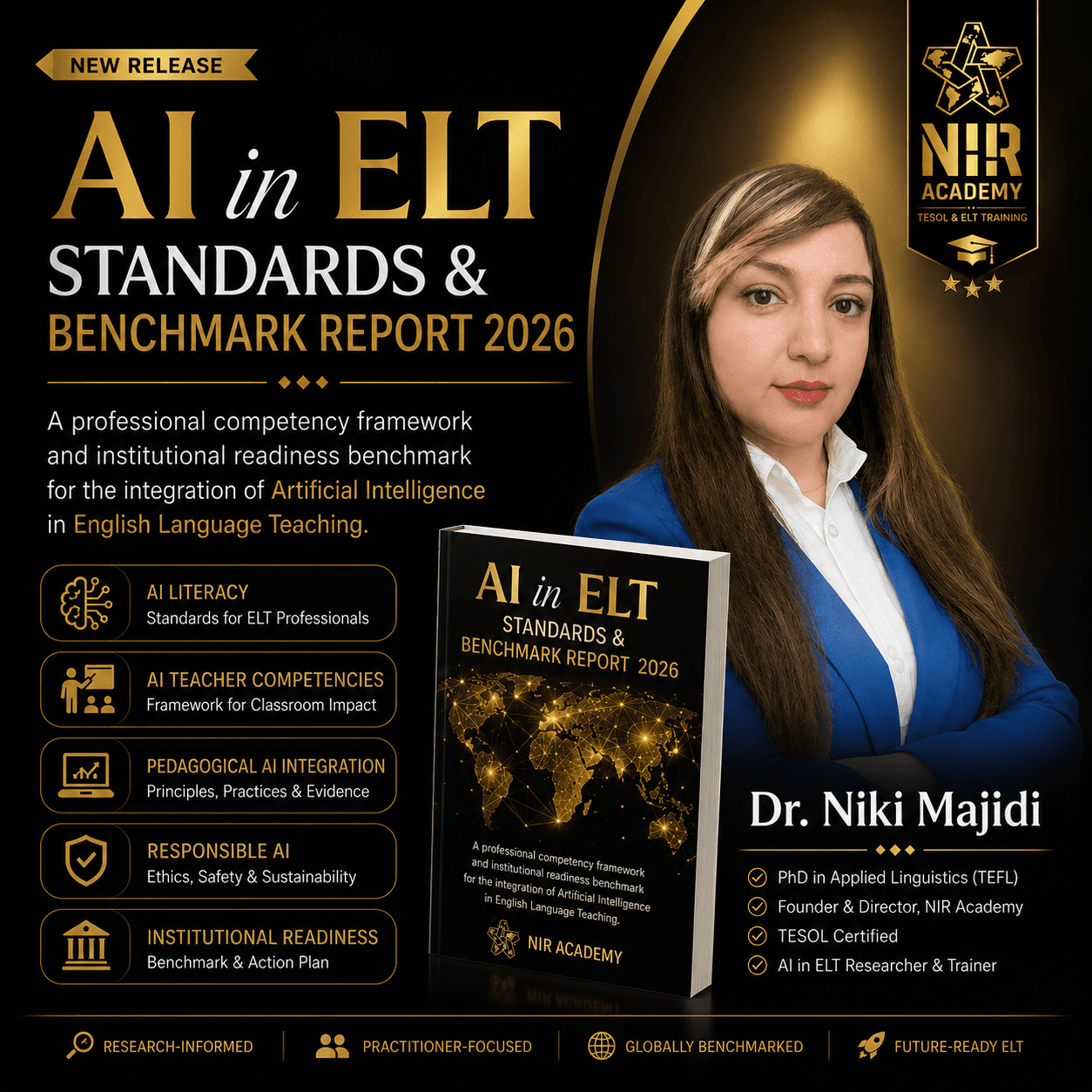
AI in ELT Standards & Benchmark Report 2026 — A comprehensive framework for AI literacy, AI teacher competencies, pedagogical AI integration, and responsible AI in English Language Teaching, published by NIR Academy.
AI in ELT Standards &
Benchmark Report 2026
A professional competency framework and institutional readiness benchmark for the integration of Artificial Intelligence in English Language Teaching.
A Framework Built on Evidence, Not on Enthusiasm
AI tools are now embedded across language learning platforms as standard features — speech recognition, adaptive vocabulary, automated feedback, and assessment generation. Yet principled frameworks for how teachers should engage with these systems remain underdeveloped.
This report addresses that gap with a structured, evidence-informed competency framework grounded in established pedagogy, aligned to international teacher education standards, and designed to support responsible AI integration in ELT.
It is intended for English language teachers, teacher trainers, academic managers, and institutional policymakers navigating the practical and ethical dimensions of AI adoption in language education.
“The question is not whether AI will become part of English language teaching. It already has. The question is whether that integration will be principled, pedagogically sound, and ethically responsible.” — Dr. Niki Majidi, PhD TEFL · Founder, NIR Academy
Report Scope at a Glance
What this report provides
A structured competency framework (6 standards), a teacher readiness maturity model (4 levels), and an institutional benchmark across 4 strategic dimensions.
Why standards are necessary
Unguided AI adoption risks pedagogical inconsistency, ethical oversight failures, and missed opportunities for principled integration. Standards provide the professional anchors that make adoption sustainable.
Our philosophical anchor
Human-centered AI. The teacher remains the instructional decision-maker. AI is a tool in service of pedagogy — not a substitute for professional expertise, relational teaching, or ethical judgment.
Three Layers of the NIR Academy AI-in-ELT Framework
This report occupies a specific layer within a broader NIR Academy knowledge architecture. Understanding the relationship between the three layers helps clarify what each one addresses and for whom.
Defines what individual ELT professionals should know and be able to do when integrating AI into teaching, assessment, and professional practice. Addresses teachers, teacher educators, and institutional stakeholders.
Evaluates the pedagogical quality of AI-supported ELT materials, activities, assessments, and teaching decisions — using the eight-dimension NIR AI-in-ELT Quality Framework™. Addresses teachers and teacher educators working with specific AI-generated content.
Evaluates whether an ELT institution has the organisational conditions — infrastructure, policy, staff competency, and ethical governance — required for responsible and effective AI integration. This layer is currently in development as a formal assessment instrument.
| Framework | Core Question | Level |
|---|---|---|
| AI in ELT Standards & Benchmark Report 2026 | What should ELT professionals know and do? | Professional |
| NIR ELT Intelligence™ | Is this AI-supported teaching pedagogically sound? | Teaching / Content |
| Institutional AI Readiness Benchmark™ (Developing) | Is the institution ready to integrate AI responsibly? | Institutional |
Why AI Standards Are Necessary in ELT
AI diffusion in education has outpaced professional guidance. Four structural challenges make principled standards not merely useful, but necessary.
Accelerated Adoption Without Preparation
AI tools enter classrooms faster than professional development can respond. Teachers are expected to integrate unfamiliar systems without training, guidance, or evaluation criteria.
Pedagogical Disconnect
Many AI language tools are built without grounding in SLA research, CLT, or CEFR frameworks. Teachers require frameworks to assess the pedagogical alignment of AI outputs.
Quality Control Deficits
AI-generated content is not inherently reliable. Without output evaluation skills, educators cannot consistently identify inaccuracies, biases, or level-suitability issues in AI-produced materials.
Ethical & Privacy Concerns
AI adoption in education raises substantive questions around data privacy, algorithmic transparency, and academic integrity — concerns that require principled institutional policy, not improvised responses.
AI in ELT Competency Standards
The following six standards constitute the NIR Academy AI in ELT Competency Framework. Each standard defines a distinct domain of professional knowledge and practice required for principled AI integration in English language teaching contexts.
AI Literacy
The foundational competency: a working understanding of how AI systems function, what they can and cannot do, and where their outputs may embed bias or inaccuracy. In ELT, AI literate teachers distinguish appropriate from inappropriate use cases and communicate that distinction clearly to their learners.
Pedagogical AI Integration
Connecting AI tools to established methodological frameworks — CLT, TBLT, PPP — rather than treating AI as a standalone content source. The teacher retains full agency over objectives, materials, and assessment; AI is a resource within the methodology, not a replacement for it.
Prompt and Interaction Skills
Communicating with AI systems effectively is a distinct professional skill. Prompt literacy in ELT means framing requests that yield CEFR-calibrated, pedagogically appropriate outputs — and understanding how context, role specification, and iterative refinement shape AI responses.
AI Output Evaluation
No AI output enters the classroom without professional review. This standard covers assessment of AI-generated content for factual accuracy, linguistic appropriateness, cultural sensitivity, and level suitability — including hallucination detection. AI outputs are drafts, not finished resources.
AI Assessment Literacy
Using AI in assessment contexts — item generation, automated feedback, progress tracking — without compromising validity, reliability, or positive washback. Includes designing tasks that retain meaning when AI assistance is available to learners, and interpreting automated feedback in pedagogically supportive ways.
Responsible AI Practice
The capstone competency. Responsible AI practice covers data privacy, transparency of AI involvement, academic integrity, and equitable access. Crucially, ethical considerations are not a compliance checklist — they are embedded in the professional culture of how a teacher works with AI every day.
AI Teacher Readiness Levels
AI competency develops progressively. The NIR Academy AI Teacher Readiness Model maps four levels of professional growth — each with distinct skills, behaviours, and instructional practices — for use in self-assessment, development planning, and institutional evaluation.
Recognises AI’s relevance to education but has not yet systematically applied it in ELT practice.
- Can name common AI tools relevant to language learning
- Has begun engaging with AI tool documentation or demos
- Recognises the difference between AI-generated and human-authored content
- Understands basic ethical concerns at a conceptual level
Uses AI for bounded tasks — materials generation, vocabulary lists, lesson drafts — with supplementary, task-specific integration.
- Uses AI tools regularly to support lesson preparation
- Applies basic prompt strategies to improve output quality
- Reviews and edits AI outputs before classroom use
- Follows institutional data privacy policies with AI tools
AI is embedded across planning, delivery, feedback, and assessment within a coherent methodological framework.
- Selects AI tools based on pedagogical fit, not convenience
- Scaffolds student AI literacy alongside language skills
- Guides peers in principled AI tool selection
- Maintains critical evaluation of all AI-generated outputs
Designs, evaluates, and advocates for principled AI practice at the institutional or field level.
- Develops and shares AI integration frameworks with peers
- Evaluates AI tools against established research criteria
- Participates in professional communities advancing AI in ELT
- Contributes to policy development and institutional AI strategy
Institutional AI Readiness Benchmark™
teacher competency alone is insufficient. Sustainable AI integration requires institutional commitment across four strategic dimensions. The following dimensions constitute the institutional readiness layer described in this report. They are intended to guide structured self-evaluation — not as a validated psychometric instrument. A more formal institutional assessment tool is under development.
Infrastructure & Access
Does the institution provide reliable, equitable access to approved AI tools? Are technical systems in place to support AI-enhanced instruction without creating digital equity gaps among staff or learners?
Policy & Governance
Has the institution developed clear, accessible policies on AI use in teaching and assessment? Do these policies address data privacy, academic integrity, and teacher disclosure obligations?
Staff Competency Development
Does the institution provide structured, ongoing professional development in AI integration? Are training programmes aligned with research-informed competency standards, or are they ad hoc and vendor-led?
Ethical Governance
Does the institution have mechanisms for ongoing ethical review of AI tools and their outcomes? Are staff empowered to raise concerns, and are student interests explicitly protected in AI-related decisions?
How to Use This Benchmark
Convene a cross-functional team — academic leaders, IT managers, and teachers — to rate current capacity honestly. Aspirational scoring produces no useful priorities. Revisit annually, as both AI tooling and institutional context evolve continuously.
Institutional AI Readiness: Maturity Levels
The following four levels describe a developmental continuum of institutional AI readiness. These are conceptual descriptors, not a validated scoring scale. They are distinct from the four AI Teacher Readiness Levels described earlier, which address individual professional competency. A higher institutional level does not automatically produce better teaching or improved student learning outcomes.
AI use is fragmented and largely individual. No institution-wide policy, structured professional development, or governance framework is yet in place.
The institution has begun establishing AI policies, approving specific tools, and providing initial staff development. Governance is partial and implementation is uneven.
AI integration is structured, supported, and governed institution-wide. Policy, professional development, and ethical frameworks are coherent and applied consistently.
AI is embedded in institutional strategy, continuous improvement, and evidence-informed decision-making. The institution contributes to professional knowledge and reviews AI practices systematically.
AI Application Areas in ELT
The following maps established AI application areas in ELT, with the key pedagogical consideration each domain requires.
Lesson Planning
AI assists with structured activity outlines, mixed-ability differentiation, and CEFR-aligned content. Teacher judgment governs contextual adaptation and final design decisions.
Speaking Practice
AI speech agents provide low-stakes oral practice at scale. Teacher-led debriefing bridges automated phonological feedback to communicative competence goals.
Writing Feedback
AI writing tools offer immediate feedback on accuracy, cohesion, and register. Effective integration builds learner revision autonomy — not reliance on automated correction.
Assessment Design
AI supports item generation and automated scoring, reducing workload in formative assessment. Professional review for validity and reliability remains mandatory before summative deployment.
Vocabulary Learning
Adaptive AI tools personalise review sequences and exposure frequency. Meaningful contextual integration — not isolated drilling — optimises long-term retention.
Classroom Observation
AI observation tools generate structured feedback across established pedagogical dimensions. Developmental dialogue between observer and teacher remains the core mechanism for professional growth.
Teacher Development
AI coaching supports reflective practice, lesson analysis, and methodology training. Highest impact occurs when AI analysis is embedded within structured mentoring and peer professional communities.
Responsible AI Principles for ELT
Responsible AI is a professional orientation, not a checklist — it shapes every stage of instructional design, delivery, and evaluation.
Human-Centred AI
The teacher is the instructional decision-maker. AI expands professional capacity — it does not substitute for pedagogical judgment.
Transparency
Institutions and teachers disclose AI involvement in instruction and assessment. Learners have the right to informed awareness of AI in their learning environment.
Teacher Control
No AI system operates in a teaching context without meaningful teacher oversight. Automation that removes teacher agency is pedagogically and ethically problematic.
Student Data Privacy
Learner data processed by AI must comply with applicable data protection law. Institutions bear direct responsibility for every tool they authorise for use.
Ethical Implementation
AI adoption must account for equitable access, cultural appropriateness, algorithmic bias, and the long-term professional sustainability of teachers in AI-rich environments.
The NIR Academy AI Ecosystem in Practice
NIR Academy’s tools provide potential operational applications of the competencies and principles described in this framework. Their use should remain subject to pedagogical evaluation, institutional policy, professional judgment, privacy requirements, and responsible AI principles. Using these tools does not in itself constitute AI readiness — readiness is determined by the competency standards and institutional dimensions described in this report.
A conversational AI research and methodology coach designed for ELT professionals. NIRA supports teachers in understanding AI applications in language teaching, exploring methodological frameworks, and navigating professional development decisions with an AI interlocutor trained on TEFL-specific knowledge.
An AI-powered speaking coach that provides structured pronunciation, fluency, and coherence feedback. NIRVO demonstrates how AI can support speaking assessment literacy by giving teachers and learners a transparent model of automated oral feedback.
A writing feedback tool that analyses learner texts for grammatical accuracy, cohesion, and register appropriateness. NIRVE illustrates the Standard 4 principle of treating AI output as a draft — the tool generates structured feedback for teacher review, not final verdicts.
An AI-assisted evaluation platform supporting systematic assessment of learner performance. NIREV is designed to augment teacher assessment judgment, not replace it — maintaining the validity and reliability principles central to Standard 5.
An exam and activity authoring tool that enables teachers to generate CEFR-calibrated test items using structured prompts. NIRAS directly builds Standard 3 (prompt literacy) and Standard 5 (assessment design) competencies in teachers who use it.
A classroom simulation environment that allows teachers to practise instructional scenarios with AI-generated student profiles. NIR SIM™ supports the Standard 2 principle of maintaining teacher agency in methodologically grounded AI-supported environments.
An AI-powered classroom observation and analysis tool built on a five-dimension pedagogical scoring framework. NIR OBSERVE™ demonstrates how AI can support structured teaching analysis while placing professional interpretation firmly in the teacher’s hands.
The AITTC is NIR Academy’s structured professional development programme for AI integration in ELT. It maps directly to the six competency standards in this framework, guiding teachers from foundational AI literacy through to responsible, pedagogically grounded AI practice. The course is designed for both independent study and institutional deployment.
How to Use This Report
This report is a professional development and strategic planning resource — not a validated high-stakes certification assessment. The following five steps provide a structured approach to applying the framework in practice.
Self-Assess
Use the AI Teacher Readiness Model to locate your current professional level. Use the four institutional dimensions to identify where your organisation currently stands.
Identify Gaps
Compare current practice against the six competency standards and the four institutional dimensions. Be specific about which standards are underdeveloped rather than seeking a single overall score.
Prioritise
Not all gaps require immediate attention. Identify the most consequential professional, pedagogical, ethical, or governance gaps given your institutional context.
Develop
Design or access structured professional development and institutional planning that addresses priority areas. Align development with the specific competency standards relevant to your context.
Review
Reassess periodically. AI technologies, research evidence, and institutional policies evolve continuously. A framework used only once provides limited long-term benefit.
Academic Foundation & Suggested References
This framework draws on scholarly literature in SLA, CALL, teacher education, AI ethics, and educational technology. The following selection supports deeper engagement with the evidence base.
- Crompton, H., & Burke, D. (2023). Artificial intelligence in higher education: the state of the field. International Journal of Educational Technology in Higher Education, 20(1), Article 22. doi.org/10.1186/s41239-023-00392-8 — Provides a systematic review of AI applications across educational levels.
- Godwin-Jones, R. (2022). Partnering with AI: Intelligent writing assistance and instructed language learning. Language Learning & Technology, 26(2), 5–24. doi.org/10.64152/10125/73474 — Examines AI writing tools in relation to SLA principles and learner autonomy.
- Long, M. H. (2015). Second Language Acquisition and Task-Based Language Teaching. Malden, MA: Wiley-Blackwell. — Foundational text for the task-based methodology alignment underpinning Standard 2.
- Canale, M., & Swain, M. (1980). Theoretical bases of communicative approaches to second language teaching and testing. Applied Linguistics, I(1), 1–47. doi.org/10.1093/applin/I.1.1 — Foundational framework for communicative competence, informing Standards 1–3.
- UNESCO. (2022). Recommendation on the Ethics of Artificial Intelligence. United Nations Educational, Scientific and Cultural Organization. — Provides the international ethical governance framework referenced in Standard 6.
- Selwyn, N. (2019). Should Robots Replace Teachers? AI and the Future of Education. Cambridge: Polity Press. — A critical examination of AI claims in education, essential for balanced evaluation of AI capabilities.
- Council of Europe. (2020). Common European Framework of Reference for Languages: Learning, Teaching, Assessment — Companion Volume. Council of Europe Publishing. — Establishes the CEFR descriptors referenced in Standards 3 and 5.
- Messick, S. (1989). Validity. In R. L. Linn (Ed.), Educational Measurement (3rd ed., pp. 13–103). American Council on Education/Macmillan. — Core validity framework informing the Assessment Literacy standard.
- Warschauer, M., & Matuchniak, T. (2010). New technology and digital worlds: Analyzing evidence of equity in access, use, and outcomes. Review of Research in Education, 34(1), 179–225. doi.org/10.3102/0091732X09349791 — Addresses equity dimensions referenced in Responsible AI Principle 5.
- Holmes, W., Bialik, M., & Fadel, C. (2019). Artificial Intelligence in Education: Promises and Implications for Teaching and Learning. Boston, MA: Center for Curriculum Redesign. — Broad synthesis of AI in education literature relevant to the institutional benchmark.
Note: The framework represents NIR Academy’s research-informed synthesis of established scholarship and international guidance. Citation of a source does not imply endorsement of the NIR Academy framework by its authors or institutions. Readers are encouraged to access sources through institutional library databases such as JSTOR, ERIC, or Google Scholar.
Methodology & Evidence Base
The following section describes how the NIR Academy AI in ELT Competency Framework was developed and the principles that guide its application. Transparency about methodology is essential to academic credibility.
Framework Development
The six competency standards were synthesised from established ELT pedagogy, AI literacy, teacher education, assessment literacy, educational technology, and responsible AI principles. The synthesis process drew on peer-reviewed research and authoritative international guidance.
Operationalisation
Each competency standard is expressed through observable and professionally interpretable knowledge, skills, and practices grounded in ELT practice and teacher education research. The indicators are designed for reflective professional use, not high-stakes automated scoring.
Institutional Benchmark
The four institutional dimensions represent organisational conditions that the research literature identifies as necessary for sustainable AI integration. They are intended as structured reflection prompts, not a validated scoring instrument.
Limitations
This framework is research-informed rather than externally validated. Readiness levels are developmental descriptors, not psychometric categories. Institutional benchmark dimensions are not a validated measurement instrument. Ratings should not be interpreted as direct measures of teaching quality or learner outcomes. Future validation and empirical research may refine the framework.
Versioning
This is Version 1.0, published in 2026. The framework will be revised as the evidence base for AI in ELT develops, as professional feedback is gathered, and as empirical research in the field matures. Version history will be documented and published.
Future Validation
NIR Academy intends to pursue empirical research and expert consultation to strengthen the evidence base for these competency standards and institutional dimensions. Validation studies and longitudinal research are identified as future priorities.
What’s Available and What’s Next
The Professional Competency Framework
The research-informed framework comprising six competency standards, four teacher readiness levels, four institutional benchmark dimensions, and five responsible AI principles.
Assessment Instruments & Benchmarking Resources
Structured self-assessment tools, institutional benchmarking resources, and implementation guides aligned to the six competency standards and institutional dimensions.
Validation, Certification & Longitudinal Research
Potential validation studies, institutional benchmarking datasets, formal certification pathways, and longitudinal research on AI integration outcomes in ELT contexts.
Questions on AI in ELT Standards
Related Resources & Tools
Develop Your AI Readiness as an ELT Professional
NIR Academy provides structured, evidence-informed pathways for English language teachers who want to integrate AI purposefully, ethically, and effectively — from foundational AI literacy to innovative classroom practice.
