

Speaking & Communication
ELT Framework
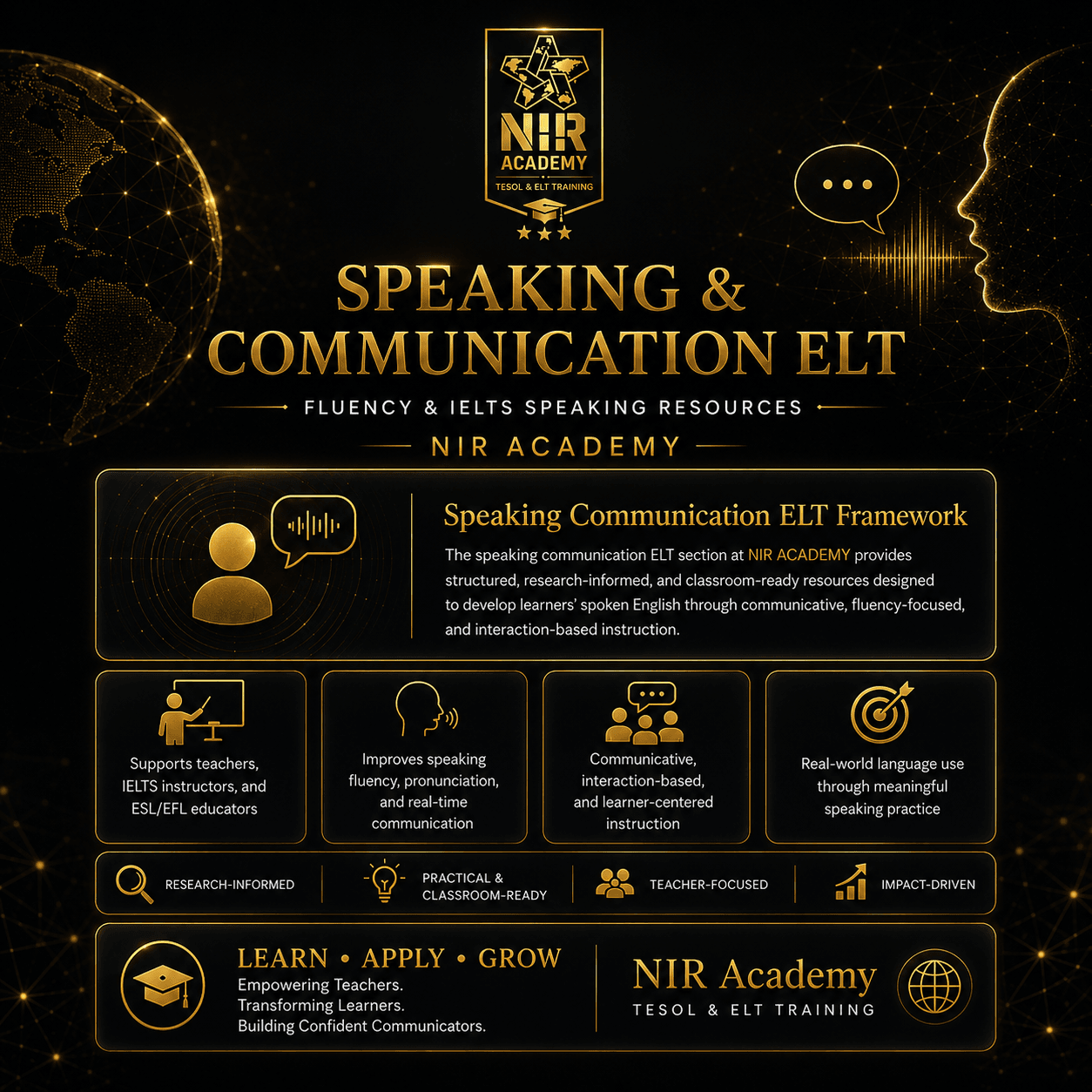
The Speaking Communication ELT section at NIR Academy provides structured, research-informed, and classroom-ready resources for developing learners’ spoken English through communicative, fluency-focused, and interaction-based instruction.
Speaking instruction here is not based on memorisation or isolated drills. It is built on meaningful interaction, structured speaking tasks, and learner-centered communication that reflects real-world language use — grounded in CLT and TBLT methodology.
Why Speaking Communication ELT Is Essential
Many English learners can understand grammar and vocabulary but struggle to communicate fluently and confidently. The gap between language knowledge and communicative ability is one of the central challenges in ELT — and structured speaking instruction is the solution.
5 Core Areas of Speaking Communication ELT
Each area addresses a distinct dimension of spoken English development — from fluency and interaction to pronunciation and IELTS-specific preparation.
Speaking Fluency Development in ELT
Speaking fluency is the ability to produce spoken language smoothly, naturally, and continuously without excessive hesitation or breakdown. Developing fluency requires deliberate practice through task types that prioritise flow and meaning over accuracy — giving learners the confidence and automaticity to communicate in real time.
Effective fluency development is grounded in TESOL research on communicative output and Nation’s fluency-focused instruction framework.
Classroom Communication Activities & Interaction Tasks
Effective speaking activities are communicative in purpose — learners speak because they need to exchange information, solve a problem, or complete a task, not simply to practice a language form. Task-Based Language Teaching provides the theoretical foundation for designing speaking activities that develop genuine interactional competence.
All activities are designed to increase learner speaking time and decrease teacher-dominated interaction, in line with British Council CLT research.
Pronunciation & Spoken Communication Clarity
Modern pronunciation instruction in ELT focuses on intelligibility rather than native-like accuracy. The goal is for learners to be clearly understood in real communicative contexts — not to eliminate accent, but to develop the phonological awareness and control needed for effective spoken communication. This approach is supported by research on English as a Lingua Franca (ELF) from Cambridge ELT.
Speaking Resources for ESL & EFL Classrooms — A1 to C1
Speaking resources are differentiated across learner levels — from foundation A1–A2 activities that build basic interaction confidence, to intermediate B1–B2 tasks that develop discourse management and spontaneous communication, to upper-intermediate C1 materials focused on extended spoken discourse and academic speaking. All activities follow the CEFR framework and communicative teaching principles.
Speaking Feedback & Oral Error Correction in ELT
Providing effective feedback on spoken English is one of the most nuanced skills in ELT. Teachers must decide when to correct, how to correct, and which errors to prioritise — balancing the need for accuracy with the communicative flow of interaction. Research distinguishes between different types of oral corrective feedback: recasts (implicit correction), elicitation (prompting self-correction), explicit correction, metalinguistic feedback (explaining the rule), and clarification requests. Each has different effects on learner uptake and is appropriate in different communicative contexts.
IELTS Speaking — Parts, Criteria & Strategies
IELTS Speaking is a face-to-face interview evaluating spoken English across four independent criteria. Effective IELTS speaking instruction goes beyond memorising phrases — it develops the genuine communicative fluency, discourse management, and lexical range that examiners evaluate.
The examiner asks questions about familiar topics: home, family, studies, hobbies, and daily life. Part 1 tests the ability to give extended, natural responses to personal questions without excessive hesitation. Teaching strategies focus on idea expansion, natural discourse markers, and reducing formulaic responses.
The candidate speaks for 1–2 minutes on a cue card topic. Part 2 evaluates the ability to organise and sustain extended spoken discourse. Teaching strategies include structured note-taking from the cue card, discourse organisation training, idea generation practice, and timed speaking rehearsal with criteria-referenced feedback.
The examiner leads a deeper discussion on abstract topics related to the Part 2 theme. Part 3 tests higher-order thinking, abstract language use, and the ability to discuss ideas, speculate, and give opinions. Teaching strategies include opinion expression frameworks, speculation language, and abstract topic discussion practice.
How NIR Academy Approaches Speaking Communication ELT
At NIR Academy, speaking instruction is grounded in research-informed methodology — not trends, memorisation techniques, or template-based IELTS coaching.
“Meaningful communication, not memorisation. Structured interaction and learner engagement. Balanced fluency and accuracy development. These are not design preferences — they are evidence-based principles of effective speaking instruction.
AI-Supported Speaking Practice & Instruction Tools
Artificial Intelligence is transforming speaking instruction in ELT — enabling learners to practice beyond class hours, receive immediate feedback, and develop fluency through simulated conversational interaction. At NIR Academy, every AI speaking tool is evaluated for communicative validity and IELTS alignment before being recommended.
AI-Generated Speaking Prompts
Generative AI creates topic-specific speaking prompts, conversation starters, discussion questions, and IELTS cue cards tailored to learner level and target band — supporting lesson planning and independent speaking practice.
AI Pronunciation Feedback
AI pronunciation tools analyse spoken output and provide feedback on stress, rhythm, connected speech, and intelligibility — supporting the development of phonological awareness without requiring continuous teacher monitoring.
Conversation Simulation & Role-Play AI
AI conversation partners simulate real-world interaction scenarios — job interviews, academic discussions, everyday communication — giving learners low-stakes speaking practice with immediate feedback outside classroom hours.
NIRVO AI — Speaking Intelligence
NIR Academy’s own speaking intelligence platform — evaluates spoken responses against IELTS speaking criteria, provides criteria-referenced coaching feedback on fluency, vocabulary, grammar, and pronunciation, and tracks learner progress over time.
Speaking Task Design with AI
AI tools support teachers in designing communicative speaking tasks, information gap activities, role-play scenarios, and discussion frameworks — reducing lesson preparation time while maintaining pedagogical quality and CLT alignment.
Ethical AI in Speaking ELT
Not all AI speaking tools align with communicative methodology or IELTS criteria. NIR Academy evaluates every tool for pedagogical appropriateness, communicative validity, and the preservation of teacher judgment in feedback and evaluation.
Speaking Resources by CEFR Level
Speaking instruction differs significantly across learner levels. Resources are designed to meet learners where they are — building from basic interaction confidence at A1 to extended academic discourse at C1.
Designed for Speaking-Focused ELT Professionals
From IELTS instructors developing speaking programmes to ESL teachers looking to increase classroom interaction — these resources support every speaking context in ELT.
Frequently Asked Questions — Speaking Communication ELT
Key questions about speaking instruction, IELTS speaking preparation, and the NIR Academy approach.
What is communicative speaking instruction in ELT?
How can teachers develop speaking fluency in ELT classrooms?
What are the IELTS Speaking band descriptors?
What is the difference between fluency and accuracy in speaking?
How can AI support speaking instruction in ELT?
How should IELTS Speaking Part 2 be taught?
What speaking activities work best for ESL and EFL classrooms?
Is pronunciation correction important in speaking ELT?
Explore the Full NIR Academy ELT Ecosystem
Speaking Communication ELT connects directly with assessment, AI tools, professional development, and research across the NIR Academy platform.
Build Fluency-Focused Speaking Instruction
Explore fluency-focused speaking activities, communicative classroom strategies, pronunciation support, IELTS speaking development, and AI-enhanced instructional tools — all designed for modern English language teachers.
Pedagogy First. AI Enhanced. Future Ready.
