

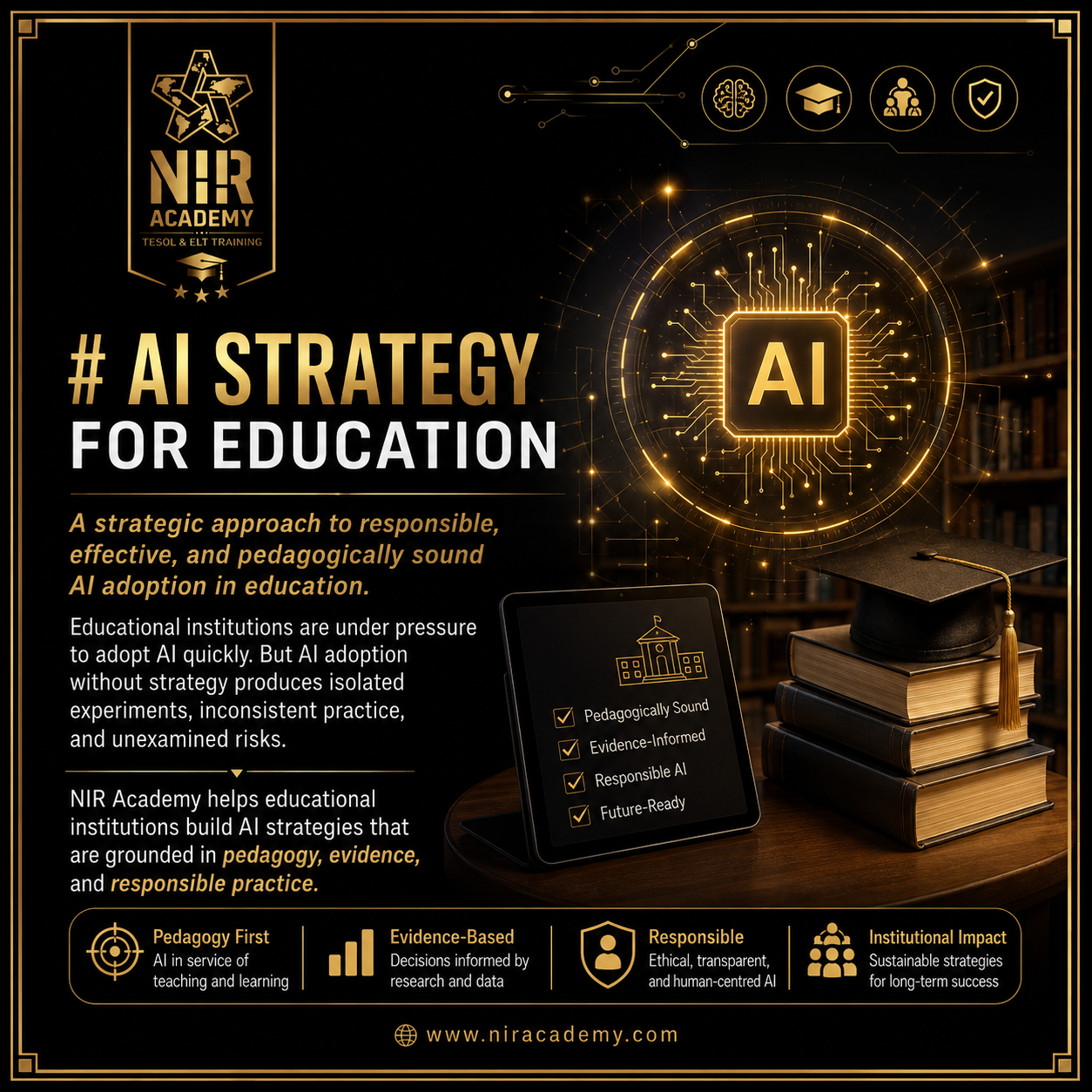
AI strategy for education — NIR Academy provides a 6-stage AI strategy framework for educational institutions. AI strategy for education — NIR Academy provides a strategic framework for responsible, pedagogically sound AI adoption in educational institutions. AI strategy for schools, universities, and ELT organisations covering pedagogy, teacher competency, assessment, AI governance, responsible AI, and implementation.
AI Strategy for Education
A strategic approach to responsible, effective, and pedagogically sound AI adoption in education.
Educational institutions are under pressure to adopt AI quickly. But AI adoption without strategy produces isolated experiments, inconsistent practice, and unexamined risks. NIR Academy helps educational institutions build AI strategies that are grounded in pedagogy, evidence, and responsible practice.
AI Is Not Just a Technology Decision
Most educational institutions approach AI adoption as a procurement or IT decision — selecting tools, running pilots, and hoping teachers will figure out the rest. This rarely produces sustainable or educationally sound outcomes.
Effective AI adoption in education requires strategic decisions across every dimension of institutional practice — a position supported by UNESCO’s global guidance on AI in education.
Institutions that purchase AI tools without addressing these questions typically find that adoption is uneven, teacher confidence is low, learner outcomes are unclear, and risks — particularly around assessment integrity and data — are unmanaged.
The question is not whether to use AI in education. The question is how to use it in a way that genuinely serves teaching, learning, and professional practice.
That requires a strategy — not just a subscription.
The NIR Academy AI Strategy Framework™
A six-stage strategic framework for responsible, pedagogically informed AI adoption in educational institutions — from initial understanding to continuous evaluation and improvement.
Understand
Develop a professional understanding of AI capabilities, limitations, and educational opportunities — grounded in evidence rather than marketing claims or fear.
Assess
Assess institutional readiness across infrastructure, staff competency, governance, policy, and current AI practice — identifying strengths, gaps, and priorities. See: Institutional AI Readiness Benchmark™
Define
Define educational priorities, AI principles, and strategic goals — establishing a shared institutional understanding of what responsible AI adoption means in your context.
Develop
Develop teacher competencies, institutional policies, and implementation capacity — building the professional foundation for sustainable AI integration. See: AITTC
Implement
Integrate AI into teaching, learning, and assessment responsibly — with clear guidance, professional support, and attention to learner agency, teacher judgment, and responsible AI principles.
Evaluate
Monitor impact, pedagogical quality, risks, and outcomes — using evidence to guide continuous improvement. See: NIR ELT Intelligence™
What an AI Strategy Should Cover
A sound AI strategy for education addresses six interconnected dimensions — not just technology procurement or teacher training in isolation.
Pedagogy
How AI supports — rather than replaces — effective teaching methodology, communicative learning, and professional instructional judgment across subjects and levels.
Teacher Competency
What AI literacy, pedagogical AI skills, and professional development teachers need to use AI effectively, critically, and responsibly. Grounded in the AI Teacher Competency Framework™.
Assessment
How AI changes what and how institutions assess — including academic integrity, AI-generated work, assessment validity, and the role of AI in formative and summative evaluation.
AI Governance
Institutional policies, guidelines, decision-making structures, and leadership responsibilities for AI adoption — ensuring consistent, principled, and accountable AI use.
Data & Responsible AI
Privacy, data protection, transparency, bias awareness, learner agency, and responsible AI principles — the ethical foundation of any institutional AI strategy.
Infrastructure & Access
Technical infrastructure, tool selection, access equity, and the practical conditions required for staff and learners to engage with AI effectively and safely.
For Educational Institutions
NIR Academy’s AI strategy support is designed for educational leaders and professional development teams moving from isolated AI use to institution-wide strategic practice.
School Leaders & Principals
Developing institutional AI policy, strategy, and governance — ensuring AI adoption is educationally principled and professionally managed.
Academic Directors
Aligning AI adoption with curriculum, assessment standards, and pedagogical priorities — maintaining academic quality through the transition.
Heads of Department
Translating institutional AI strategy into departmental practice — supporting teaching teams and maintaining subject-specific standards.
Teacher Development Teams
Designing and delivering AI professional development — building teacher confidence, competency, and professional judgment around AI integration.
For detailed institutional partnership and professional development — see NIR Academy for Institutions.
NIR Academy Tools for Every Strategic Stage
NIR Academy’s ecosystem of tools and resources supports institutions at every stage of the AI Strategy Framework — from initial readiness assessment to ongoing quality evaluation.
AI Teacher Readiness Assessment™
Measure current teacher AI readiness across six competency standards and four developmental levels.
ExploreAITTC — AI Teacher Training Course
Structured professional development in AI integration for English language teachers — grounded in six competency standards.
ExploreNIR ELT Intelligence™
Eight-dimension pedagogical framework for evaluating the quality of AI-supported ELT content and practice.
ExploreNIR OBSERVE™
AI-powered classroom observation and pedagogical feedback — supporting professional reflection and development.
ExploreNIREV AI & NIRAS AI
AI-powered assessment tools for evaluating learner performance and generating exam content responsibly.
ExploreAI in ELT Standards & Benchmark Report 2026
The professional competency and responsible AI standards framework — the foundation for institutional AI strategy in ELT.
ExploreWhy Institutions Work With NIR Academy
ELT & Educational Expertise
23+ years of professional experience in English Language Teaching, teacher education, curriculum design, assessment, and educational development.
Research-Informed
AI strategy frameworks grounded in applied linguistics, pedagogical research, AI in education scholarship, assessment theory, and responsible AI principles — not vendor claims.
Pedagogical Intelligence
NIR Academy evaluates AI from a pedagogical perspective — understanding what makes AI-supported teaching effective or ineffective in real ELT contexts.
Responsible AI Orientation
Human oversight, learner agency, teacher judgment, transparency, privacy, and ethical AI use are central to every aspect of NIR Academy’s AI strategy approach.
Connected Ecosystem
From readiness assessment to teacher training to quality evaluation — NIR Academy provides connected tools and resources that support the full AI strategy lifecycle.
Practical & Scalable
NIR Academy’s frameworks are designed for real institutional contexts — professional, adaptable, and focused on evidence-informed implementation rather than abstract theory.
Build an AI Strategy That Serves Education
Move beyond AI experimentation toward purposeful, responsible, and sustainable implementation. NIR Academy works with educational institutions to develop AI strategies grounded in pedagogy, evidence, and professional practice.
