

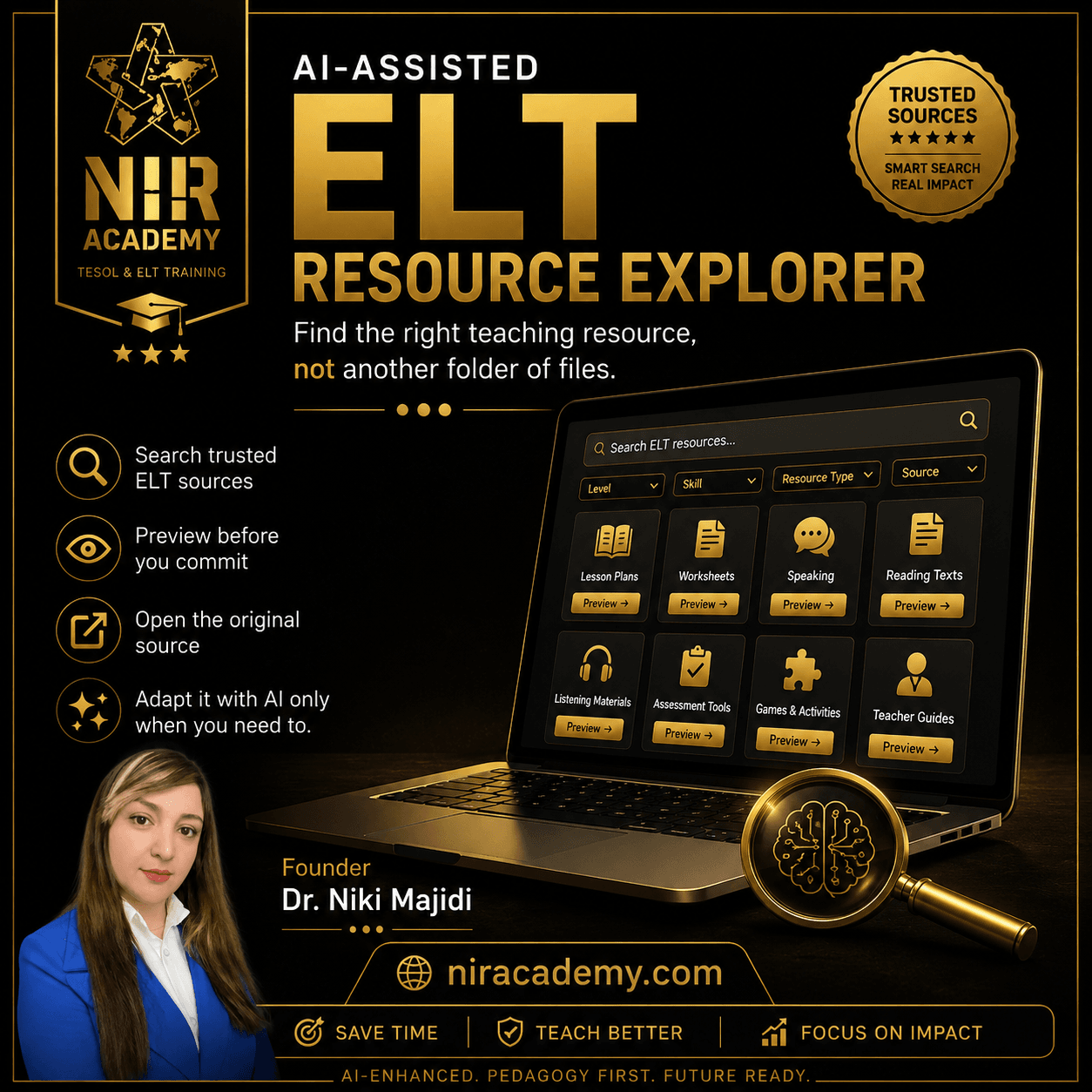
AI-Assisted ELT Resource Explorer
Find the right teaching resource, not another folder of files.
Search trusted ELT sources, preview before you commit, open the original — and adapt it with AI only when you need to.
Twelve ways in
Every card is a shelf. Pick one to see what’s catalogued there.
Try these searches
Click any card to search trusted ELT sources instantly.
Search results
We only catalogue what’s worth your time
How to Find High-Quality ELT Resources (Without Losing an Evening to It)
A practical framework for evaluating, filtering, and adapting English language teaching materials — for teachers who have forty minutes, not four hours, to plan a lesson.
Start with the outcome, not the format
Most resource searches go wrong at the first step: teachers search by format before they’ve pinned down what students should be able to do by the end of the lesson. A clear outcome narrows a search far more efficiently than a format alone.
Match the CEFR level to the actual class
Coursebook levels and CEFR descriptors don’t always line up. When previewing a resource, check the language sample itself — sentence length, tense range, vocabulary frequency — against what your learners can currently produce, not just the publisher’s label.
Preview before you commit
Before opening a resource with a class, check three things: the actual task types, the length against your available lesson time, and whether an answer key is included. This three-point check takes under a minute and prevents mismatches mid-lesson.
Adapt deliberately, not automatically
AI tools can simplify a text or draft comprehension questions in seconds — but speed isn’t the same as fit. Before adapting a resource, decide what specifically needs to change: vocabulary load, task complexity, length, or register. A targeted request produces a usable resource.
Read the complete guideRelated: Using AI Responsibly in ELT · Choosing Lesson Plans for Different CEFR Levels
Related topics
Common questions
Start Exploring ELT Resources Today
ELT teaching resources are essential for English teachers looking for high-quality lesson plans, worksheets, grammar activities, speaking tasks, and IELTS materials. NIR ELT Explorer helps educators discover trusted ELT teaching resources from leading publishers such as British Council, Cambridge, Oxford, BBC Learning English, TESOL, and IATEFL. Teachers can search, preview, compare, and explore classroom-ready materials while using AI-powered tools to adapt resources efficiently for different CEFR levels.
Knowledge base
Everything English Teachers Need to Know About ELT Resource Discovery
What Is NIR ELT Explorer?
NIR ELT Explorer is an AI-powered resource discovery tool built exclusively for English language teachers. Instead of searching across dozens of websites individually, teachers can enter a single query — such as “B1 speaking activities” or “IELTS Writing Task 2 lesson plan” — and receive a curated, ranked list of relevant materials from trusted ELT publishers, all in one place.
The tool searches a carefully selected catalogue of leading ELT sources, including British Council, Cambridge English, Oxford ELT, BBC Learning English, TESOL, IATEFL, and more. Artificial intelligence then analyses and ranks the results, helping teachers find what they need quickly — without spending hours browsing individual websites.
NIR ELT Explorer is part of the NIR Academy ecosystem, a platform dedicated to AI-powered English language teaching professional development.
How to Find ELT Resources Efficiently
Finding the right teaching resource in less time requires a clear, repeatable approach. Most resource searches go wrong at the first step: teachers search by format before they have identified what learners should be able to do by the end of the lesson.
Start with a clear learning outcome
A specific outcome — such as “students can describe trends in a graph using appropriate vocabulary at B2 level” — narrows any search far more effectively than a format alone. This one step can reduce search time significantly and improve the relevance of results.
Match resources to your learners’ CEFR level
CEFR levels across different publishers are not always consistent. A resource labelled B1 by one publisher may sit closer to A2+ in practice. When reviewing a resource, check the actual language sample — sentence length, vocabulary frequency, and grammatical range — against what your specific class can currently produce.
Preview before you use in class
A title and thumbnail rarely tell you enough. Before committing classroom time to any resource, check three things: the actual task types, the estimated duration against your available lesson time, and whether an answer key or teacher notes are included. This three-point check takes under a minute and prevents the far more common problem of discovering a mismatch mid-lesson.
Adapt deliberately, not automatically
AI tools can simplify a text, generate comprehension questions, or create a worksheet in seconds — but speed is not the same as fit. Before adapting any resource, decide exactly what needs to change: vocabulary load, task complexity, length, or register. A targeted adaptation request produces a classroom-ready result; a vague one produces more editing work than starting from scratch.
Trusted ELT Sources We Search
NIR ELT Explorer searches a curated set of twenty trusted ELT sources. Every source in this list has been selected for editorial quality, CEFR accuracy, and proven classroom usefulness.
British Council
British Council and TeachingEnglish offer one of the largest free libraries of lesson plans, skills activities, and teacher development resources available online. Materials are peer-reviewed and aligned to CEFR descriptors.
Cambridge English & Oxford ELT
Cambridge English provides exam preparation resources, assessment tools, and classroom materials grounded in the Cambridge English Corpus. Oxford ELT offers a broad range of teacher resources, methodology guides, and supplementary materials across all levels and age groups.
BBC Learning English
BBC Learning English is one of the most widely used authentic listening resources in ELT. Its short audio and video episodes — with transcripts and vocabulary support — make it suitable for classroom use at B1 level and above.
TESOL & IATEFL
TESOL International Association and IATEFL provide access to professional development articles, research-informed teaching materials, and resources for teacher educators. These sources are particularly useful for experienced practitioners looking for evidence-based classroom approaches.
Additional sources
The full catalogue also includes Pearson English, Macmillan English, OneStopEnglish, National Geographic Learning, ELLLO, ESL Brains, Randall’s ESL Lab, EnglishClub, Breaking News English, TEFL.net, UsingEnglish, and IELTS.org — covering exam preparation, authentic materials, and skills-based activities across all CEFR levels.
How AI Improves ELT Resource Discovery
Traditional resource discovery requires a teacher to visit multiple websites, evaluate each result manually, and make individual judgements about relevance, level, and classroom fit. This process can take anywhere from twenty minutes to over an hour for a single lesson.
NIR ELT Explorer replaces this process with AI-powered search and ranking technology. When a teacher enters a query, the system retrieves results from across all trusted sources simultaneously, then uses artificial intelligence to rank and analyse each result — evaluating relevance to the query, source credibility, and likely classroom usefulness.
Importantly, the AI never invents information. If a CEFR level or resource type is not explicitly stated in the source material, it will not be inferred or guessed. This commitment to accuracy means teachers can trust what they see, rather than having to verify every detail independently.
The result is a shortlist of three to five ranked resources — with a plain-language explanation of why each one was selected — delivered in seconds rather than hours.
ELT Resource Types Explained
Understanding the difference between resource types helps teachers search more precisely and evaluate results more quickly.
Lesson Plans
A complete lesson plan includes a learning objective, staged tasks, timing guidance, and usually an answer key or teacher notes. Lesson plans are the most complete resource type and require the least additional preparation, but they must be checked carefully for level and timing fit before use.
Speaking & Listening Activities
Speaking activities range from structured drills and guided dialogues to freer discussion tasks and roleplay scenarios. Listening activities typically include an audio or video source, pre-listening prediction tasks, and post-listening comprehension or language focus tasks. Both types are most effective when the task — not just the topic — is matched to learners’ current productive level.
Grammar & Vocabulary Resources
Grammar resources vary widely in approach, from explicit rule explanation and controlled practice to communicative tasks that embed target structures in meaningful contexts. Vocabulary resources similarly range from decontextualised word lists to story-based or lexical chunk approaches. For most classes, resources that contextualise language within realistic tasks produce more durable learning outcomes.
IELTS & Exam Preparation
IELTS preparation materials include task-specific practice (Writing Task 1 and Task 2, Speaking Part 2 long turns, Academic Reading passage work), band descriptor analysis, and timed test simulations. The most effective exam preparation resources balance test strategy with genuine language development — not just repeated test practice.
Teacher Development Resources
Professional development resources for English teachers include methodology articles, classroom observation frameworks, reflective practice tools, and training course materials. These are particularly relevant for teachers pursuing qualifications such as AI-integrated teacher training or continuing professional development in ELT.
Continue Your AI Teaching Journey
NIR ELT Explorer is one part of a broader ecosystem of AI-powered tools and training designed specifically for English language teaching professionals. If you found this tool useful, these resources from NIR Academy are the logical next step.
