Fluent output is not the same as pedagogically sound output. An AI assistant can generate a grammatically coherent, logically structured, professionally formatted lesson plan that nonetheless fails to meet the learning objectives of a specific group of learners at a specific CEFR level.
This is the central challenge of AI in English language teaching — and the reason that AI teaching mistakes are not primarily technological failures. They are professional ones. They happen when teachers mistake capability for quality, speed for effectiveness, and output for pedagogy.
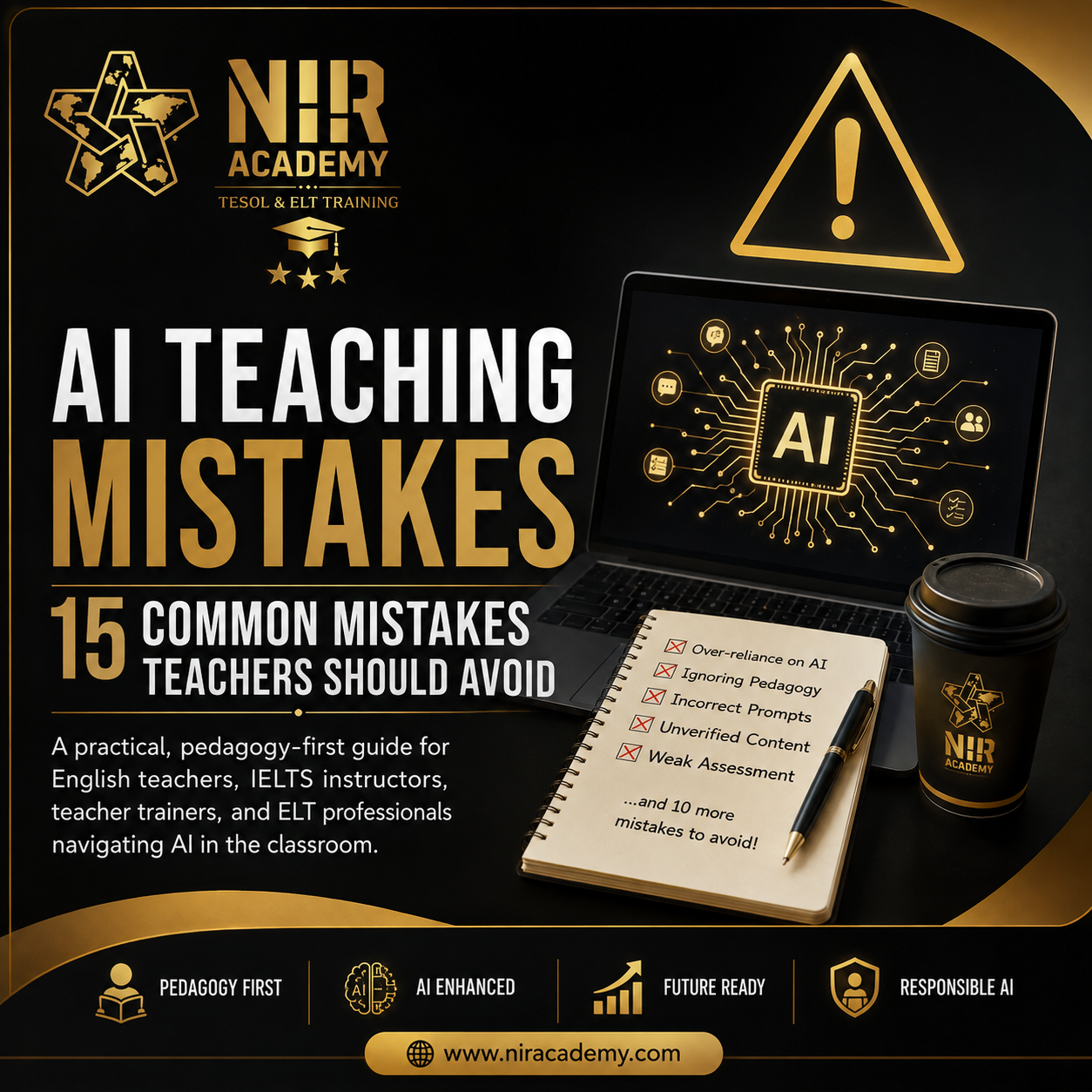
The 15 mistakes below are the most common patterns NIR Academy observes across ELT practice. Each one is recognisable, understandable — and avoidable with the right professional framework.
Why AI Teaching Mistakes Matter
AI tools for teaching are not neutral. They reflect the data they were trained on, the assumptions built into their design, and the limitations of language models that generate plausible text rather than pedagogically informed instruction. When teachers use AI without a critical professional framework, these limitations pass directly into classrooms — into the materials learners receive, the feedback they read, and the assessments they sit.
The stakes are particularly high in ELT. Language learning is a slow, non-linear process shaped by communicative interaction, affective conditions, and incremental exposure to comprehensible input. An AI-generated reading text at the wrong CEFR level is not merely unhelpful — it actively works against the acquisition process. An AI-written piece of writing feedback that targets the wrong construct does not just fail to improve learner writing; it teaches the learner something incorrect about what good writing is.
Understanding common AI teaching mistakes is therefore not about technology literacy. It is about protecting the quality of professional practice in ELT.
NIR Academy’s position: AI can make teaching faster. It does not automatically make teaching better. The difference lies entirely in the professional judgement of the teacher — the capacity to evaluate, adapt, and apply AI output within a sound pedagogical framework. This is what
Pedagogy First. AI Enhanced. Future Ready. means in practice.
15 Common AI Teaching Mistakes
These mistakes are not signs of poor teaching. Most of them are understandable responses to the novelty of AI tools, time pressure, and the absence of structured professional guidance. What matters is recognising them — and knowing the better practice that replaces each one.
What it is
Opening an AI tool and typing a topic — “B2 lesson on climate change” — without first deciding what learners should be able to do by the end of the lesson.
Why it matters
AI generates content, not outcomes. Without a clear objective, the lesson becomes a collection of activities around a topic rather than a structured learning experience.
Better practiceDefine the learning objective first. “By the end of this lesson, learners will be able to discuss causes and effects of climate change using passive constructions at B2 level.” Then prompt AI from that objective — not from the topic.
What it is
Accepting AI-generated grammar explanations, CEFR level labels, or teaching suggestions as accurate without professional verification.
Why it matters
AI models generate plausible text, not verified pedagogy. A grammar rule explanation may be broadly correct but subtly inaccurate in ways that mislead learners at a critical stage of acquisition — a risk documented in
TESOL’s professional standards for language teachers.
Better practiceTreat all AI output as a first draft requiring professional review. Verify grammar explanations against authoritative ELT references, including the
Council of Europe’s CEFR Companion Volume. Check CEFR level claims using the
NIR CEFR Checker or the Council of Europe descriptors.
What it is
Taking an AI lesson plan and using it as written, without considering the specific learner group, institutional context, prior learning, or actual classroom dynamics.
Why it matters
AI generates generic plans for imaginary learners. Real lessons require professional adaptation — adjusting timing, scaffolding, sequence, and task difficulty for the specific people in the room.
Better practiceUse AI lesson plans as structural frameworks, not finished products. The teacher’s professional contribution is in the adaptation — adjusting for learner needs, prior knowledge, and the actual conditions of the lesson.
What it is
Using AI-generated texts, tasks, or assessments without verifying that vocabulary range, grammatical complexity, and task demands match the learner’s actual proficiency level.
Why it matters
General AI tools apply CEFR labels inconsistently. A text labelled B1 may contain C1 lexical items or cognitive demands far beyond the stated level. Level mismatch directly undermines comprehensible input and task achievability.
Better practiceAlways verify CEFR alignment independently. Specify the target level in your prompt with concrete criteria — not just a letter — and check the output against descriptors from the CEFR Companion Volume.
What it is
Using AI-generated reading passages, example sentences, or cultural references without verifying that the content is factually accurate and linguistically appropriate.
Why it matters
AI models hallucinate. Confident, fluent text can contain factual errors, dated information, cultural inaccuracies, or subtle linguistic problems — particularly with idiomatic expressions and register.
Better practiceFact-check content before using it with learners. Pay particular attention to named references, statistics, and cultural examples. Use AI for structure; verify substance independently.
What it is
Deferring to AI recommendations about teaching approaches, sequencing, or assessment without applying professional ELT expertise to evaluate whether those recommendations are sound.
Why it matters
AI does not know the learner. It cannot observe engagement, detect confusion, or adapt in real time to what is actually happening in the room. Teacher judgement is not a bottleneck in AI-assisted teaching — it is the quality standard.
Better practiceAI informs professional decision-making; it does not replace it. Use AI to generate options, not to make instructional decisions. The teacher evaluates, selects, adapts, and teaches.
What it is
Designing learning tasks so that AI does the cognitive work — editing, drafting, or generating responses — that learners need to do themselves to develop language competence.
Why it matters
Language acquisition requires learner production, error, and correction. When AI produces the output and learners only read or submit it, the learning process is bypassed rather than supported.
Better practiceDesign tasks where AI is a resource for learners, not a substitute for their production. Learners compare AI output with their own, analyse differences, and reflect on what they notice — maintaining cognitive engagement throughout.
What it is
Defaulting to AI for every teaching preparation task — even those where human judgement, creativity, or direct knowledge of the learner group is far more effective.
Why it matters
Over-reliance on AI reduces the deliberate instructional decision-making that defines expert teaching. Not every task benefits from AI involvement, and some are actively weakened by it.
Better practiceIdentify where AI adds genuine value — materials generation, differentiation, formative feedback at scale — and where it does not. Use AI selectively and purposefully, not by default.
What it is
Believing that because AI can generate different content for different learners, it is automatically providing personalised instruction of educational value.
Why it matters
AI personalisation is content differentiation based on input parameters — not pedagogically informed responsiveness to how a specific learner learns, what they need emotionally, or where they are in their acquisition journey.
Better practiceUse AI-generated differentiated content as one input into personalised instruction. The teacher’s knowledge of the individual learner — their strengths, anxieties, goals, and progress — remains the foundation of genuine personalisation.
What it is
Deploying AI-generated quiz items, test tasks, or rubrics directly in formative or summative assessment without verifying that they actually measure the intended construct.
Why it matters
Assessment validity is the most consequential issue in AI-assisted teaching. A test item that looks professional but measures the wrong thing produces data that misleads teachers, institutions, and learners about actual competence.
Better practiceEvaluate every AI assessment item against the construct it is meant to measure. Check distractor plausibility in multiple-choice items, verify task instructions are unambiguous, and ensure CEFR calibration is accurate before use.
What it is
Passing AI-generated feedback on learner writing to students without reviewing whether it targets the right dimension of their writing development at the right level of specificity.
Why it matters
AI writing feedback frequently focuses on surface-level accuracy at the expense of coherence, task achievement, or idea development — the dimensions that matter most for communicative writing competence. Passing on unchecked AI feedback can actively mislead learners about what good writing involves.
Better practiceReview AI feedback against the rubric or criteria you are actually using. Check that it addresses the most important writing development priority for that learner — not just what the AI noticed first.
What it is
Prompting AI with minimal context — “make a grammar exercise on present perfect” — and expecting pedagogically appropriate output without providing the learner level, task type, learning objective, or instructional context.
Why it matters
AI output quality is directly proportional to prompt quality. A generic prompt produces a generic output that may be technically adequate but is rarely pedagogically purposeful for the specific class it is intended for.
Better practiceBuild prompts that specify CEFR level, learning objective, learner context, task type, and intended use. Prompt design is a professional skill — developing it is part of AI literacy for teachers.
What it is
Submitting learner writing samples, personal data, or assessment responses to commercial AI platforms without understanding what data is retained, processed, or used for model training.
Why it matters
Learner data is personal data. Submitting it to AI systems without appropriate consent, data governance, or GDPR compliance is a professional and legal obligation — not just an ethical preference. This is especially critical when working with minors.
Better practiceKnow the data policies of every AI tool you use with learner data. Never submit identifiable learner work to a platform whose data retention and processing practices you have not verified. Anonymise where possible.
What it is
Evaluating AI integration by how much time it saves, how many materials it produces, or how quickly lessons can be prepared — rather than whether learner outcomes have improved.
Why it matters
Productivity is a means, not an end. A teacher who creates 30 AI-generated worksheets in an hour has not necessarily improved learning. Time saved is only professionally valuable if it is redirected toward higher-quality instructional work.
Better practiceMeasure AI integration by educational outcomes: learner progress, engagement quality, assessment performance, and communicative development. Time savings are valuable only when they serve better teaching.
What it is
Incorporating AI into teaching practice without ever stepping back to evaluate whether it is improving instruction, creating new dependencies, or subtly shifting professional decision-making in unhelpful directions.
Why it matters
Unreflective AI use hardens into habit. Without regular professional reflection, the AI teaching mistakes above become default practice — invisible precisely because they are routine.
Better practiceBuild AI reflection into professional development. Ask regularly: Is this making my teaching better? What have I stopped doing that I should still be doing? Where is AI serving pedagogy, and where has it started to replace it?
From AI Mistakes to Better Practice
Avoiding AI teaching mistakes is not about using AI less. It is about using it within a professional framework that keeps pedagogy — not technology — in the lead. NIR Academy’s seven-step framework for responsible AI integration in ELT:
Pedagogy
Start with the learning objective, not the tool
Purpose
Identify what AI can specifically contribute here
Prompt
Build a context-rich, specific prompt
Evaluate
Review output against pedagogical criteria
Adapt
Modify for your specific learner group
Teach
Apply professional expertise in the classroom
Reflect
Did AI improve outcomes? What to do differently?
This framework applies to every AI application in ELT — lesson planning, materials creation, assessment design, writing feedback, and speaking task development. It keeps the teacher as the professional decision-maker at every stage, with AI serving a clearly defined supporting role.
Frequently Asked Questions
What are the most common AI teaching mistakes?
The most common AI teaching mistakes are using AI before defining a learning objective, accepting AI output without pedagogical evaluation, copying AI-generated lesson plans without adaptation, ignoring CEFR level calibration, and using AI to replace rather than support teacher judgement. These mistakes share a common cause: treating AI capability as a substitute for professional expertise.
Can teachers trust AI-generated lesson plans?
AI-generated lesson plans can provide a useful structural starting point, but they require professional evaluation before classroom use. An AI can produce a structurally plausible lesson plan that is poorly sequenced for a specific learner group, misaligned with their prior knowledge, or based on pedagogically outdated approaches. Teacher review is professional standard, not optional extra work.
How should teachers evaluate AI-generated materials?
Check AI-generated materials against the specific learning objective, CEFR level descriptors, factual accuracy, and task design logic. Ask whether the material actually requires learners to produce language, whether it fits the specific group, and whether the difficulty is appropriate. The ten-question AI Teaching Mistake Test above provides a practical evaluation framework.
Can AI replace English teachers?
No. AI can automate certain tasks — generating materials, providing formative feedback, creating differentiated practice exercises — but it cannot replicate the relational, adaptive, and motivational dimensions of skilled teaching. Effective AI use in ELT enhances what teachers do; it does not substitute for the professional expertise that makes teaching effective.
Should teachers use AI for assessment?
AI can support assessment by generating practice test items, formatting assessment instruments, and providing first-draft feedback on written work. However, assessment validity requires professional verification that AI tools cannot provide on their own. Every AI-generated assessment item needs to be checked for construct validity, CEFR alignment, and distractor quality before use with learners.
How can teachers use AI responsibly in ELT?
Responsible AI use in ELT involves verifying data privacy and GDPR compliance for any AI tool used with learner data, maintaining transparency with learners about AI involvement, evaluating AI outputs against pedagogical criteria before use, and ensuring that AI use develops rather than replaces learner language competence. NIR Academy’s
AI Quality Assurance Framework provides a structured approach to responsible AI integration.
How can teachers avoid overusing AI in their teaching?
Develop a clear sense of where AI genuinely adds value and where human professional expertise is more effective. Use AI selectively — for tasks that genuinely benefit from its capabilities — rather than by default. Build regular professional reflection into your practice: ask whether AI is improving learning outcomes, or simply speeding up output generation. The seven-step framework in this guide (Pedagogy → Purpose → Prompt → Evaluate → Adapt → Teach → Reflect) helps maintain this balance.
NIR Academy Perspective
NIR Academy’s approach to AI in English Language Teaching is grounded in the philosophy that pedagogy governs technology — not the reverse. The 15 AI teaching mistakes above are not failures of technology; they are failures of professional framework. They happen when AI adoption outpaces AI competency — when teachers have access to tools before they have the pedagogical framework to use them well.
Developing that framework is the core purpose of NIR Academy’s work. The following resources provide the professional structures that help teachers move from AI teaching mistakes to informed, responsible, pedagogy-first practice.
Philosophy
NIR Academy’s guiding educational philosophy — the principle that connects all the resources below and provides the framework for responsible AI use in ELT.
Professional Development
Structured professional development that develops the AI literacy, pedagogical judgement, and responsible AI competencies that prevent the mistakes above from becoming habits.
Intelligence Framework
The pedagogical quality framework that evaluates AI-supported teaching across eight professional dimensions — providing the standard against which AI output should be measured.
Competency Standard
Defines the professional competencies that future-ready ELT teachers need — from prompt literacy and output evaluation to responsible AI practice and assessment literacy.
Research
NIR Academy’s annual research framework for measuring AI readiness in ELT — including the adoption-competency gap that underlies most of the mistakes in this guide.
Resource Hub
NIR Academy’s primary resource for teachers, trainers, and institutions navigating AI integration in English language teaching.
Don’t ask only what AI can do for your teaching.
Ask what it should do.
The difference between those two questions is the difference between AI teaching mistakes and AI teaching wisdom. Pedagogy First. AI Enhanced. Future Ready.