

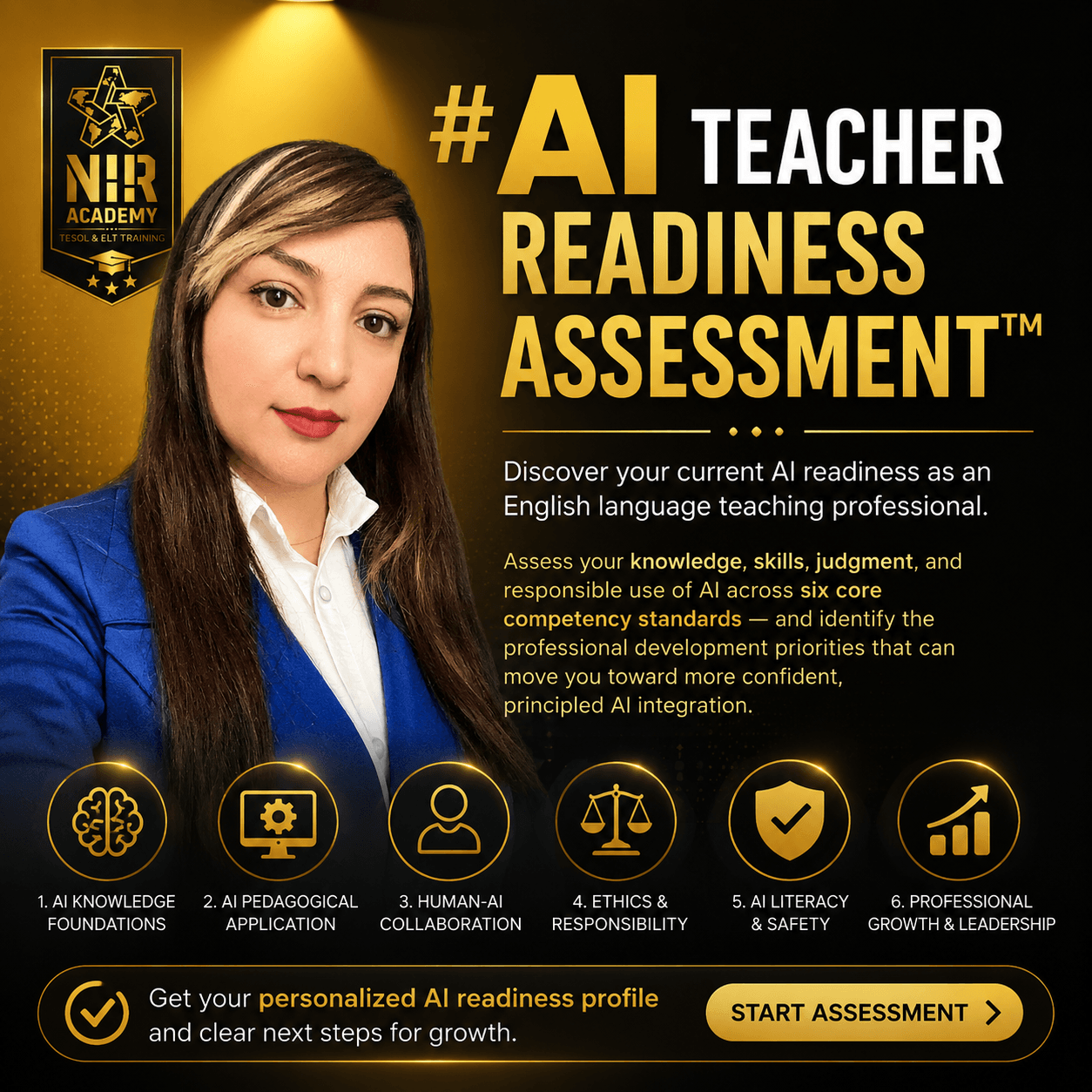
AI Teacher Readiness Assessment™ by NIR Academy — a research-informed professional self-assessment for English language teachers to evaluate AI readiness across six competency standards and four developmental AI Teacher Readiness levels.
AI Teacher Readiness Assessment™
Discover your current AI readiness as an English language teaching professional.
Assess your knowledge, skills, judgment, and responsible use of AI across six core competency standards — and identify the professional development priorities that can move you toward more confident, principled AI integration.
What Does the Assessment Measure?
AI readiness in English language teaching is more than knowing how to use AI tools. The assessment evaluates six professional competency areas — because tool familiarity alone does not indicate professional AI readiness.
AI Literacy
Understanding of how AI systems function, their capabilities, limitations, and where their outputs may reflect bias or inaccuracy.
Pedagogical AI Integration
Ability to connect AI tools to established ELT methodologies — CLT, TBLT, PPP — while maintaining teacher agency and instructional coherence.
Prompt & Interaction Skills
Skill in framing instructional prompts that yield CEFR-calibrated, pedagogically appropriate outputs from AI systems.
AI Output Evaluation
Ability to assess AI-generated content for accuracy, linguistic appropriateness, cultural sensitivity, level suitability, and hallucination.
AI Assessment Literacy
Using AI in assessment contexts — item generation, automated feedback — without compromising validity, reliability, or positive washback.
Responsible AI Practice
Upholding data privacy, transparency, academic integrity, and equitable access in all AI-related professional decisions and classroom use.
Four Levels of AI Teacher Readiness
The assessment maps your responses against four developmental levels. These levels describe professional readiness — not rankings of teacher quality, intelligence, or classroom effectiveness.
AI-Aware Teacher
Recognises the relevance of AI to ELT but has not yet integrated it systematically into professional practice.
- Can identify AI tools relevant to language teaching
- Understands basic ethical concerns conceptually
- Has begun exploring AI tool documentation or demos
- Development focus: AI literacy and foundational use
AI-Assisted Teacher
Uses AI for bounded professional tasks — lesson preparation, materials development, vocabulary activities — with consistent teacher review.
- Uses AI regularly for task-specific preparation
- Applies basic prompt strategies to improve outputs
- Reviews and edits AI outputs before classroom use
- Development focus: pedagogical integration and prompting
AI-Integrated Teacher
Integrates AI across planning, teaching, feedback, and assessment within a coherent pedagogical framework and methodological approach.
- Selects AI tools based on pedagogical fit
- Scaffolds learner AI literacy alongside language skills
- Guides peers in principled AI tool selection
- Development focus: assessment literacy and leadership
AI-Innovative Teacher
Designs, evaluates, leads, and contributes to principled AI integration at a professional or institutional level.
- Develops and shares AI integration frameworks
- Evaluates AI tools against research criteria
- Contributes to institutional policy and professional communities
- Development focus: research, contribution, and mentoring
How the Assessment Works
Respond
Answer scenario-based and professional-practice questions about your current AI use, decision-making, and pedagogical judgments.
~15–20 minutes · ELT-specific scenarios
Evaluate
Responses are mapped against the six NIR Academy AI in ELT Competency Standards and four teacher readiness levels.
Research-informed · Not AI-scored automatically
Profile
Receive an AI Teacher Readiness Profile showing your strongest and developing competency areas across all six standards.
Visual profile · Dimension breakdown
Develop
Receive practical recommendations for your next stage of professional development, connected to relevant NIR Academy resources.
Actionable · Resource-linked
Your AI-in-ELT Competency Profile
The assessment produces a six-dimension profile — showing not just an overall level but where you are strongest and where development would be most valuable.
AI Literacy
Evaluates your understanding of AI systems, outputs, limitations, bias, and appropriate use cases in ELT.
Pedagogical Integration
Evaluates how you connect AI tools to methodology, maintain teacher agency, and design AI-informed lessons.
Prompt & Interaction Skills
Evaluates how effectively you frame AI requests to produce CEFR-calibrated, pedagogically appropriate outputs.
AI Output Evaluation
Evaluates your ability to review AI-generated content for accuracy, bias, cultural suitability, and level appropriateness.
AI Assessment Literacy
Evaluates your approach to using AI in feedback design, item generation, and maintaining assessment validity.
Responsible AI Practice
Evaluates how you address data privacy, transparency, academic integrity, and equitable access in AI use.
Example Assessment Result
The following illustrates how an assessment result might be presented. All details are fictional and for demonstration purposes only.
Recommended Development Priorities
Strengthen pedagogical AI integration — connect AI tools to established CLT and TBLT frameworks.
Develop CEFR-aware prompt design skills — frame AI requests with learner level and language goals specified.
Build structured AI output evaluation habits — review all AI-generated content before classroom use.
Develop AI assessment literacy — design tasks that retain pedagogical validity in AI-available contexts.
What Your Readiness Level Means
Each level describes where you currently are in your AI professional development journey — not how good a teacher you are. Teachers at every level may also show different readiness across different competency domains.
AI-Aware Teacher
Build foundational AI literacy. Explore ELT-specific AI tools. Understand what AI can and cannot do in language teaching contexts.
AI-Assisted Teacher
Connect AI use to established ELT methodology. Develop CEFR-aware prompting. Build structured output evaluation habits.
AI-Integrated Teacher
Deepen AI assessment literacy. Scaffold learner AI literacy. Begin contributing to professional communities and institutional practice.
AI-Innovative Teacher
Lead and contribute to field-level knowledge. Evaluate tools against research evidence. Design frameworks that others can use.
Turn Your Assessment Into a Development Plan
Based on your competency profile, the assessment connects you to relevant NIR Academy professional development resources. These are recommendations — not prerequisites for taking the assessment.
A conversational AI methodology coach trained on TEFL knowledge — ideal for building AI literacy in an ELT-specific context.
NIR Academy’s structured programme mapping directly to the six AI in ELT Competency Standards — for teachers at any readiness level.
A classroom simulation environment for practising AI-informed instructional scenarios with AI-generated student profiles.
Assessment intelligence and exam authoring tools that build practical competency in Standard 5 — AI Assessment Literacy.
The pedagogical evaluation framework for assessing whether AI-generated teaching materials are sound — complementing Standard 4.
Why Assess AI Readiness?
Make Your Starting Point Visible
Professional development planning begins with an honest picture of where you are now. The assessment replaces guesswork with a structured, ELT-specific readiness profile.
Identify Specific Gaps
Move beyond vague ideas of being “good with AI.” The six-dimension profile pinpoints exactly which competency areas would benefit most from development.
Plan Professional Development
Focus development effort on the competencies that matter most for your teaching context — not a generic AI course that may not address your actual gaps.
Track Professional Growth
Repeat the assessment periodically — after completing a development programme or following deliberate practice — to reflect on how your readiness has developed.
Built on the NIR Academy AI-in-ELT Framework
The AI Teacher Readiness Assessment™ is not a standalone tool. It operationalises the NIR Academy competency framework for individual professional reflection.
Defines the six professional competency standards and four teacher readiness levels that structure the assessment.
Helps individual teachers map their current readiness against the framework — producing a personalised competency profile and development recommendations.
Evaluates the pedagogical quality of specific AI-generated ELT materials — addresses content rather than the individual teacher’s professional competency.
Provides structured professional development across all six competency standards — aligned to the assessment profile.
Important Note on Assessment & Validity
Responsible professional assessment requires transparency about what an instrument is — and is not.
What It Is
The AI Teacher Readiness Assessment™ is a research-informed professional self-assessment designed to support structured reflection and professional development planning.
It is grounded in the NIR Academy AI in ELT Competency Framework, which draws on established ELT pedagogy, AI literacy research, and teacher education principles — including UNESCO AI ethics guidance and Council of Europe CEFR frameworks.
Questions About the Assessment
Find Your AI Teacher Readiness Level
Understand your current strengths, identify your development priorities, and build a more principled approach to AI in English language teaching.
Research-informed · Professional self-assessment · Not a certification exam · ELT-specific
