

What is the AI Teacher Training Course (AITTC)?
The AI Teacher Training Course (AITTC) is a professional development course that helps English teachers develop the knowledge and practical skills needed to use AI effectively and responsibly. The course focuses on AI literacy, teacher judgment, pedagogical decision-making, classroom applications, and responsible AI use in English language teaching.
AI Teacher Training Course
for English Language Educators
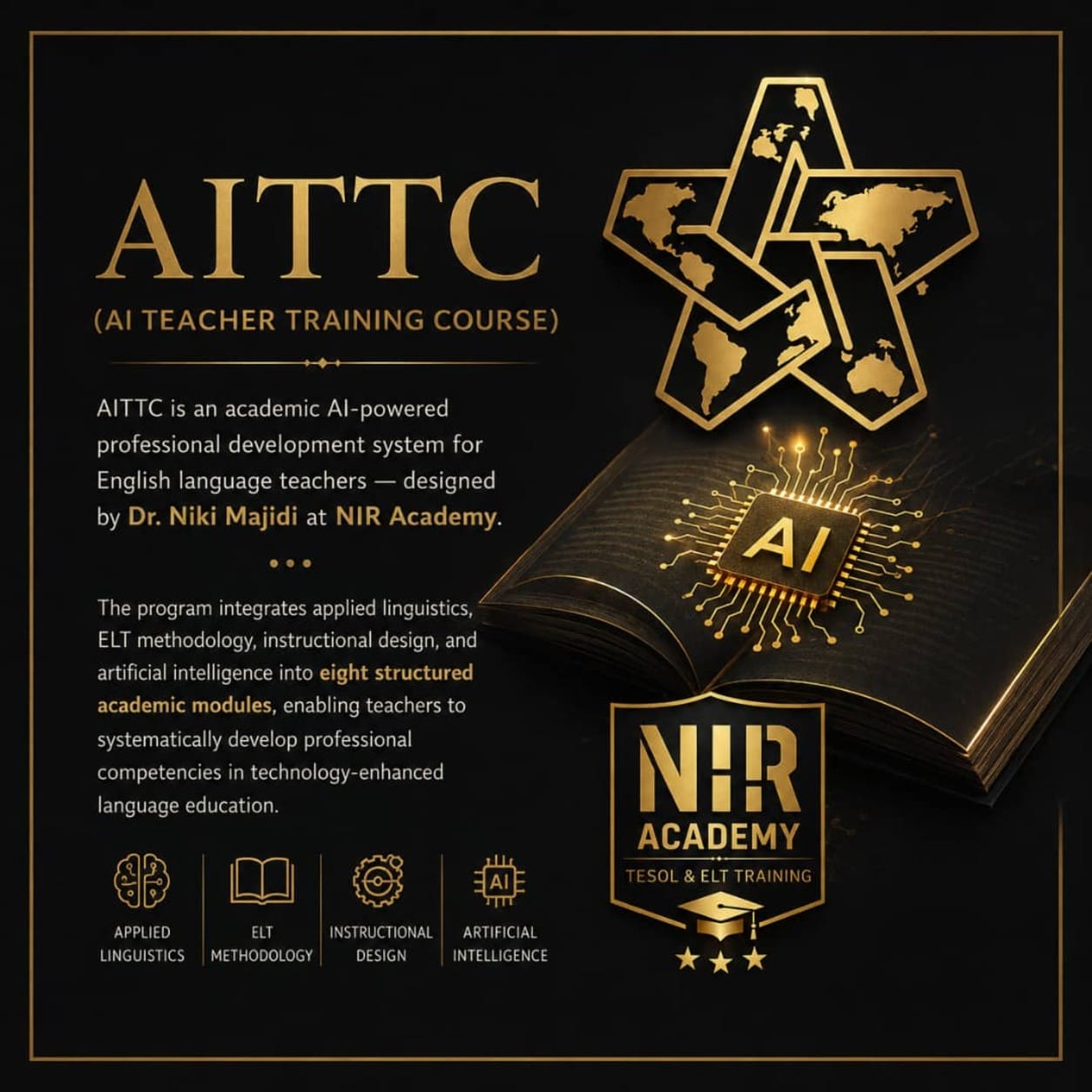
AITTC (AI Teacher Training Course) is an academic AI-powered professional development system for English language teachers — designed by Dr. Niki Majidi at NIR Academy.
The program integrates applied linguistics, ELT methodology, instructional design, and artificial intelligence into eight structured academic modules, enabling teachers to systematically develop professional competencies in technology-enhanced language education.
AITTC vs Conventional Teacher Training Programs
AITTC responds to a critical gap in ELT professional development — the absence of a structured, academic framework that integrates AI into teacher education without sacrificing pedagogical rigour.
A Structured Academic System for AI-Enhanced Teacher Education
AITTC is a structured, cloud-based professional development system for English language teacher education. Unlike workshop-based or observation-led training programs, AITTC is built as an academic system — with a coherent theoretical framework, sequenced module progression, and measurable professional learning outcomes.
The program is designed to bridge the gap between theoretical knowledge and classroom implementation through AI-supported workflows — enabling teachers to move from understanding ELT principles to applying them effectively within modern, technology-enhanced educational environments.
AITTC integrates three core domains rarely brought together in conventional ELT professional development:
8 Academic Modules — AITTC Course Structure
Each module addresses a distinct domain of ELT professional competence — from foundational theory to applied AI integration. Modules are sequenced to build from theoretical understanding to practical classroom implementation.
This foundational module examines the critical distinction between linguistic competence and pedagogical competence — establishing that effective language teaching requires far more than fluency in English. Teachers develop a principled understanding of what professional teaching expertise consists of, grounded in SLA theory, teacher cognition research, and reflective practice frameworks.
This module provides a comprehensive survey of major language teaching methodologies — from historical approaches to contemporary CLT and TBLT frameworks — and examines how each can be practically integrated with AI-assisted instructional design. Teachers develop the ability to make principled, methodologically informed decisions when selecting and designing classroom activities.
This module focuses on the principled pedagogical integration of AI tools within ELT workflows. Teachers evaluate AI systems against CLT and TBLT criteria — not adopting them for novelty but selecting them for their demonstrable contribution to communicative language development. Covers AI-supported lesson design, automated material generation, and digital pedagogical ecosystems.
This module addresses the principles of language assessment and their application to AI-supported evaluation frameworks. Teachers develop assessment literacy — the professional knowledge required to design, evaluate, and use language tests purposefully and responsibly. Covers criterion-referenced assessment, rubric construction for productive skills, and the technical principles of validity, reliability, and washback.
This module focuses on systematic lesson planning using established pedagogical and technological frameworks. Teachers master backward design — starting from desired learning outcomes and working back to appropriate assessment and instructional activities — and learn to use AI tools to support this process without compromising pedagogical integrity or curriculum alignment.
This module examines individual learner variability — proficiency level, learning styles, motivational profiles, and cognitive differences — and develops teachers’ capacity to design instructional responses that support the full range of learners in mixed-ability ELT classrooms. AI-based adaptive learning systems are evaluated as tools for personalised language development at scale.
This module addresses the operational dimension of effective teaching — how to manage classroom time, interaction, and resources efficiently while maintaining pedagogical quality. Teachers learn to use AI systems to reduce preparation workload without reducing instructional effectiveness, and develop digital workflow integration strategies that support sustainable professional practice.
This module critically examines the ethical dimensions of AI-enhanced education — ensuring that AITTC graduates can adopt AI responsibly, advocate for learner protection, and maintain teacher agency in AI-integrated environments. Teachers are not passive consumers of AI tools; they are informed professional evaluators who can assess ethical risks and institutional implications.
What AITTC Graduates Are Able to Do
Upon completion of AITTC, participants demonstrate six core professional competencies that define the AI-enhanced ELT educator of the future.
NIR Academy · PhD TEFL · ELT AI Researcher
“AITTC represents my conviction that the future of English language teaching lies not in choosing between pedagogy and technology — but in developing teachers who can hold both with equal rigour. Pedagogy remains the primary driver. AI is the system that amplifies it.”
Why AITTC Matters for the Future of ELT
AITTC responds to three converging pressures in modern English language education — each of which demands a new kind of teacher professional development.
Pedagogy Remains the Primary Driver
AITTC is built on a single foundational commitment: pedagogy always leads technology. Artificial intelligence is a supportive system — it amplifies professional teaching practice, it never replaces it.
AI integration without ethical frameworks risks undermining teacher agency, learner data privacy, and educational integrity. Module 8 ensures AITTC graduates can critically evaluate AI tools and advocate for responsible standards in their institutions — not as passive consumers of technology, but as informed professional educators.
AITTC Is Designed for ELT Professionals at Every Stage
From early-career teachers building foundational ELT competencies to experienced academic coordinators leading institutional AI adoption — AITTC serves the full spectrum of ELT professional development.
Frequently Asked Questions — AITTC
Key questions about the AITTC program, its structure, and what it offers ELT professionals.
What is AITTC?
Who is AITTC designed for?
What are the 8 modules in AITTC?
What will I be able to do after completing AITTC?
What is the educational philosophy behind AITTC?
How is AITTC different from conventional ELT training programs?
Why is Module 8 on ethical AI important?
Is AITTC aligned with IELTS and CEFR standards?
AITTC Connects with the Full NIR Academy Ecosystem
AITTC is the professional development pathway that connects with NIR Academy’s AI tools, research resources, and the full ELT knowledge system.
Become a Technologically Competent, Pedagogically Informed ELT Educator
AITTC establishes a structured pathway for developing the professional competencies that define future-ready English language teaching — grounded in applied linguistics, powered by AI, guided by pedagogical rigour.
Pedagogy First. AI Enhanced. Future Ready.
