

Assessment Literacy Course for ELT Teachers
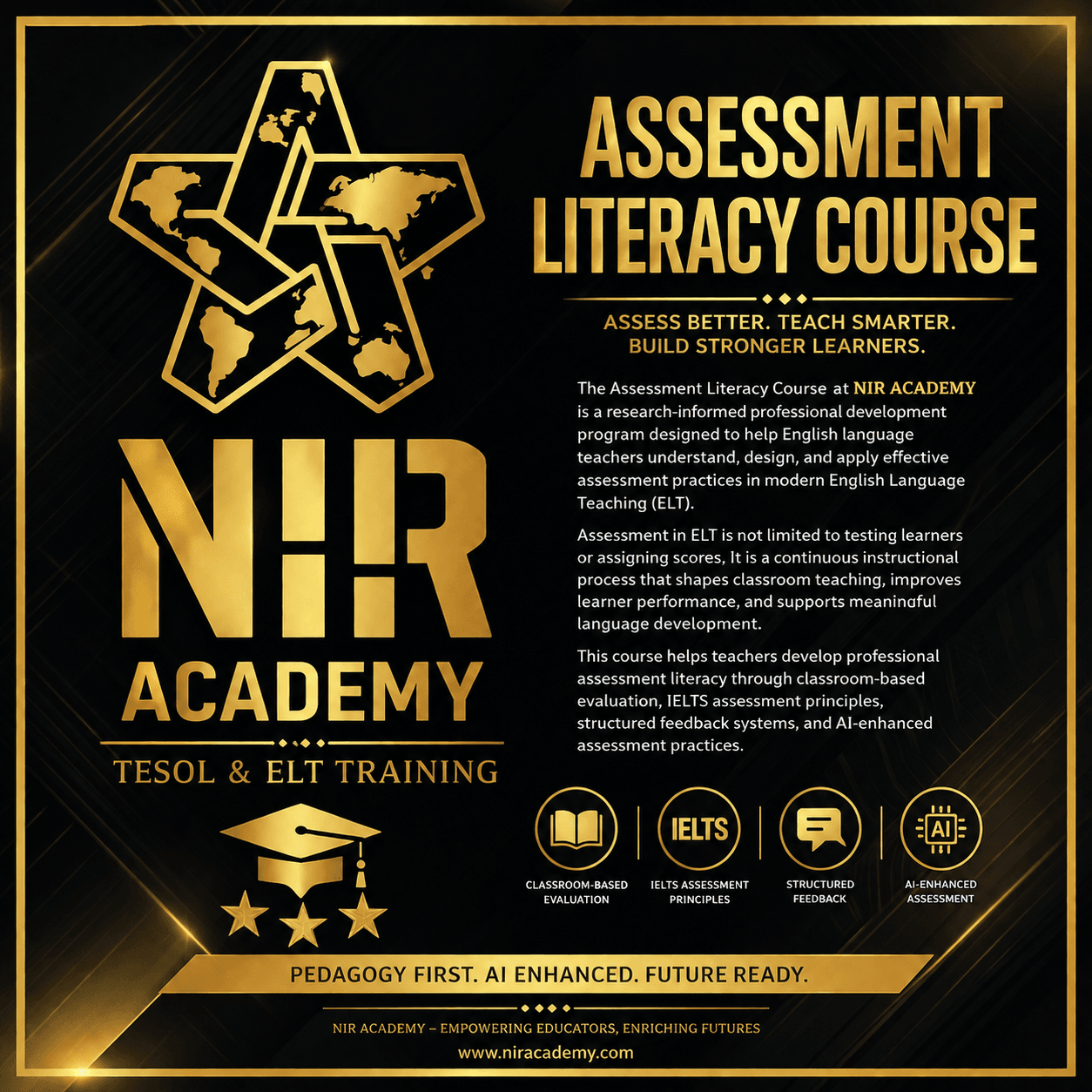
The Assessment Literacy Course at NIR ACADEMY is a research-informed professional development program designed to help English language teachers understand, design, and apply effective assessment practices in modern English Language Teaching (ELT).
Assessment in ELT is not limited to testing learners or assigning scores. It is a continuous instructional process that shapes classroom teaching, improves learner performance, and supports meaningful language development.
This course helps teachers develop professional assessment literacy through classroom-based evaluation, IELTS assessment principles, structured feedback systems, and AI-enhanced assessment practices.
Pedagogy First. AI Enhanced. Future Ready.What Is Assessment Literacy in ELT?
Assessment literacy refers to a teacher’s ability to understand how language assessment works and how evaluation supports learning.
It includes understanding:
Without assessment literacy, instruction often becomes disconnected from real learner progress and communicative outcomes. Strong assessment literacy helps teachers make more accurate, structured, and evidence-based instructional decisions. Developing assessment literacy is not a one-time event — it is an ongoing professional process that deepens through practice, reflection, and continuous engagement with both classroom data and current ELT research.
Recommended External Resources
Explore the research and standards that inform assessment literacy in English Language Teaching:
Why Assessment Literacy Matters
Modern English language teachers are not only instructors. They are also evaluators of learner development.
- Provide inconsistent feedback
- Misunderstand learner performance
- Focus only on grammar correction
- Struggle with IELTS preparation
- Separate assessment from classroom learning
- Design clearer learning objectives
- Evaluate speaking and writing effectively
- Apply IELTS criteria accurately
- Improve learner performance systematically
- Provide structured educational feedback
- Integrate assessment into daily instruction
Assessment literacy is essential for effective English language teaching and professional IELTS preparation.
What You Will Learn
Seven core modules covering the full scope of assessment literacy for ELT professionals.
1. Foundations of Language Assessment
Understand key principles of language assessment, including:
- Formative and summative assessment
- Diagnostic evaluation in language learning
- Criteria-based assessment systems
- Validity and reliability principles
- Performance-based evaluation
- Assessment for learning (AfL)
- Communicative assessment approaches
Learn how assessment functions as part of instruction rather than a separate classroom activity.
2. IELTS Assessment Framework
Develop a deep understanding of IELTS evaluation systems:
- IELTS Speaking band descriptors
- IELTS Writing assessment criteria
- Fluency and coherence evaluation
- Lexical resource assessment
- Grammatical range and accuracy
- Pronunciation assessment principles
- Task achievement and response quality
This helps teachers design IELTS-focused instruction aligned with authentic exam standards.
IELTS Teaching Course →3. Speaking Assessment in ELT
Learn how to assess speaking performance effectively through:
- Fluency versus accuracy evaluation
- Interactive speaking tasks
- Communicative performance observation
- Speaking rubric design
- Classroom speaking assessment
- Learner confidence tracking
- Communicative speaking feedback
The focus is placed on meaningful communication rather than memorization or isolated error correction.
4. Writing Assessment & Feedback
Develop professional writing evaluation skills through:
- IELTS writing assessment strategies
- Paragraph-level feedback systems
- Coherence and cohesion evaluation
- Vocabulary and grammar assessment
- Formative writing correction techniques
- Learner improvement tracking
- Process-oriented writing feedback
Learn how effective feedback can improve learner writing systematically.
5. Classroom-Based Assessment
Apply assessment principles in everyday teaching through:
- Formative assessment techniques
- Peer and self-assessment activities
- Classroom performance evaluation
- Learner progress tracking
- Continuous feedback cycles
- Learning outcome measurement
- Communicative classroom assessment
Assessment becomes part of learning, not only a final-stage event.
6. Feedback Design & Implementation
Learn how to provide effective educational feedback through:
- Constructive correction strategies
- Fluency-focused feedback
- Delayed versus immediate correction
- Learner motivation support
- Error treatment methods
- Speaking and writing feedback systems
- Performance improvement guidance
Well-designed feedback is one of the strongest drivers of language development.
7. AI in Language Assessment
Explore how Artificial Intelligence can support modern assessment practices through:
- AI-assisted writing feedback
- Speaking performance analysis tools
- Rubric-based evaluation support
- Automated classroom task generation
- Assessment planning assistance
- Learner progress analysis
- AI-supported instructional evaluation
At NIR ACADEMY, AI supports teacher judgment rather than replacing professional expertise.
AI in ELT Pedagogy Course →Who This Course Is For
Learning Outcomes
This assessment literacy course is designed to produce measurable professional growth. By completing the course, teachers will be able to:
- Understand core principles of language assessment
- Apply IELTS band descriptors effectively
- Design valid assessment tasks
- Evaluate speaking and writing more accurately
- Provide meaningful educational feedback
- Integrate assessment into classroom instruction
- Improve learner performance systematically
- Use AI responsibly in assessment design
Our Educational Philosophy
At NIR ACADEMY, assessment is viewed as an essential part of teaching and learning. We believe effective assessment should be:
- Transparent
- Criteria-based
- Learner-centered
- Communicative
- Instructionally meaningful
- Formative as well as summative
- Aligned with pedagogical goals
Assessment and pedagogy must work together to improve educational outcomes.
Related Professional Learning Pathways
AI in ELT Pedagogy Course
Ethical, pedagogy-first AI integration for language teaching.
Explore →NIRA AI
NIR Academy’s AI assistant for English teachers and learners.
Try NIRA →Teaching & Learning Resources
Free PDF library on ELT methodology and AI in ELT.
Explore →Courses Hub
Browse all NIR Academy professional development courses.
Explore →Frequently Asked Questions
Common questions about the Assessment Literacy Course at NIR ACADEMY.
Develop Your Professional Assessment Literacy
Strengthen your teaching practice through research-informed pedagogy, IELTS evaluation expertise, and AI-enhanced assessment strategies. Learn how to assess, support, and develop English language learners more effectively in modern ELT classrooms.
