

Assessment & IELTS
for English Language Teachers
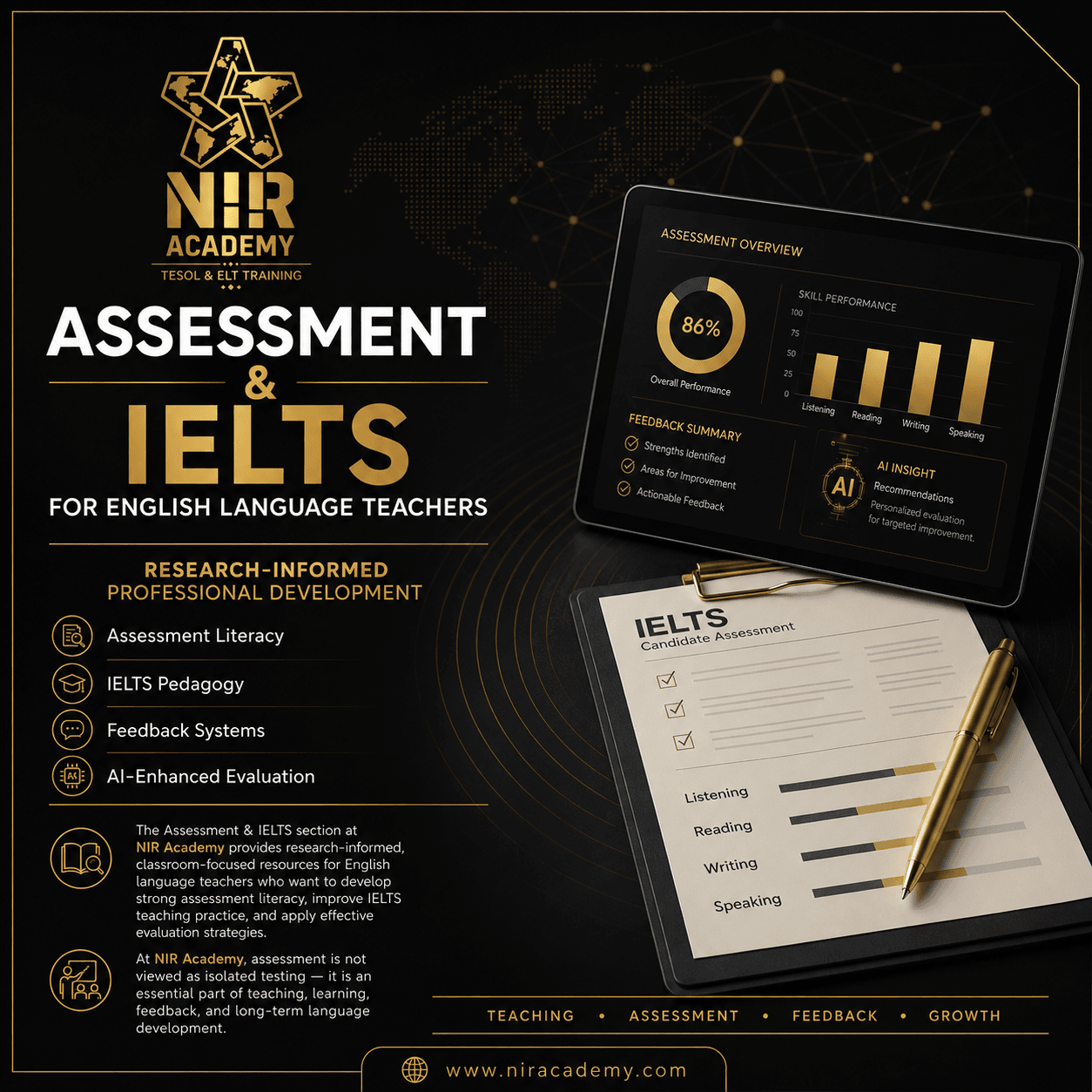
The Assessment & IELTS section at NIR Academy provides research-informed, classroom-focused resources for English language teachers who want to develop strong assessment literacy, improve IELTS teaching practice, and apply effective evaluation strategies.
At NIR Academy, assessment is not viewed as isolated testing — it is an essential part of teaching, learning, feedback, and long-term language development.
Why Assessment Literacy Matters in ELT
Effective English language teaching requires more than delivering lessons or correcting grammar. Teachers need to understand how language proficiency is evaluated, how assessment criteria function, and how feedback drives long-term learner development.
6 Core Areas of Assessment & IELTS Practice
From assessment theory to classroom application — each area connects research-informed principles with practical ELT tools and strategies.
Foundations of Language Assessment
Develop a deeper understanding of how language proficiency is conceptualised, measured, and reported. Covers validity, reliability, washback, criterion-referencing, and the relationship between communicative competence and formal assessment — grounded in internationally recognised frameworks from Cambridge English and TESOL International.
IELTS Assessment Criteria & Band Descriptors
Explore how IELTS Speaking and Writing are evaluated against four independent criteria. Understand how band descriptors function as criterion-referenced scales, how examiners apply them, and how teachers can use them to design more targeted instruction and give more principled feedback. Aligned with official IELTS materials.
IELTS Speaking Instruction & Evaluation
Develop communicative IELTS speaking resources and learn how to evaluate spoken performance against the four IELTS speaking criteria: Fluency & Coherence, Lexical Resource, Grammatical Range & Accuracy, and Pronunciation. Covers task design, examiner interaction, and strategies for developing band-targeted speaking fluency in the classroom.
IELTS Writing Instruction & Feedback Design
Writing task development and feedback strategies for IELTS Task 1 and Task 2. Covers how to evaluate writing against IELTS criteria (Task Achievement, Coherence & Cohesion, Lexical Resource, Grammatical Range & Accuracy), how to design feedback that develops discourse competence rather than just correcting surface errors, and how to build writing instruction into communicative lesson sequences. Informed by ELT Journal research.
Classroom Assessment Practices
Formative and summative classroom assessment strategies that integrate evaluation with teaching. Covers assessment for learning (AfL), diagnostic assessment design, rubric creation, peer and self-assessment, and how to align classroom-based tasks with IELTS-style evaluation. Grounded in British Council ELT Research and Black & Wiliam’s evidence base for formative assessment.
Feedback & Error Correction Strategies
Learner-centered feedback systems for speaking and writing that go beyond surface error correction. Covers oral corrective feedback types (recasts, explicit correction, metalinguistic feedback), written feedback strategies, criteria-referenced commentary, and how feedback can be designed to develop both accuracy and fluency within a communicative framework.
How NIR Academy Approaches Assessment in ELT
At NIR Academy, assessment is treated as a continuous teaching tool — not an event that interrupts learning. Every resource and course is shaped by five core principles.
“Assessment literacy is not a skill reserved for test designers or examiners. Every English language teacher needs to understand how language is evaluated — and how that evaluation can be made to serve learning rather than merely judge it.
AI-Supported IELTS & Assessment Tools
Artificial Intelligence is increasingly present in language assessment contexts — from automated speaking feedback to AI-powered writing analysis. At NIR Academy, every AI assessment tool is evaluated for IELTS alignment, communicative validity, and pedagogical appropriateness before being recommended.
AI-Powered Speaking Assessment
AI tools that provide automated feedback on IELTS speaking criteria — fluency, vocabulary, grammar, and pronunciation — allowing learners to practice and receive structured feedback outside class hours.
AI Writing Analysis & Feedback
AI-assisted writing evaluation tools that analyse IELTS writing against task achievement, coherence, vocabulary, and grammar criteria — producing criteria-referenced feedback for learner improvement.
Adaptive Assessment & Progress Tracking
AI platforms that adapt to individual learner performance, identify gaps in speaking or writing competence, and generate personalised practice sequences aligned with IELTS band targets.
NIREV AI — Assessment Intelligence
NIR Academy’s own AI assessment platform — designed specifically for ELT assessment contexts with IELTS-aligned scoring, structured feedback on speaking and writing, and progress analytics for teachers.
AI Feedback Generation for Teachers
Generative AI tools that support teachers in drafting criteria-referenced written feedback — reducing workload while maintaining feedback quality aligned with IELTS band descriptor language.
Ethical Standards in AI Assessment
Not all AI assessment tools align with communicative validity or IELTS criteria. NIR Academy evaluates every tool against pedagogical appropriateness, data ethics, and the preservation of teacher judgment.
Designed for Assessment-Focused ELT Professionals
From new IELTS teachers learning the band descriptors to experienced assessors deepening their evaluation frameworks — this section supports every stage.
Frequently Asked Questions — Assessment & IELTS
Key questions about IELTS teaching, assessment literacy, and NIR Academy’s evaluation framework.
What is assessment literacy in ELT?
How do IELTS band descriptors work for speaking and writing?
What is the difference between formative and summative assessment?
How can AI support IELTS teaching and assessment?
How should teachers give feedback on IELTS speaking and writing?
What is the NIR Academy Assessment Literacy Course?
Is this section suitable for teachers new to IELTS?
Are NIR Academy assessment resources aligned with official IELTS standards?
Explore the Full NIR Academy ELT Ecosystem
Assessment & IELTS connects directly with every major section of NIR Academy — each one supporting a different dimension of professional ELT practice.
Build Your Assessment Literacy as an ELT Professional
Explore assessment literacy resources, IELTS teaching frameworks, communicative evaluation strategies, and AI-enhanced instructional support — designed for modern English language educators who believe assessment should serve learning.
Pedagogy First. AI Enhanced. Future Ready.
