

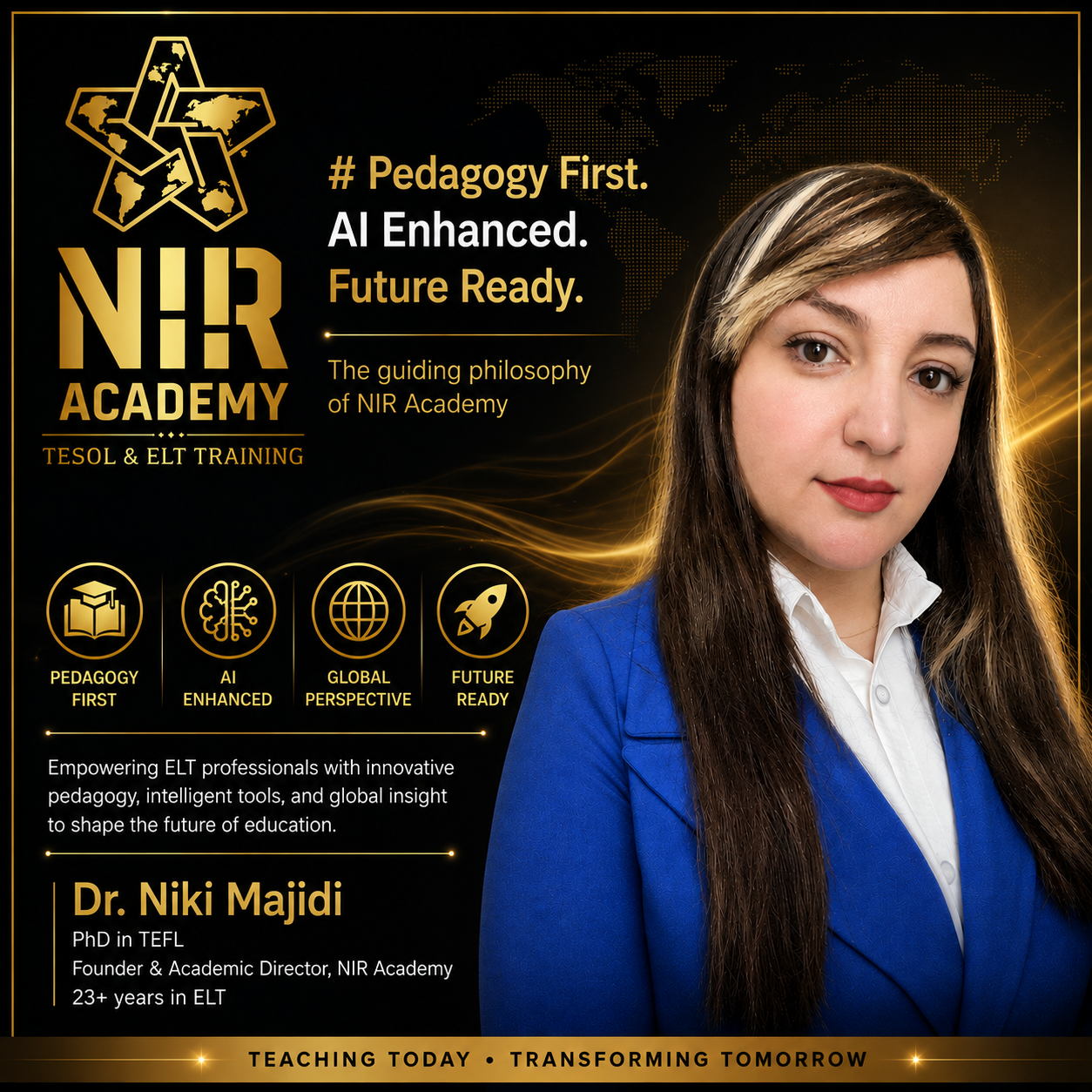
NIR Academy Educational Philosophy
Pedagogy First.
AI Enhanced.
Future Ready.
The guiding philosophy of NIR Academy
“Pedagogy First. AI Enhanced. Future Ready.” is the guiding educational philosophy of NIR Academy. This is more than a tagline. It is the principle that guides how NIR Academy thinks about teaching, technology, teacher development, and the future of English language education.
Every decision NIR Academy makes — about which AI tools to develop, how to design professional development programmes, what standards to apply to AI-generated teaching content, and how to prepare educators for an AI-shaped future — flows from this philosophy. Understanding it is the clearest way to understand NIR Academy.
AI enhances professional practice.
Educators must be prepared for the future.
These are not three separate ideas. Together, they form a single, coherent educational philosophy.
Why This Philosophy Matters
The pace of AI adoption in education has been extraordinary. In English language teaching — as in many other fields — AI tools are being integrated into professional workflows faster than the professional frameworks to govern their use can be developed. The result is a recognisable pattern: adoption without strategy, tools without purpose, capability without competency.
Better technology does not automatically produce better teaching. A lesson plan generated by an AI assistant is not a good lesson plan by virtue of being AI-generated — it may be structurally plausible, linguistically fluent, and pedagogically inadequate. Automated feedback on learner writing is not useful feedback simply because it is consistent — it may reward surface accuracy while missing the actual learning objective. An AI speaking tool is not an effective speaking intervention simply because it is available.
These are not arguments against AI in education. They are arguments for a clear philosophy about how AI should be used — one that keeps educational purpose, teacher expertise, and learner agency at the centre of every decision.
That is what “Pedagogy First. AI Enhanced. Future Ready.” does. It establishes the order of priorities, the role of technology, and the standard of professional readiness that NIR Academy holds itself and its community to.
Pedagogy First
Teaching comes before technology
At NIR Academy, the first question is never “what can this AI tool do?” It is “what does this learner need, and how does good teaching deliver it?” Pedagogy — the disciplined practice of teaching, grounded in applied linguistics, language acquisition research, and instructional design — comes before the selection of any tool or technology.
This means that learning objectives determine how AI is used, not the reverse. It means that the learner’s linguistic needs, communicative context, and developmental stage are the primary reference points for any instructional decision. It means that teacher expertise and pedagogical judgement are not supplementary to AI use — they are its prerequisite.
In practice, this principle manifests in a commitment to:
- Learning objectives as the anchor: Every AI application is evaluated against a specific learning purpose — not general capability.
- Learner needs above tool features: What the learner requires pedagogically determines which AI tool, if any, is appropriate.
- Teacher judgement as the quality gate: AI outputs — whether lesson plans, exercises, feedback, or assessments — require professional evaluation before they reach learners.
- Meaningful interaction: Language acquisition depends on purposeful communication — a principle grounded in decades of applied linguistics research and reflected in the Council of Europe’s CEFR framework. AI tools that replace interaction rather than support it are pedagogically counterproductive.
- Assessment validity: AI-generated assessment instruments must be evaluated against the constructs they purport to measure, not just their surface plausibility.
- Learner agency: Effective language teaching develops learner independence. AI tools that create dependency rather than competence work against the educational purpose.
AI Enhanced
AI strengthens professional practice
NIR Academy uses AI to enhance what teachers do — not to replace them. This distinction is more than rhetorical. It reflects a specific understanding of what AI is good at, what it is not, and where the boundary between AI capability and human professional expertise lies.
AI is genuinely useful in ELT for a range of professional tasks: generating first-draft lesson materials at specified proficiency levels, producing practice test items in standard formats, analysing patterns in learner writing across a large cohort, providing immediate formative feedback on pronunciation, and creating differentiated versions of a reading text for a mixed-ability class. These are tasks that previously required significant time from teachers — time that can now be used for the irreplaceable parts of the profession.
What AI cannot do is teach. It cannot establish the relational conditions for learning, adapt in real time to the complex interplay of affect, comprehension, and motivation in a classroom, exercise ethical judgement about a learner’s needs, or take professional responsibility for the quality of educational decisions. These remain human responsibilities — and NIR Academy’s philosophy ensures they stay that way.
AI capability is not the same as teaching expertise. A tool that produces fluent output has not demonstrated pedagogical value. A tool that automates a task has not demonstrated that the task should be automated. NIR Academy evaluates AI tools against educational criteria — CEFR alignment, methodological grounding, assessment validity, learner appropriateness — not against technological sophistication alone.
Future Ready
Educators need knowledge, judgement, and competency — not just tool familiarity
Being future-ready as an English language teacher in 2026 does not mean knowing how to use ChatGPT. It means being able to evaluate any AI tool — present or future — against pedagogical criteria, make informed decisions about when AI use is appropriate and when it is not, protect learners from the risks AI creates, and develop the professional competencies that remain relevant as the technology continues to change.
NIR Academy understands future-readiness as a set of professional competencies, not a list of tools. Future-ready educators are those who can:
- Apply AI literacy critically: Understanding what AI can and cannot do in ELT contexts, and what its limitations mean for professional decision-making.
- Evaluate AI outputs pedagogically: Assessing AI-generated materials, feedback, and assessments against CEFR descriptors, task design principles, and specific learning objectives.
- Integrate AI with methodological purpose: Using AI tools within communicative, task-based, and lexical approaches — not around them.
- Practice responsible AI use: Protecting learner data, maintaining transparency, recognising bias, and ensuring equitable access.
- Develop assessment literacy for an AI age: Understanding how AI affects what gets measured, how, and by whom — and maintaining professional standards in evaluation.
- Pursue continuous professional development: Treating AI competency not as a one-time acquisition but as an evolving professional responsibility.
Future-ready educators know when AI should be used, why it should be used, how it should be used, and — equally importantly — when it should not. That last competency is the one most often neglected in technology-first approaches to professional development.
Three Principles. One Philosophy.
Separately, each principle addresses a distinct professional question. Together, they form NIR Academy’s coherent position on AI and English language teaching.
Teaching, learning objectives, and professional expertise come before technology. Pedagogy determines how AI is used — not the reverse. The learner’s needs are the primary reference point for every instructional decision.
AI amplifies what teachers can do, frees time for what only teachers can do, and extends learning opportunities for students. It does not replace teacher expertise, professional judgement, or human interaction.
Educators need the knowledge, competency, and professional framework to make sound decisions about AI — now and as the technology continues to develop. Readiness is a professional standard, not tool familiarity.
The three principles are ordered deliberately. Pedagogy establishes purpose. AI enhancement serves that purpose. Future readiness sustains it over time. No principle stands alone — each depends on the others to be coherent.
The NIR Academy Approach
NIR Academy’s approach to AI in English Language Teaching is grounded in three principles: pedagogy comes first, AI enhances professional practice, and educators must be prepared for an AI-shaped future. This philosophy is not applied selectively — it runs through every area of what NIR Academy does.
In AI adoption, it means evaluating every tool against pedagogical criteria before recommending it to teachers. In teacher development, it means building programmes that develop analytical competency and professional judgement, not just tool familiarity. In classroom practice, it means maintaining the primacy of communicative, learner-centred instruction. In assessment, it means ensuring that AI-supported evaluation maintains the validity standards that assessment requires. In research, it means grounding all claims in evidence and being transparent about what is known and what is not. In institutional strategy, it means helping organisations develop AI policies that protect educational quality, not merely adopt AI for its own sake.
This approach distinguishes NIR Academy from technology-first platforms that lead with capability and follow with educational justification. At NIR Academy, educational justification comes first — always.
From Philosophy to Practice
The NIR Academy philosophy is not abstract. It is expressed in every area of the Academy’s work — in the tools developed, the frameworks published, the training programmes designed, and the professional standards applied.
Each of these areas reflects the same underlying logic: pedagogy determines purpose, AI serves that purpose, and professional development ensures that teachers can navigate the relationship between them with confidence and competence. For a full picture of the NIR Academy ecosystem, visit the NIR Ecosystem and About AI in ELT pages.
What NIR Academy Believes
The philosophy is grounded in a set of commitments about education, technology, and the relationship between them.
What NIR Academy Does Not Believe
Defining a philosophy also means being clear about what it excludes. NIR Academy’s position is not anti-technology — it is pro-pedagogy. But the distinction matters, and it requires naming what NIR Academy does not believe.
The Future of ELT
NIR Academy’s vision for the future of English language teaching is not a future in which AI has replaced teachers. It is a future in which skilled teachers, informed by evidence and guided by pedagogy, use AI as a professional tool — in the same way they use course books, assessment rubrics, or corpus data. Purposefully. Critically. Within a clear professional framework.
Future-ready educators are not those who use the most AI tools. They are educators who can make informed pedagogical decisions about AI — knowing when to use it, how to evaluate its outputs, how to protect learners from its limitations, and how to develop the professional competencies that remain relevant as the technology evolves.
For a detailed look at where the profession stands on this journey, see the ELT AI Readiness Index™ 2026 — NIR Academy’s annual research framework for measuring AI readiness across English language teaching.
What This Means for Educators
Whether you are a classroom English teacher, an IELTS instructor, a teacher trainer, an academic English educator, or an ELT researcher, NIR Academy’s philosophy has a direct implication for your professional practice.
What This Means for Institutions
For language schools, universities, examination centres, and professional development providers, “Pedagogy First. AI Enhanced. Future Ready.” offers a principled framework for institutional AI strategy — one that prioritises educational quality over technological adoption.
institutions that apply the philosophy are those that develop AI policies grounded in pedagogical values, not generic technology policies. They commission professional development that builds analytical and pedagogical AI competency, not tool familiarity. They apply quality assurance frameworks to AI-generated content before it reaches learners. They establish data governance protocols for AI tools that process learner data. And they measure the outcome of AI adoption in learning quality and teacher confidence — not in tools deployed.
NIR Academy supports institutions through the AI Teacher Competency Framework™, the AI Quality Assurance Framework™, the AI Teacher Readiness Assessment, and dedicated institutional services.
The NIR Academy Philosophy
AI Enhanced.
Future Ready.
At NIR Academy, this is more than a tagline. It is the principle that guides how we think about teaching, technology, teachers, and the future of English language education. Every tool we build, every course we design, every standard we apply, and every professional judgement we make flows from this philosophy.
NIR Academy’s educational philosophy is Pedagogy First. AI Enhanced. Future Ready. It is grounded in the conviction that AI’s role in English language teaching should be determined by educational purpose, governed by professional expertise, and evaluated against what actually helps learners learn — not by what technology can do, but by what education requires.
For more on how this philosophy is applied across NIR Academy’s research, tools, and professional development programmes, explore the AI in ELT resource hub and the NIR Ecosystem.
Discover the tools, frameworks, and professional development programmes that bring “Pedagogy First. AI Enhanced. Future Ready.” to life.
AITTC Teacher Training → NIR Ecosystem →