

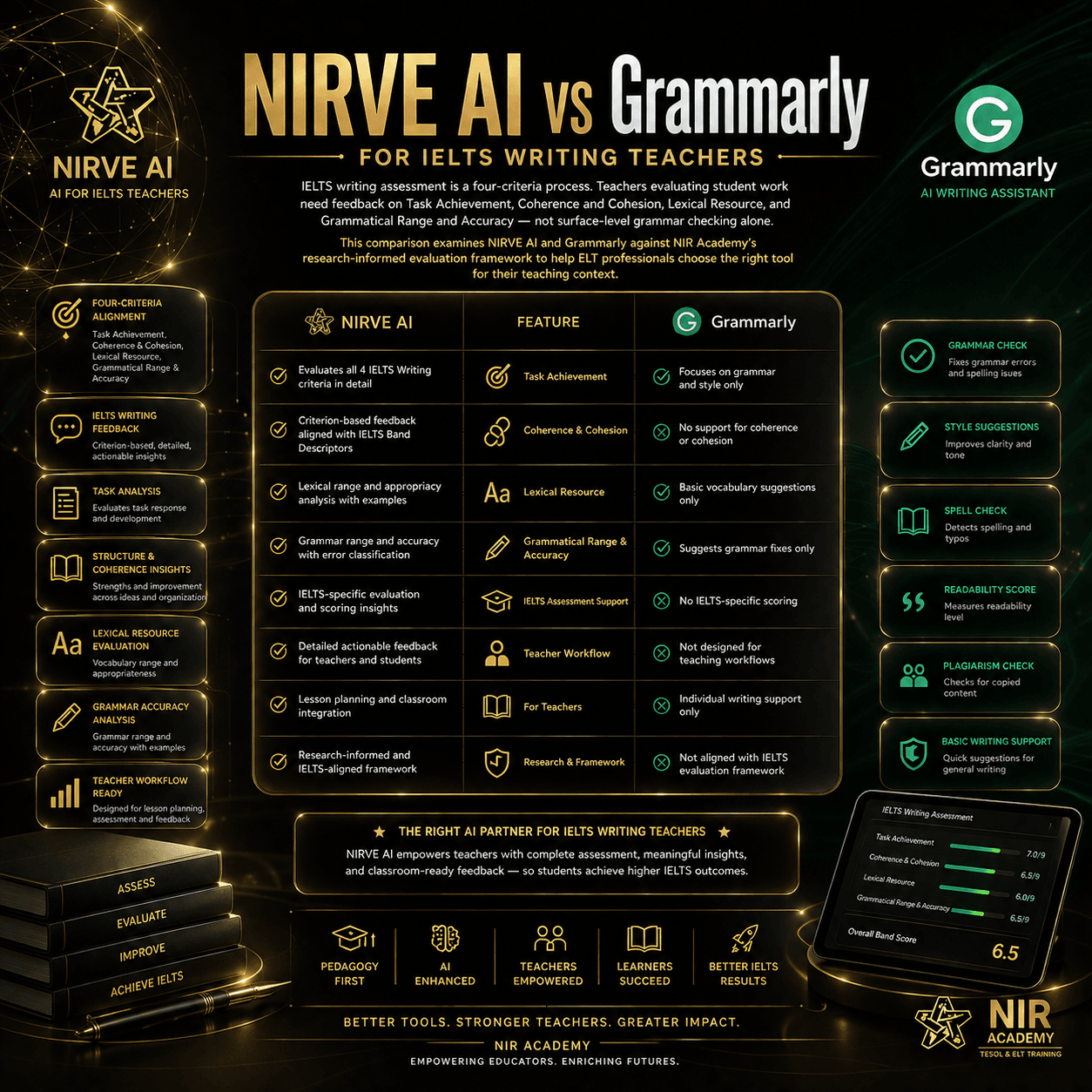
NIRVE AI vs Grammarly
for IELTS Writing Teachers
IELTS writing assessment is a four-criteria process. Teachers evaluating student work need feedback on Task Achievement, Coherence and Cohesion, Lexical Resource, and Grammatical Range and Accuracy — not surface-level grammar checking alone. This comparison examines NIRVE AI and Grammarly against NIR Academy’s research-informed evaluation framework to help ELT professionals choose the right tool for their teaching context.
How we evaluated these tools
What each tool is
Understanding the design intent behind each platform is essential before comparing features. NIRVE AI and Grammarly are built for different users, different workflows, and different definitions of “good writing feedback.”
- Purpose-built for IELTS writing instruction
- Evaluates all 4 IELTS writing band descriptor criteria
- Task Achievement / Task Response feedback
- Coherence & Cohesion analysis (IELTS-aligned)
- Lexical Resource evaluation
- Grammatical Range & Accuracy scoring
- Teacher dashboard and class management
- CEFR-referenced feedback
- Structured workflow for Task 1 and Task 2
- AI-powered grammar and style editor
- Real-time spelling, punctuation, grammar detection
- Tone and clarity suggestions
- Plagiarism detection (premium)
- Writing style and conciseness feedback
- Wide platform integration (browser, Word, Google Docs)
- Individual users — no dedicated teacher dashboard
- Not designed for IELTS writing assessment
NIRVE AI vs Grammarly: feature comparison
Evaluated against NIR Academy’s ELT framework. Ratings reflect IELTS writing applicability and classroom suitability, not general writing tool quality.
| Criterion | NIRVE AI | Grammarly |
|---|---|---|
| Designed for IELTS writing instruction | ||
| Task Achievement / Task Response | ||
| Coherence & Cohesion (IELTS) | ||
| Lexical Resource (IELTS) | ||
| Grammatical Range & Accuracy | ||
| Grammar error detection (general) | ||
| Spelling & punctuation | ||
| Writing style & clarity | ||
| CEFR alignment | ||
| Teacher dashboard | ||
| Platform integration | ||
| Classroom workflow |
NIRVE AI vs Grammarly: IELTS writing assessment
The IELTS writing exam is marked on four band descriptor criteria. Each criterion carries equal weight in the final score. This is the central frame for evaluating any tool used in IELTS writing instruction.
NIRVE AI
NIRVE AI evaluates student writing responses against all four public IELTS writing band descriptors for both Task 1 and Task 2. Task Achievement feedback assesses whether the student has fully addressed the task — a criterion that grammar tools cannot evaluate without understanding the task prompt and examiner expectations. Coherence and Cohesion analysis goes beyond sentence-level clarity to assess logical progression, paragraph structure, and the appropriate use of cohesive devices. Lexical Resource evaluation identifies the range and precision of vocabulary used, including less common items and collocations. Grammatical Range and Accuracy scoring measures the variety of structures, not only surface errors.
Grammarly
Grammarly’s writing feedback is comprehensive at the surface level. It detects grammar errors, spelling mistakes, punctuation issues, and provides style suggestions for clarity and conciseness. These are useful skills for any writer. However, Grammarly does not assess whether a Task 2 response addresses the question, whether paragraph cohesion meets IELTS band 7 standards, or whether the lexical range is sufficient for a target band score. Teachers who use Grammarly as their primary IELTS writing feedback tool will need to supply all four IELTS criteria assessments manually.
CEFR alignment in writing feedback
The Common European Framework of Reference for Languages (CEFR) provides a shared language for describing learner proficiency. For IELTS writing instruction, CEFR alignment helps teachers communicate student progress in internationally recognised terms and map band scores to corresponding CEFR levels.
NIRVE AI integrates CEFR level references into its writing assessment feedback, allowing teachers to connect IELTS band score indicators to CEFR descriptors. A student writing at a B2 level, for example, will receive feedback that reflects the expected lexical and grammatical range at that proficiency level.
Grammarly does not reference CEFR levels in its feedback. This is expected — Grammarly is not designed for language proficiency assessment. However, it means ELT teachers using Grammarly as their primary feedback tool need to make the CEFR connection themselves, which adds an additional step to the marking and feedback workflow.
How each tool fits into your marking workflow
NIRVE AI
NIRVE AI is structured around the teacher’s workflow. Teachers can submit student writing samples for assessment, select Task 1 or Task 2, specify the target band score, and receive a structured breakdown of performance across all four IELTS criteria. A teacher dashboard allows progress tracking across students and sessions, making it practical for classes of any size. The output is designed to reduce the time teachers spend on manual IELTS marking while maintaining criterion-by-criterion rigour.
Grammarly
Grammarly is designed for individual writers, not for teachers managing student submissions. Students can use Grammarly to self-edit their IELTS writing drafts before submission, which is a legitimate and useful application. However, Grammarly does not provide a teacher interface, class management tools, or structured IELTS assessment reports. Teachers who want to incorporate Grammarly into their IELTS writing workflow will typically direct students to use it as a self-editing tool before formal teacher feedback.
Classroom use cases for each tool
Where NIRVE AI fits
NIRVE AI is well-suited for IELTS writing classes where teachers need to provide structured, criterion-referenced feedback on student essays. Use cases include: formative assessment of Task 1 and Task 2 drafts, identifying specific skill gaps across the class, tracking individual student progress toward a target band score, and generating feedback reports that students can use for self-directed improvement.
Where Grammarly fits
Grammarly is most effective as a self-editing tool for students before they submit IELTS writing drafts for teacher assessment. It helps students catch surface errors that distract from the quality of their ideas, reducing the volume of basic corrections teachers need to make during formal marking.
Using both tools together
A practical classroom approach: students use Grammarly to self-edit their IELTS writing drafts (catching surface errors, improving clarity), then submit to NIRVE AI for formal criterion-referenced assessment. This combination reduces teacher marking load while maintaining full IELTS band descriptor coverage.
Honest assessment of both platforms
- Full IELTS writing band descriptor coverage
- Task Achievement / Task Response assessment
- CEFR-referenced feedback
- Dedicated teacher dashboard
- Structured for both Task 1 and Task 2
- Reduces manual marking time
- Focused on IELTS — not a general grammar editor
- Surface-level grammar detection less refined than Grammarly
- Less useful for non-IELTS writing tasks
- Excellent surface-level grammar detection
- Wide platform integration (browser, Word, Google Docs)
- Helpful for student self-editing before submission
- Clear, accessible interface for all skill levels
- Useful across many writing contexts beyond IELTS
- Does not evaluate IELTS band descriptor criteria
- No Task Achievement or Task Response assessment
- No teacher dashboard or class management tools
- No CEFR alignment in feedback
- Not designed for IELTS writing instruction
Which tool should you choose?
The most appropriate tool depends on your role, your students’ needs, and what your teaching context actually requires from writing feedback.
| If you are… | Recommended tool |
|---|---|
| IELTS writing instructor | NIRVE AI |
| ELT teacher preparing students for IELTS | NIRVE AI |
| Teacher trainer covering IELTS writing | NIRVE AI |
| Curriculum designer (IELTS programmes) | NIRVE AI |
| Student — self-editing before submission | Grammarly |
| Teacher — general writing quality feedback | Grammarly |
| Teacher — IELTS + surface error reduction | Both tools together |
What this comparison tells us
- NIRVE AI and Grammarly serve different purposes — comparing them as direct alternatives misframes the decision for IELTS teachers.
- If your primary need is IELTS writing assessment across all four band descriptor criteria, NIRVE AI is the appropriate tool. Grammarly does not cover Task Achievement, IELTS-aligned Coherence, or Lexical Resource.
- If your primary need is surface-level grammar correction and writing style improvement, Grammarly is more refined in that specific area than NIRVE AI.
- CEFR alignment is available in NIRVE AI but not in Grammarly — relevant for teachers working within CEFR-referenced curricula.
- A teacher dashboard for managing student submissions exists in NIRVE AI; Grammarly is designed for individual users.
- Using both tools in sequence — Grammarly for student self-editing, NIRVE AI for formal criterion-referenced assessment — is a practical and pedagogically coherent approach.
- Neither tool replaces the professional judgement of an experienced IELTS writing teacher. Both are tools that support, not substitute for, human instruction.
Common questions about NIRVE AI vs Grammarly
Sources & further reading
Try NIRVE AI — Built for IELTS Writing Teachers
Assess all four IELTS writing band criteria in one platform. Two months of free access — no credit card required.
