


AI in ELT · Featured Webinar
What Should English Teachers Actually Trust AI to Do?
English teachers trust AI for some classroom tasks and not others — this research-informed session shows exactly when to trust, question, adapt, or reject AI-generated lesson plans, materials, and feedback.
Important: The live webinar access link will be shared exclusively through the official NIR Academy WhatsApp Channel. Please follow the channel before the event.
Why This Webinar
Why English Teachers Trust AI — Selectively
Every English teacher using AI has hit the same wall: the output looks polished, but something is quietly off — a task that doesn’t fit the level, feedback that misses the real error, a lesson plan that reads well but wouldn’t survive first contact with real students. Knowing which parts to trust, and which to double-check, is the actual skill.
The Challenge
AI Doesn’t Know What Your Students Need
Confident, fluent output isn’t the same as pedagogically sound teaching.
Read More
The Challenge
AI Doesn’t Know What Your Students Need
Confident, fluent output isn’t the same as pedagogically sound teaching.
AI doesn’t reliably know what your students need. It generates confident, fluent output — confident and fluent aren’t the same as pedagogically sound.
The Real Skill
Judgment Closes the Gap AI Can’t
Better prompts alone don’t close the gap between AI output and sound teaching.
Read More
The Real Skill
Judgment Closes the Gap AI Can’t
Better prompts alone don’t close the gap between AI output and sound teaching.
The gap between AI-generated content and pedagogically sound teaching isn’t closed by better prompts alone — it’s closed by a teacher who knows what to check, and why. This aligns with UNESCO’s guidance on AI in education, which places teacher judgment at the center of responsible AI use.
What You’ll Learn
A working framework for evaluating any AI output in front of you.
-
Trust
When to trust AI — the categories of task where AI output is reliable enough to use with light review.
-
Question
When to question AI — the warning signs that an output needs a second look before it reaches students.
-
Adapt
When to adapt AI output — how to reshape a generic response into something that fits your specific class.
-
Reject
When to reject it entirely — and do the task yourself, faster and better than a prompt could.
-
Evaluate
How to evaluate AI-generated lesson plans, materials, and feedback against real pedagogical criteria — not just fluency and formatting.
Live Demonstration
We’ll review a real lesson plan — live, on screen.
Watching the evaluation happen, not just hearing about it
Dr. Majidi will walk through an actual AI-generated lesson plan (or feedback sample) line by line, marking exactly where it holds up pedagogically and where it quietly breaks down — so you leave with a method you can repeat on your own materials, not just a list of rules.
The NIR Academy Framework
This session follows the same four-stage path our teacher training is built on.
This webinar covers the first two stages in depth. Teachers who want to go further — building this judgment into daily practice — can continue with AITTC, NIR Academy’s AI Teacher Training Course.
Connected to the NIR Academy Ecosystem
Ideas from this webinar connect to tools already built for the same purpose.
You won’t need any of these to follow the session — they’re referenced only where they illustrate a point.
Teacher Assistant
An always-on assistant for day-to-day lesson planning and classroom prep.
Explore NIRA AISpeaking Intelligence
Analyzes spoken student output for fluency, accuracy, and pronunciation patterns.
Explore NIRVO AIWriting Intelligence
Evaluates written work against real pedagogical criteria, not just surface fluency.
Explore NIRVE AIAssessment Intelligence
Turns raw student performance data into actionable, level-aware assessment insight.
Explore NIREV AIExam Authoring
Generates exam content and materials with built-in level and format control.
Explore NIRAS AIAI Teacher Training
The full course this webinar draws from — go deeper on the same evaluation framework.
Explore AITTCWho Should Attend
Built for anyone making pedagogical calls about AI output.
English Language Teachers
Anyone using AI daily for lesson prep, materials, or feedback.
IELTS Instructors
Evaluating AI-generated speaking, writing, and mock exam content.
Teacher Trainers
Shaping how newer teachers learn to work with AI responsibly.
TESOL & TEFL Educators
Building AI literacy into certification and training programs.
Curriculum Designers
Deciding where AI-generated content belongs in a syllabus.
Applied Linguistics Researchers
Studying how AI output holds up against pedagogical theory in practice.
Speaker
Dr. Majidi founded NIR Academy to bring research-informed, pedagogy-first AI integration to English language teaching. Her work focuses on where AI genuinely helps teachers — and where it doesn’t — grounded in classroom practice rather than trend-chasing.
Session Recap
What Should English Teachers Actually Trust AI to Do?
Webinar Overview
This webinar explored one of the most important questions facing English language teaching today: how can teachers use AI without surrendering their professional and pedagogical judgment?
Led by Dr. Niki Majidi, the session combined research-informed perspectives, practical ELT examples, and professional reflection — emphasizing that effective AI integration is not about generating more content, it is about making better teaching decisions.
The TQAR Framework
A practical four-step process for evaluating AI-generated teaching content:
Identify when AI genuinely adds value to your teaching practice.
Critically evaluate AI output before using it in the classroom.
Modify AI-generated materials to fit your learners and context.
Discard AI content that is inaccurate, inappropriate, or pedagogically unsound.
Key Takeaways
- AI predicts the next word — it does not understand meaning or context.
- Whether to trust AI depends entirely on the task, not the tool.
- Always verify AI-generated classroom content against reliable sources.
- Apply the TQAR Framework before using any AI output in teaching.
- Human professional judgment remains the most important tool in ELT.
Topics Covered
Pedagogy First. AI Enhanced. Future Ready. — NIR Academy
FAQ
Frequently Asked Questions
Do I need any AI experience to attend? +
No. The session is built for teachers at every level of AI familiarity, from complete beginners to those already experimenting with AI tools in their lesson planning.
Is this a product demo? +
No. This is a pedagogy-first session about evaluating AI output critically. Any NIR Academy tools shown are used only to illustrate the evaluation framework, not to sell you anything.
Will I get a recording if I can’t attend live? +
Registered attendees will be notified about recording access once the session date is confirmed.
Is this free? +
Yes. The webinar is free and open to English language teachers, IELTS instructors, teacher trainers, and TESOL/TEFL educators worldwide.
When exactly is the webinar? +
Saturday, 8 August 2026 — 20:00 Iran time / 19:30 Türkiye time. Registration is open now.
Don’t Miss the Live Link
The live webinar link will be shared exclusively through our official WhatsApp Channel. Follow now to make sure you don’t miss it.
Reserve Your Place
Saturday, 8 August 2026 — registration is open now.
Free · Online · With Dr. Niki Majidi
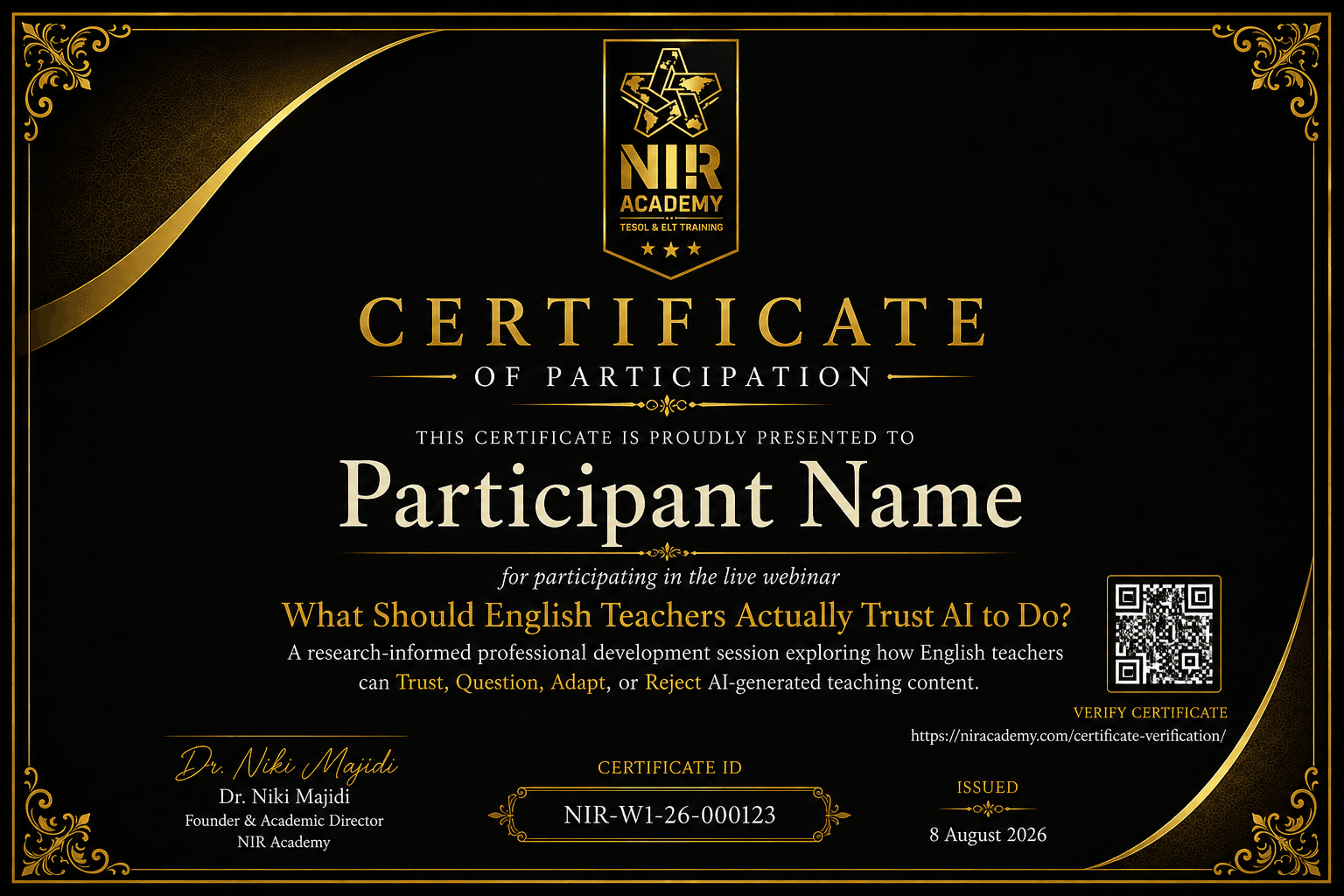
Certificate of Participation
Your Digital Certificate of Participation
Every participant who attends the live webinar will receive a professionally designed Digital Certificate of Participation from NIR Academy.
Academic Context Why This Webinar Exists — And Why This Title Matters The research-informed reasoning behind "What Should English Teachers Actually Trust AI to Do?"
The title of this webinar is deliberately framed as a question of trust, rather than a question of technology. Generative AI can now produce lesson plans, classroom activities, explanations, assessment items, corrective feedback, and learning materials with remarkable speed and linguistic fluency. However, fluency does not necessarily indicate pedagogical validity.
Why "What Should English Teachers Actually Trust AI to Do?"
For English language teachers, the central professional question is not simply whether AI can perform a task. The more important question is whether its output can be trusted for a particular pedagogical purpose, with particular learners, in a particular classroom context.
"Can AI do this?"
"Can I trust this output for this pedagogical purpose, with these learners, in this context?"
That distinction is at the heart of responsible AI integration in English Language Teaching (ELT).
The Academic Problem Behind the Webinar
Generative AI systems are designed to produce plausible and coherent responses. They are not inherently designed to understand the complete pedagogical context of a classroom.
An AI-generated lesson plan may be grammatically accurate and professionally formatted while still containing problems related to CEFR level appropriacy, task difficulty, learning objectives, cognitive demand, interaction patterns, timing, assessment validity, feedback quality, or learner needs.
Does the output look convincing?
Fluency, coherence, formatting, speed, and apparent completeness.
Is the output educationally appropriate?
Alignment with learners, objectives, context, methodology, assessment principles, and classroom realities.
Why Teachers Remain Central
AI can generate options. It cannot automatically determine which option is pedagogically appropriate for a particular group of learners. That decision requires teacher judgment.
AI literacy in ELT therefore should not be reduced to prompt engineering. Effective AI integration also requires teachers to evaluate what AI produces and make informed decisions about how that output should enter the learning process.
Why the Word "Actually" Matters
The word "actually" is intentional. AI is often discussed through broad claims about what it can do. This webinar moves the discussion from technological possibility to professional applicability.
The question is not whether AI can generate a lesson plan. It clearly can. The more important question is whether that lesson plan should be trusted, questioned, adapted, or rejected before it reaches learners.
That shift — from capability to judgment — is the central academic purpose of this session.
From AI Literacy to Pedagogical Judgment
Teachers do not become AI-ready simply by learning more tools. They become AI-ready when they can critically evaluate AI output and make informed pedagogical decisions about when and how to use it.
AI Literacy
Understand what AI can produce, where it is limited, and how its outputs should be interpreted.
Pedagogical Judgment
Evaluate whether an AI output is appropriate for learners, objectives, and context.
Practical Application
Adapt and use AI output deliberately within authentic teaching situations.
Reflective Teaching
Review outcomes and continuously refine the teacher's use of AI.
This webinar is not primarily about discovering another AI tool. It is about developing a professional decision-making framework for working with AI-generated educational content.
Reserve Your Seat
Saturday, 8 August 2026
What Should English Teachers Actually Trust AI to Do? — a free, research-informed session with Dr. Niki Majidi on evaluating AI-generated lesson plans, materials, and feedback.
