

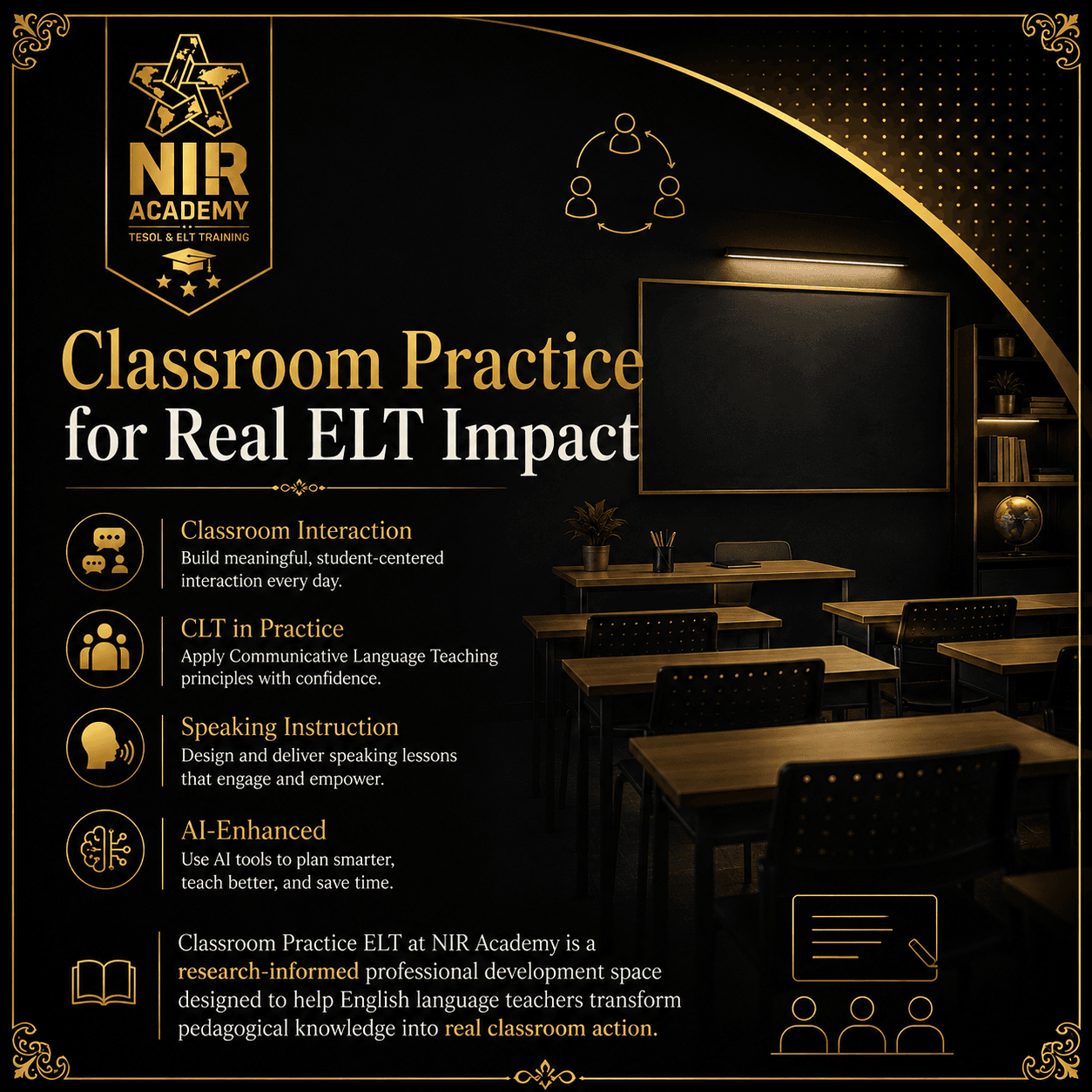
Classroom Practice
for Real ELT Impact
Classroom Practice ELT at NIR Academy is a research-informed professional development space designed to help English language teachers transform pedagogical knowledge into real classroom action.
Unlike theory-based methodology, this section focuses on how teaching actually happens in real classrooms — interaction, communication, management, feedback, and instructional decision-making in real time. It bridges ELT theory, instructional design, and classroom reality through structured, communicative, and AI-supported teaching practice.
Why Classroom Practice Matters in ELT
Effective English language teaching is not only about knowing methodology — it is about applying it in real classrooms with real learners under real-time conditions. The gap between knowing and doing is where most teacher development stalls.
7 Core Areas of ELT Classroom Practice
Each area addresses a specific dimension of what happens — and what must be managed — in real English language teaching classrooms.
Communicative Classroom Teaching
Communicative Language Teaching (CLT) in the classroom is not about following a textbook — it is about creating conditions where learners must use language meaningfully to achieve communicative goals. This requires deliberate task design, strategic grouping, and a shift from teacher-controlled exchange to genuine learner interaction.
Pair and group work, information gap activities, and discussion tasks are the mechanisms through which CLT becomes classroom reality. The teacher’s role shifts from information deliverer to interaction facilitator — managing communication rather than controlling content. Grounded in Cambridge ELT communicative methodology research.
Real Classroom Interaction Strategies
Classroom interaction quality determines how much real language acquisition happens. The difference between a communicative classroom and a passive one lies in specific, teachable interaction strategies that can be learned and deployed deliberately by any teacher.
Elicitation techniques that prompt learner production rather than teacher transmission, scaffolding strategies that support participation without reducing cognitive demand, and engagement control methods that sustain focus during communicative tasks — these are the micro-skills of effective ELT classroom practice. Supported by TESOL International classroom interaction research.
Teaching Speaking in Classroom Practice
Speaking instruction in classroom practice is distinct from IELTS preparation — it is about creating regular, structured opportunities for learners to produce spoken language meaningfully within lesson sequences. Fluency-building tasks, role-plays, and structured speaking progressions must be designed deliberately into the lesson, not treated as afterthoughts.
Pronunciation support in classroom contexts focuses on intelligibility and communicative clarity rather than accent reduction — aligned with current ELF (English as a Lingua Franca) research and British Council CLT pedagogy.
Grammar & Vocabulary in Classroom Context
Grammar and vocabulary instruction in communicative ELT classrooms is contextualised, inductive, and task-embedded — not delivered through isolated rule explanation or decontextualised word lists. Inductive grammar teaching presents learners with language in use, guides noticing of patterns, and builds understanding through meaningful examples before explicit rule formation.
Vocabulary activation through collocations, chunks, and real-world language use gives learners the lexical resource they need for genuine communication — aligned with Nation’s vocabulary acquisition research and ELT Journal evidence.
Classroom Management in ELT
Effective classroom management in ELT is not about behaviour control — it is about designing and maintaining learning environments that maximise engagement, communicative interaction, and on-task participation. This includes strategic grouping for pair and group work, clear task instructions that reduce confusion, smooth transitions between lesson stages, time management across a lesson sequence, and differentiated support for mixed-level learners.
Strong classroom management creates the conditions in which CLT can actually happen — without it, communicative tasks collapse into confusion or silence.
Feedback & Real-Time Correction in ELT
Providing effective feedback during classroom practice is one of the most demanding teaching skills in ELT. Teachers must decide when to correct, what to correct, and how — balancing fluency and accuracy development with the communicative flow of the lesson. Different stages of a lesson call for different feedback approaches.
During fluency tasks, delayed feedback (noting errors and addressing them post-task) preserves communicative momentum. During accuracy tasks, immediate oral corrective feedback (recasts, elicitation, metalinguistic commentary) shapes language precision. Formative assessment of in-class performance provides continuous data for instructional adjustment. Aligned with ELT Journal corrective feedback research.
AI-Supported Classroom Practice in ELT
Artificial Intelligence is changing what is possible in ELT classroom practice — from lesson planning support and speaking task generation to differentiated instruction and real-time pronunciation feedback. At NIR Academy, AI classroom tools are evaluated for alignment with CLT and TBLT methodology: they must support communicative teaching goals, not automate away the pedagogical judgment that defines effective teaching.
The teacher remains central. AI provides leverage — reducing preparation time, expanding practice opportunities, and enabling data-informed feedback — but it does not replace the moment-to-moment instructional decisions that only a skilled teacher can make.
What Teachers Gain from Classroom Practice ELT
Concrete, measurable improvements in teaching performance — from the first lesson after engaging with this section.
“Teaching is practice-based. Communication is central. Classrooms are dynamic. Feedback is continuous. And AI supports pedagogy — it never replaces the teacher’s professional judgment in the moment that counts.
Teaching is practice-based — theory must become actionCommunication is central — not a supplement to grammar instructionClassrooms are dynamic — management is a teaching skillFeedback is continuous — not confined to test resultsAI supports pedagogy — teacher judgment remains primary
AI Tools for ELT Classroom Practice
At NIR Academy, every AI classroom tool is evaluated against CLT and TBLT criteria — it must support communicative teaching goals, respect teacher agency, and enhance (not automate) pedagogical decision-making.
AI Lesson Planning Support
Generative AI assists teachers in designing communicative lesson sequences, generating task variations, creating differentiated materials, and adapting existing activities for mixed-level classrooms — reducing preparation time without reducing pedagogical quality.
Speaking Task Generation
AI generates role-play scenarios, information gap tasks, discussion prompts, and IELTS-style speaking tasks aligned with CLT principles — giving teachers a ready supply of communicative speaking activities that can be adapted for any level or topic.
Differentiated Instruction Design
AI supports the design of differentiated learning experiences for mixed-level classrooms — creating task variations at different proficiency levels, generating scaffolded versions of the same activity, and suggesting support strategies for struggling learners.
NIRVO AI — In-Class Speaking Coach
NIR Academy’s NIRVO AI provides learners with speaking practice and criteria-referenced feedback outside class hours — extending communicative practice beyond the classroom and enabling teachers to focus in-class time on higher-order interaction tasks.
NIRVE AI — Writing Practice Support
NIR Academy’s NIRVE AI supports classroom writing practice by providing immediate, criteria-referenced feedback on learner writing — enabling process-writing approaches where learners revise with data rather than guesswork.
Ethical AI in Classroom Practice
At NIR Academy, AI is adopted in classroom contexts only where it aligns with communicative validity, supports teacher agency, and preserves the interactional quality of the ELT classroom. AI that reduces genuine communication is not endorsed, regardless of efficiency gains.
Designed for Practising ELT Professionals
From early-career teachers building their first communicative classroom routines to experienced educators refining their practice with AI — this section supports every stage of ELT classroom development.
Frequently Asked Questions — Classroom Practice ELT
Key questions about communicative classroom teaching, interaction strategies, and the NIR Academy classroom practice approach.
What is Classroom Practice ELT?
How can teachers improve classroom interaction in ELT?
What is the difference between fluency-focused and accuracy-focused teaching?
How should grammar be taught in communicative ELT classrooms?
How can AI support classroom practice in ELT?
What is effective classroom management in ELT?
What is real-time feedback in ELT and how should teachers give it?
Is this section suitable for online English language teachers?
Explore the Full NIR Academy ELT Ecosystem
Classroom Practice ELT connects with every major section of NIR Academy — each one supporting a different dimension of professional teaching development.
Transform Theory into Real Teaching Performance
Classroom Practice ELT at NIR Academy helps teachers transform theory into real teaching performance through communicative, structured, and AI-enhanced classroom practice — building the skills that make a difference in every lesson.
Pedagogy First. AI Enhanced. Future Ready.
