

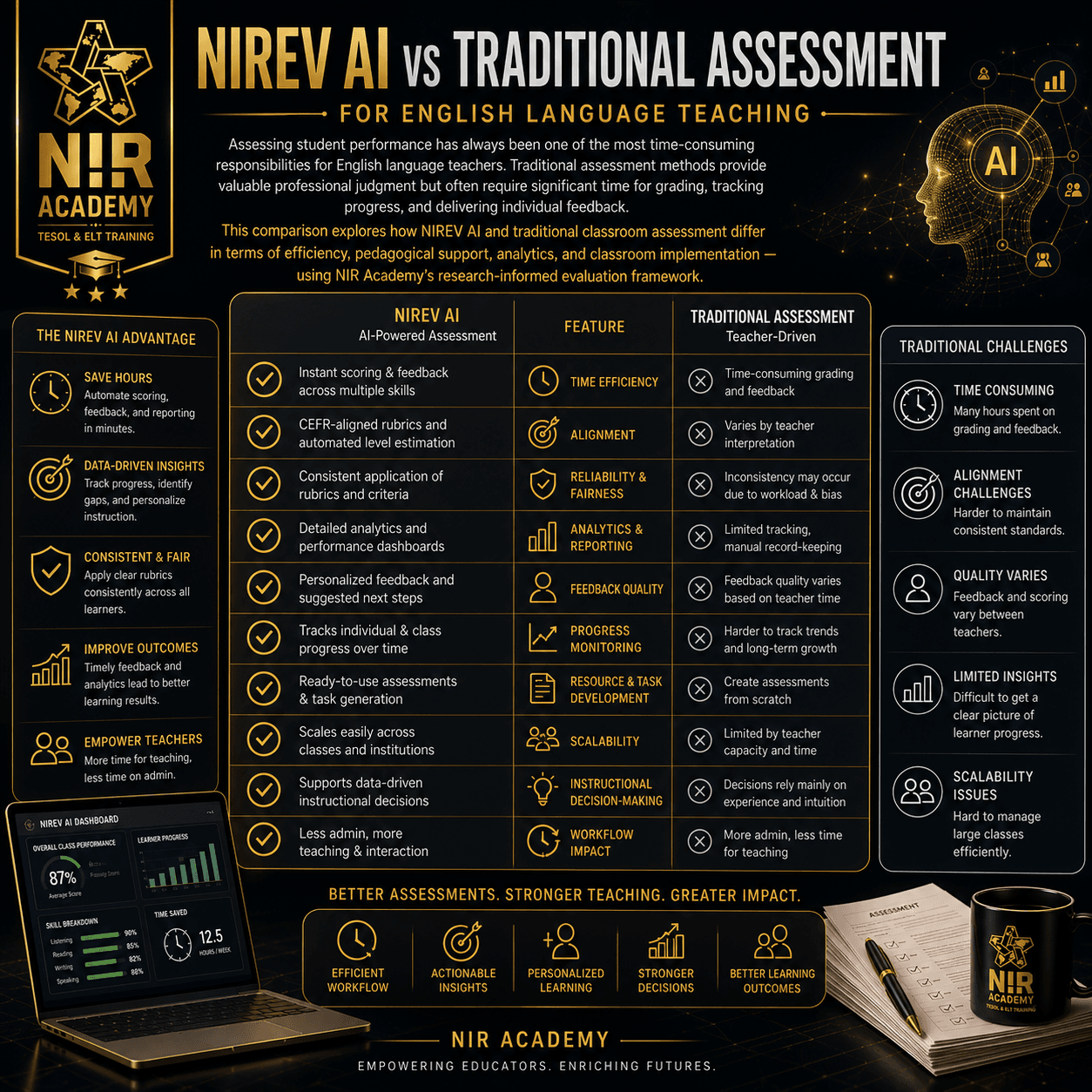
NIREV AI vs Traditional Assessment
for English Language Teaching
Assessing student performance has always been one of the most time-consuming responsibilities for English language teachers. Traditional assessment methods provide valuable professional judgment but often require significant time for grading, tracking progress, and delivering individual feedback. This comparison explores how NIREV AI and traditional classroom assessment differ in terms of efficiency, pedagogical support, analytics, and classroom implementation — using NIR Academy’s research-informed evaluation framework.
Our evaluation framework
What each approach is
NIREV AI and traditional assessment are not competing philosophies. They represent different tools within a professional assessment toolkit — each with distinct strengths depending on context, purpose, and instructional goal.
- AI-powered continuous assessment platform
- Automated progress tracking and analytics
- Real-time classroom insights and trends
- Individual learner performance reports
- Data visualisation for instructional decisions
- Designed for ELT classroom integration
- Supports — does not replace — teacher judgment
- CEFR-aligned assessment workflows
- Professional teacher judgment at the core
- Context-sensitive evaluation and interpretation
- Flexible and adaptable to classroom realities
- Quizzes, essays, oral assessments, exams
- Essential for high-stakes and certification contexts
- Established and institutionally recognised
- Valuable for nuanced qualitative feedback
- Manual grading, recording, and reporting
NIREV AI vs Traditional Assessment: feature comparison
Evaluated against NIR Academy’s ELT assessment framework. Ratings reflect classroom applicability and practical efficiency for English language teaching professionals.
| Criterion | NIREV AI | Traditional Assessment |
|---|---|---|
| Continuous progress tracking | ||
| Immediate feedback | ||
| Learning analytics | ||
| Teacher dashboard | ||
| Student reports | ||
| Classroom trends | ||
| Time efficiency | ||
| Personalised feedback | ||
| Human professional judgment | ||
| High-stakes assessment | ||
| Best use case | Ongoing formative assessment | High-stakes evaluation |
Longitudinal progress tracking
Understanding how individual students develop over time is one of the most valuable — and most time-demanding — responsibilities in language education. The difference between NIREV AI and traditional methods here is primarily one of scale and sustainability.
NIREV AI
NIREV AI tracks student performance longitudinally — across sessions, tasks, and skills — without requiring teachers to maintain manual records. Teachers can view individual student trajectories, identify skill-specific strengths and gaps, and monitor progress toward CEFR or IELTS targets. This data is available in real time and does not depend on teacher recall or manual data entry.
Traditional Assessment
Traditional progress tracking relies on teacher record-keeping — grade books, spreadsheets, or learning management system entries. For skilled and organised teachers, this can produce a meaningful picture of student development. The limitation is scalability: with large cohorts or multiple classes, maintaining granular longitudinal data for every student becomes increasingly difficult to sustain alongside teaching responsibilities.
Formative assessment and ongoing feedback
Formative assessment — the ongoing process of monitoring student learning to guide instruction — is where NIREV AI’s capabilities are most directly applicable. Classroom quizzes, learning checkpoints, and adaptive instruction all benefit from faster data processing and more consistent feedback delivery.
NIREV AI enables teachers to deploy formative assessments and receive automated analysis of class-wide and individual results. Rather than spending time marking and aggregating quiz results, teachers receive structured data they can act on immediately — identifying which students need additional support and which concepts require re-teaching before moving forward.
Traditional formative assessment, guided by an experienced teacher, remains valuable for capturing nuanced responses that automated systems may not fully interpret — student affect, contextual factors, and the quality of in-class discussion. These dimensions of learning are beyond any current AI system’s full grasp and remain a genuine strength of professional teaching practice.
Summative assessment and high-stakes evaluation
Summative assessment — final examinations, end-of-term evaluations, and certification decisions — is the domain where traditional assessment retains its central role. High-stakes educational decisions require human accountability, contextual judgment, and institutional validity that AI-generated scores alone cannot currently provide.
NIREV AI supports summative assessment indirectly: by tracking formative progress throughout a course, teachers have richer evidence to inform summative judgments and can ensure students are better prepared for high-stakes evaluations. AI can also help identify students at risk of poor summative performance early enough for meaningful intervention.
For official certification — IELTS, Cambridge, institutional examinations — human examiner assessment remains the professional and regulatory standard. AI supports the preparation and monitoring process; it does not replace the summative event itself.
Learning analytics and classroom insights
Learning analytics — the measurement, collection, and reporting of data about learners and their contexts — is an area where AI fundamentally changes what is possible for classroom teachers. Traditional assessment does not produce analytics in any structured sense; it produces marks, which teachers then interpret manually.
How each approach fits into your teaching day
Workflow efficiency directly affects teacher workload, job satisfaction, and the sustainability of thorough assessment practice. The comparison below reflects a typical assessment cycle from task creation to progress reporting.
NIREV AI workflow
Traditional assessment workflow
Using data for instructional decisions
One of the most practical benefits of NIREV AI is the connection between assessment data and instructional decision-making. Rather than relying solely on teacher intuition — which is valuable but can miss patterns across large cohorts — analytics provide evidence that informs what to teach next, how to group students, and where to focus limited instruction time.
NIREV AI can help identify struggling learners before their difficulties become entrenched, surface high-performing students who may be under-challenged, highlight common language errors that suggest a shared gap in class instruction, and clarify which instructional priorities deserve the most attention in upcoming lessons.
Traditional assessment supports these decisions too — but relies on teacher capacity to synthesise data from multiple sources, recall individual student patterns, and apply professional judgment consistently across the class. For experienced teachers with manageable class sizes, this works well. At scale or under time pressure, it becomes unreliable.
Reporting for students, parents, and institutions
Assessment reporting serves multiple audiences: students need feedback that supports learning; parents and guardians need progress summaries; institutions need data for academic decision-making and quality assurance.
NIREV AI
NIREV AI generates structured reports for students, teachers, and institutional stakeholders automatically. Student-facing reports provide personalised feedback and progress information. Teacher dashboards display class-level and individual data in visual formats that make patterns easier to identify and act on. Institutional reports can aggregate performance data across cohorts, enabling academic coordinators and school directors to make evidence-informed decisions about curriculum, grouping, and instructional resource allocation.
Traditional Assessment
Traditional assessment reporting is generated manually by teachers. Individual student reports depend entirely on teacher time and the quality of record-keeping. Institutional reporting requires aggregation of data from multiple teachers and classes — a significant administrative burden that often results in incomplete or delayed reporting cycles. Data visualisation is rarely available without dedicated software beyond the assessment itself.
Honest assessment of both approaches
- Continuous and automated progress tracking
- Significant time saving on marking and reporting
- Real-time learning analytics and classroom insights
- Individual learner tracking at scale
- Data visualisation for instructional decisions
- Supports evidence-informed teaching practice
- Depends on data quality and teacher implementation
- Should complement, not replace, professional judgment
- Not a substitute for high-stakes human evaluation
- Professional teacher judgment at the centre
- Context-sensitive and flexible evaluation
- Nuanced qualitative feedback from experienced educators
- Essential for high-stakes and certification decisions
- Institutionally established and recognised
- Time-intensive grading and reporting
- Limited longitudinal analytics
- Difficult to scale across large cohorts
- Manual record-keeping prone to gaps
Which assessment approach should you choose?
The answer for most ELT professionals is not either/or. The strongest assessment practice combines AI efficiency with teacher expertise — each contributing what it does best.
| If you are… | Recommended approach |
|---|---|
| Classroom teacher | NIREV AI + teacher judgment |
| School coordinator / Academic director | NIREV AI |
| Language institute manager | NIREV AI |
| IELTS preparation teacher | NIREV AI |
| Teacher trainer | Both approaches |
| Official examiner | Traditional + AI support |
| ELT researcher | Both approaches |
| Curriculum designer | Both approaches |
What this comparison tells us
- NIREV AI excels at continuous formative assessment, automated analytics, and longitudinal progress tracking — areas where traditional methods struggle at scale.
- Traditional assessment retains its primary role in high-stakes evaluation, context-sensitive judgment, and nuanced qualitative feedback.
- The most effective assessment practice combines AI efficiency with teacher expertise — neither approach alone produces optimal outcomes.
- Learning analytics from NIREV AI improves instructional decision-making by surfacing patterns that are difficult to detect through manual observation alone.
- AI assessment does not replace teacher judgment — it provides better data to inform that judgment.
- For school coordinators and academic directors, NIREV AI provides institutional-level insights that traditional assessment cannot generate without significant administrative overhead.
- Professional teacher accountability remains essential in any AI-supported assessment system — data without human interpretation has limited educational value.
Common questions about NIREV AI vs Traditional Assessment
Sources & further reading
Try NIREV AI — Assessment Intelligence for ELT
Continuous progress tracking, learning analytics, and automated reporting. Two months of free access — no credit card required.
