

NIR Academy · ELT Professional Development
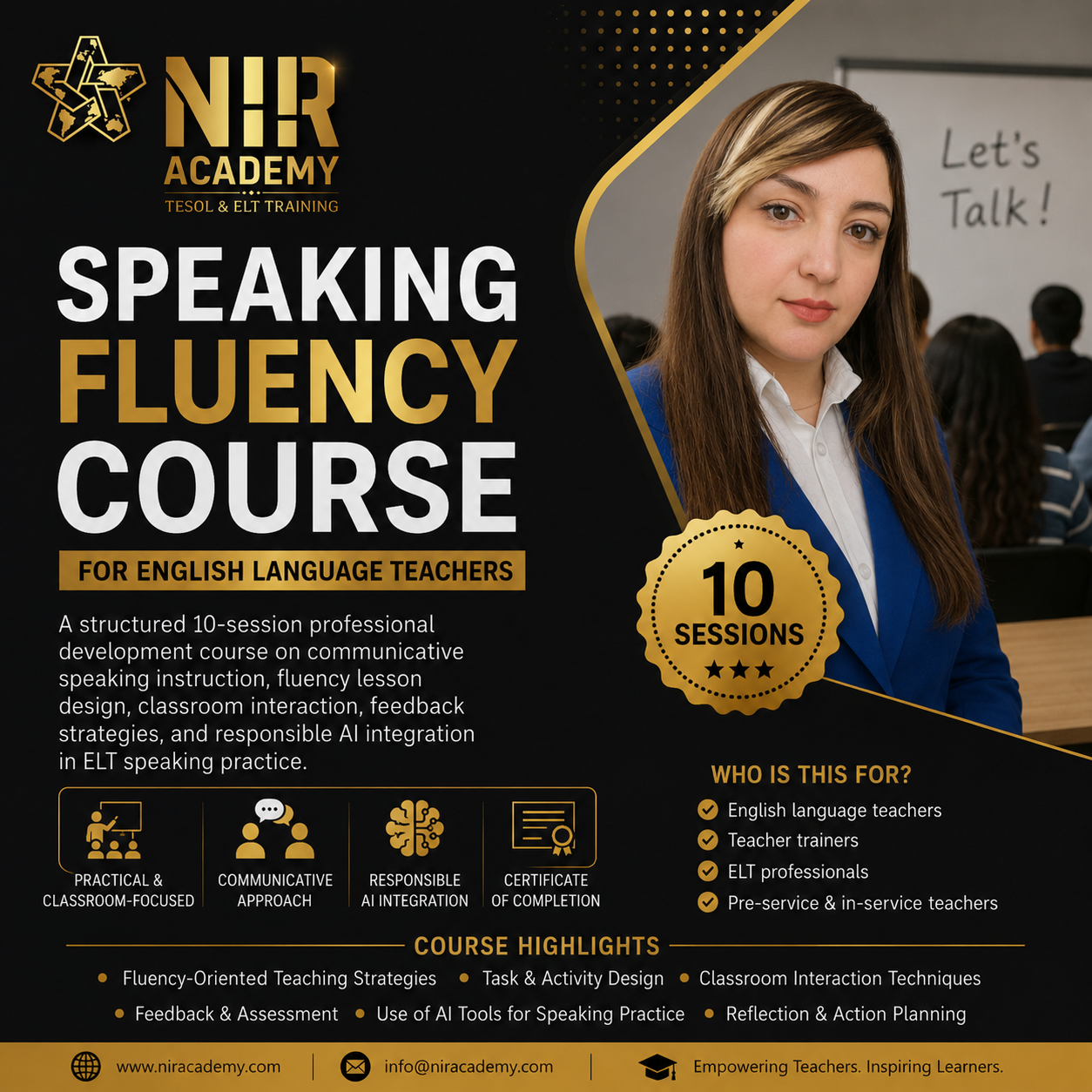
Speaking Fluency Course
for English Language Teachers
A structured 10-session professional development course covering communicative speaking instruction, fluency lesson design, classroom interaction, feedback strategies, and responsible AI integration in ELT speaking practice.
Explore All Courses → or explore the AITTC programmeWhy Speaking Fluency Matters in ELT
Many English learners study grammar and vocabulary for years without developing the ability to communicate naturally in real situations. Speaking fluency is not simply the absence of grammatical errors — it is a complex, multidimensional competence that develops through purposeful instruction.
Communicative language teaching research distinguishes clearly between fluency, accuracy, and complexity — three separate dimensions of language performance. Effective speaking instruction must address all three, but the sequencing and emphasis matter. A lesson that prioritises error correction at every turn suppresses the risk-taking that fluency development requires. A lesson with no language support produces confusion rather than communication.
True speaking fluency involves:
- Real-time language processing — accessing vocabulary and grammar under the pressure of live interaction
- Communicative confidence — the willingness to take risks, manage breakdowns, and negotiate meaning
- Interaction management — turn-taking, listening actively, responding to what is actually said
- Speaking flexibility — adjusting register, pace, and vocabulary for different communicative contexts
- Fluency development through practice — not through memorisation, but through repeated meaningful interaction
For teachers, this means that effective speaking instruction requires more than asking questions and waiting for answers. It requires deliberate lesson architecture, purposeful task design, interaction management, and feedback strategies that build competence without breaking communicative flow.
What This Course Addresses
The Speaking Fluency Course is designed around the real challenges that English language teachers face in speaking instruction — not around a list of activities or tools.
10-Session Course Curriculum
The course follows a deliberate progression from theoretical foundations through task design, classroom application, and professional reflection. Each session combines conceptual grounding with practical teaching application.
- What speaking fluency actually means in SLA research
- Fluency, accuracy, and complexity as separate dimensions
- How learners develop spoken language over time
- Why speaking is harder to teach than it looks
- Communicative competence: grammatical, sociolinguistic, strategic, discourse
- The role of interaction in language development
- Learner confidence and speaking psychology
- Affective barriers to oral production
- What makes a speaking task communicative
- Information-gap, opinion-gap, and reasoning-gap tasks
- Designing role plays that produce genuine interaction
- Discussion frameworks and conversation structures
- Collaborative speaking tasks and problem-solving
- Why teacher talk time is often too high — and how to reduce it
- Effective pair work: designing tasks that require both partners
- Group interaction patterns and their pedagogical purposes
- Managing classroom interaction productively
- Fluency circles, mingle activities, and structured discussions
- The PPP framework and its limitations for speaking
- Task-based speaking lesson structure
- Pre-speaking preparation and language support
- Controlled practice → guided interaction → free production
- Post-task reflection and language focus
- Immediate vs. delayed error correction in speaking
- When to correct and when to let errors pass
- Recasts, clarification requests, and explicit correction
- Note-taking during speaking tasks for post-task feedback
- Building learner confidence through effective feedback
- Intelligibility vs. native-like pronunciation — what matters, informed by British Council research on pronunciation in ELT
- Word stress, sentence stress, and rhythm in English
- Intonation for meaning and interaction management
- Connected speech: linking, elision, and weak forms
- Practical classroom techniques for pronunciation awareness
- Adapting speaking tasks for A1–C2 proficiency levels
- Supporting hesitant and reluctant speakers
- Mixed-ability classes: designing tasks for multiple levels
- IELTS speaking preparation: Parts 1, 2, and 3
- Business English and academic speaking contexts
- What AI can and cannot do in speaking instruction
- Evaluating AI-generated speaking prompts and tasks
- AI conversation tools: pedagogical strengths and limitations
- Using AI for speaking material differentiation
- Risks: artificial interaction patterns, over-reliance, inaccurate feedback
- NIR Academy’s pedagogy-first framework for AI in speaking
- Bringing all course elements together in a complete lesson
- Designing from objective through task, interaction, feedback, and reflection
- Evaluating speaking lesson quality against pedagogical criteria
- Professional reflection on speaking instruction practice
- Building a speaking instruction framework for your own context
AI-Enhanced Speaking Instruction
AI tools for speaking practice are increasingly available — from AI conversation partners to automated pronunciation feedback to task generation platforms. Session 09 of this course addresses how to evaluate and use these tools professionally, within NIR Academy’s pedagogy-first framework.
For teachers who want to go further in AI integration across ELT, the AITTC — AI Teacher Training Course provides a comprehensive framework for responsible AI use across all four language skills and professional development contexts.
Learning Outcomes
By the end of the Speaking Fluency Course, participants will be able to:
Who This Course Is For
This is a professional development course for teachers — not a speaking course for learners. It is designed for ELT practitioners who want to develop more effective, principled, and research-informed approaches to speaking instruction.
The course is suitable for teachers at all career stages — from those establishing their speaking instruction practice to experienced practitioners looking to integrate AI tools professionally or update their methodology.
Course Format
| Component | Detail |
|---|---|
| Duration | 4 weeks · 10 structured sessions |
| Format | Online · Self-paced or structured learning path |
| Each Session | Conceptual foundation + practical classroom application |
| Practical Tasks | Task design, lesson planning, and evaluation exercises |
| Provider | NIR Academy — AI-Powered ELT Professional Development |
| Philosophy | Pedagogy First. AI Enhanced. Future Ready. |
The NIR Academy Approach
NIR Academy’s educational philosophy — Pedagogy First. AI Enhanced. Future Ready. — is reflected throughout this course. Technology is positioned as a tool in service of pedagogical purpose, not as a replacement for teacher expertise or human interaction.
The Speaking Fluency Course is grounded in communicative language teaching, task-based learning, and SLA research. It treats AI as a professional resource that teachers must be equipped to evaluate, adapt, and deploy responsibly — not as an answer to the challenges of speaking instruction.
NIR Academy is a global professional development platform for English language teachers, with an ecosystem of AI tools, research frameworks, and courses designed specifically for the ELT profession. The NIR ELT Intelligence™ framework and AI Teacher Competency Framework™ provide the professional standards that underpin this course’s approach to AI integration.
Related NIR Academy Courses and Resources
Frequently Asked Questions
What is the Speaking Fluency Course for English teachers?
Who is this speaking fluency course for?
How is speaking fluency different from speaking accuracy?
Does the speaking fluency course cover pronunciation?
Is this course suitable for IELTS speaking teachers?
How does the course approach AI in speaking instruction?
Can teachers use AI without replacing human interaction in speaking classes?
How is this speaking fluency course different from general ELT training?
Explore NIR Academy courses, frameworks, and AI tools — all grounded in the principle that pedagogy comes first.
Explore All Courses → AITTC Programme →