

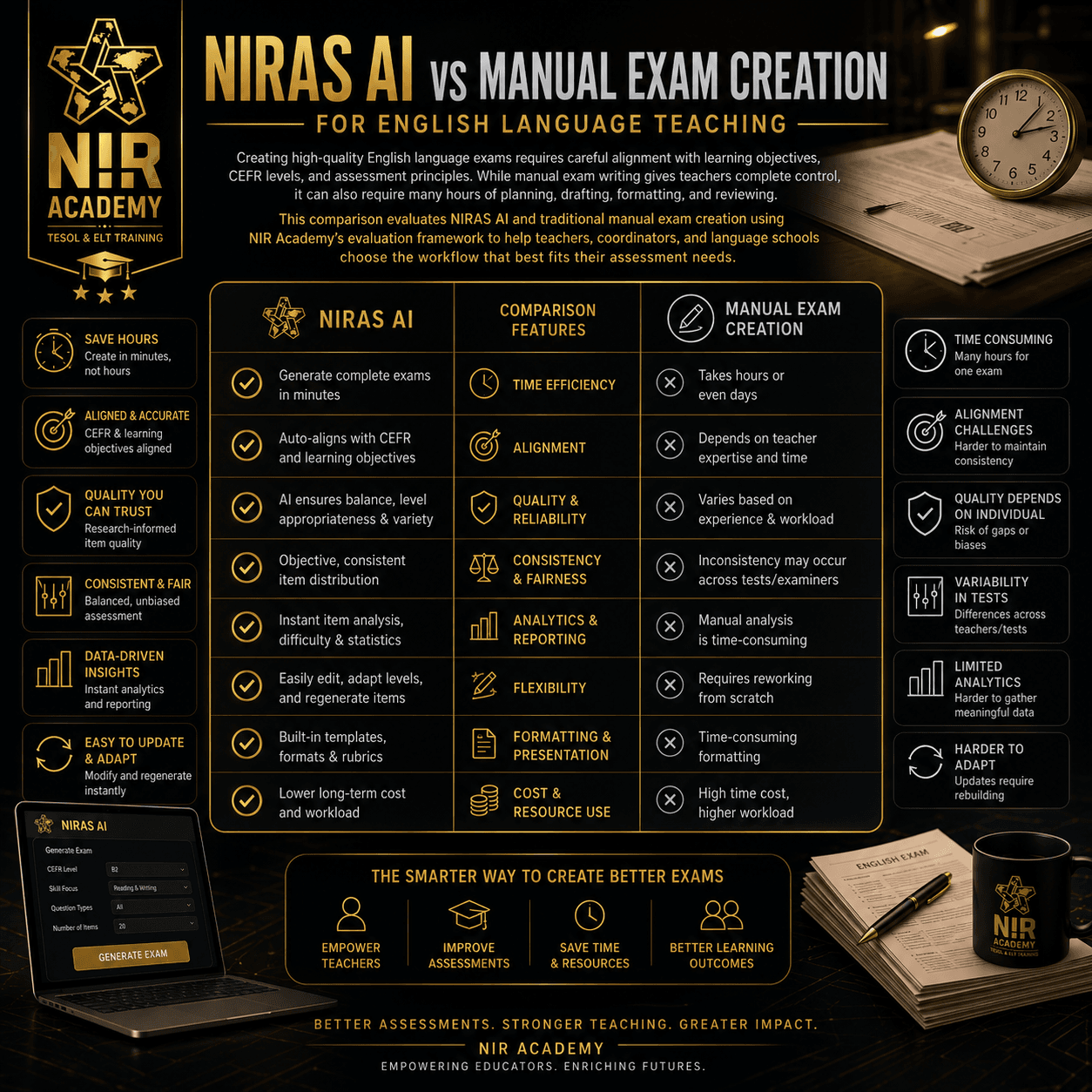
NIRAS AI vs Manual Exam Creation
for English Language Teaching
Creating high-quality English language exams requires careful alignment with learning objectives, CEFR levels, and assessment principles. While manual exam writing gives teachers complete control, it can also require many hours of planning, drafting, formatting, and reviewing. This comparison evaluates NIRAS AI and traditional manual exam creation using NIR Academy’s evaluation framework to help teachers, coordinators, and language schools choose the workflow that best fits their assessment needs.
Our evaluation framework
What each approach is
NIRAS AI and manual exam creation represent different points on the same continuum — the design and production of valid, reliable, level-appropriate English language exams.
- AI-assisted English language exam generation
- CEFR-aligned question creation by level
- Multiple question types in a single workflow
- Built-in PDF export with answer key
- Consistent formatting across all exams
- Designed for scalable institutional exam production
- Teacher review step built into the workflow
- Full teacher control over every question
- Flexible and context-sensitive design
- Questions tailored to specific course content
- Professional judgment applied throughout
- Essential for high-stakes institutional assessments
- Formatting and answer key created manually
- Time-intensive but highest degree of personalisation
NIRAS AI vs Manual Exam Creation: feature comparison
Evaluated against NIR Academy’s ELT assessment framework.
| Criterion | NIRAS AI | Manual Creation |
|---|---|---|
| CEFR alignment | ||
| Question generation speed | ||
| Multiple question types | ||
| PDF export | ||
| Formatting consistency | ||
| Scalability | ||
| Customisation depth | ||
| Teacher control | ||
| High-stakes suitability | ||
| Answer key generation |
CEFR alignment in exam design
CEFR alignment is one of the most technically demanding aspects of English language exam creation. Writing questions that are genuinely calibrated to A2, B1, B2, or C1 — rather than just labelled as such — requires expertise in level descriptors, text complexity, lexical range, and task demands.
NIRAS AI
NIRAS AI builds CEFR alignment into its generation workflow. Teachers select the target level before generating questions, and the AI produces content calibrated to that level’s descriptor requirements. This removes the need for teachers to manually check whether each question is level-appropriate.
Manual Exam Creation
In manual exam creation, CEFR alignment depends entirely on the teacher’s familiarity with CEFR descriptors and level expectations. Experienced teachers apply this knowledge accurately; less experienced teachers may produce inconsistently levelled questions that affect assessment validity.
Question types and variety
A well-constructed English language exam typically covers multiple skills and question types. NIRAS AI supports the full range of task types teachers need for comprehensive assessment:
Manual exam creation can cover all of the same question types, but each must be written, formatted, and keyed individually — often several hours vs under thirty minutes with NIRAS AI.
Exam quality and teacher review
Exam quality encompasses validity, reliability, level appropriateness, content coverage, and skill balance. NIRAS AI provides consistent formatting, structured CEFR alignment, and broad question type coverage — all supporting exam quality. However, AI-generated content should not be used in the classroom without teacher review.
Manual exam creation, when done well, produces highly valid and contextually appropriate assessments. The limitation is consistency and scalability: quality depends on individual teacher expertise and available time.
The NIR Academy recommendation for high-stakes assessments is a hybrid workflow: AI generation for speed and structural consistency, followed by thorough teacher review and contextualisation.
How each approach fits into your working day
The practical difference between NIRAS AI and manual exam creation is most visible in the workflow. Both begin with defining the assessment purpose — but the path to a print-ready exam differs significantly.
NIRAS AI workflow
CEFR level, skill, topic, question types
Questions, answer key, and formatting produced
Checks level, content, and task appropriateness
Adjusts or replaces individual questions
Print-ready exam and answer key generated
Exam delivered — minutes from start to finish
Manual creation workflow
Skills, level, topic, and question count
Each question drafted, with distractors if needed
Reviews level appropriateness question by question
Layouts exam in Word, Google Docs, or similar
Checks accuracy, instructions, and consistency
Separate answer document prepared manually
PDF export and print-ready formatting
Exam formatting is an underestimated time cost in manual exam creation. A well-formatted exam requires clear instructions, consistent question numbering, appropriate white space, distinct sections, and a separate answer key. In Word or Google Docs, this can add 30–60 minutes to an already time-consuming process.
NIRAS AI produces print-ready PDF output automatically. The exam and answer key are formatted consistently without additional teacher effort. For language schools producing multiple exams per term, this efficiency compounds into significant time savings across the academic year.
Use cases in language schools and institutions
NIRAS AI’s strongest use cases are contexts where exams need to be produced frequently, consistently, and at scale. Manual creation remains better when deep customisation or high-stakes validity is the primary requirement.
For academic coordinators managing multiple teachers and classes, NIRAS AI provides a consistent exam quality baseline that reduces variability between teachers and ensures CEFR alignment across all sections.
Honest assessment of both approaches
- Significantly faster exam development
- CEFR-informed question generation
- Consistent formatting across all output
- Multiple question types in one workflow
- Built-in PDF export with answer key
- Scalable for institutions producing many exams
- Requires teacher review before every classroom use
- Quality depends on appropriate input from the teacher
- Less suited for highly customised high-stakes exams
- Full teacher control over every question
- Flexible and context-sensitive customisation
- Questions tailored to specific course content
- Professional judgment applied throughout
- Most appropriate for high-stakes institutional exams
- Time-intensive from drafting to final PDF
- Difficult to scale across large cohorts
- CEFR alignment quality varies by teacher expertise
- Formatting and answer key require additional effort
Which approach should you choose?
For most English language teachers and schools, the answer is a hybrid workflow — NIRAS AI for speed and structural consistency, with teacher review and contextualisation ensuring quality.
| If you are… | Recommended approach |
|---|---|
| English language teacher | NIRAS AI + teacher review |
| IELTS preparation instructor | NIRAS AI |
| Language school coordinator | NIRAS AI |
| Academic coordinator | NIRAS AI |
| Exam designer | Combined workflow |
| High-stakes examiner | Manual + AI support |
| Teacher trainer | Both approaches |
| Curriculum designer | Both approaches |
What this comparison tells us
- NIRAS AI significantly reduces exam development time — from hours to minutes — for CEFR-aligned English language exams.
- Teacher expertise remains essential: all AI-generated exams should be reviewed before classroom use.
- CEFR-informed workflows improve level consistency across multiple teachers and classes.
- Manual exam creation remains the strongest approach for highly customised or high-stakes institutional assessments.
- A hybrid workflow — AI generation followed by teacher review — provides the best balance between efficiency and educational quality.
- PDF export and automated answer key generation remove one of the most time-consuming steps in manual exam production.
Common questions about NIRAS AI vs Manual Exam Creation
Sources & further reading
Try NIRAS AI — Exam Generation for ELT
CEFR-aligned exam creation in minutes, not hours. PDF export with answer key included. Two months of free access — no credit card required.
